First Farmers. First Domestication. First Legends.
 The
following section is an introduction, a framework, to the First Legend
- a background to what is discussed further on this site. If you are
new to this site the following will seem strange even radical but for
the main part it is backed up by what scientists have uncovered about
our past. It
all begins a long long time
ago,
500,000 years ago. It was a time of the arrival of the
Prince’s
staff when primitive man was still in the stone age. Prince Caligastia,
who was chosen as a member for Lucifer’s personal staff,
departed
with his entourage from a location you could say is in "heaven" and
arrived at
their headquarters in Dalamatia, a city located near what was to become
Mesopotamia. The map represents the area at that time. The Persian Gulf
basin was dry with the main river running through it. The city was most
likely built very near the river. It was green with vegetation.
The
following section is an introduction, a framework, to the First Legend
- a background to what is discussed further on this site. If you are
new to this site the following will seem strange even radical but for
the main part it is backed up by what scientists have uncovered about
our past. It
all begins a long long time
ago,
500,000 years ago. It was a time of the arrival of the
Prince’s
staff when primitive man was still in the stone age. Prince Caligastia,
who was chosen as a member for Lucifer’s personal staff,
departed
with his entourage from a location you could say is in "heaven" and
arrived at
their headquarters in Dalamatia, a city located near what was to become
Mesopotamia. The map represents the area at that time. The Persian Gulf
basin was dry with the main river running through it. The city was most
likely built very near the river. It was green with vegetation.
Caligastia was in charge of
organizing the mission intended to advance the welfare
of very early man. It is a common practice for all evolving worlds. At
that time, this first city was located at the
center of
the largest human population. Today remnants of it are beneath
the head waters of the Gulf. Included with the various angelic
orders were
the Caligastia one hundred. They were volunteers
(celestial) who received the Andonite (human) germ plasm
when they were repersonalized here with material bodies. They had human bodies with the
ability to procreate. “And much of
your subsequent
mythology grew out of the garbled legends of these early days when
these members of the Prince’s staff were repersonalized on
Urantia as supermen.” (Urantia Book, Paper 66 The Planetary
Prince of Urantia p743-4).
And this is why the later Sumerian cuneiform tables recorded this event
as the gods, their Anunnaki, coming to earth from heaven and linking
Dilmun with Dalamatia.
The
celestial plan for uplifting the planet continued on for 300,000 years.
Then came the outbreak of the Lucifer Rebellion. It caused a split
within the group, with 40 of the
staff remaining loyal and 60 went into rebellion. Calagastia supported
the rebellion. Of Lucifer it is
written, "And his
tail
drew the third part of the stars of heaven, and did cast them to the
earth:" (Revelations 11:4). There were other groups which
were torn apart as well. Van became the leader
of the faithful 40 (Vanites) and Nod led the rebel 60 (Nodites). The
loyalists withdrew to
the mountains of Afghanistan and with them they took a cutting from the
Tree of Life.
Dilmun the First Nodite City
Nod and his followers
stayed at Dalamatia but were eventually driven northward by Sangik
savages
(early races of man and considered here as archaic Homo sapiens). I think that
journey followed the
river northwards to the lip of the gulf basin. A number of years
after their departure,
Dalamatia was destroyed by a tidal wave "and
this land did not again emerge until almost every vestige of the noble
culture of those splendid ages had been obliterated." (UB 759)
Then
they continued north and then turned to the east. They built the city
of Dilmun near
the waters of the gulf. When these Nodites decided to build their
temple, the Tower of Babel, they decided not to build it in Dilmun but
further away in a second city they called Bablot. "There were many who
wished to have
this monument erected in Dilmun, but others contended that such a great
structure should be placed a safe distance from the dangers of the sea,
remembering the traditions of the engulfment of their first capital,
Dalamatia." (UB 858) "The elaborate records left by the
Sumerians
describe the site of a remarkable settlement which was located on the
Persian Gulf near the earlier city of Dilmun." (UB 860)
Dilmun was located on the flat plain leading to the foothills of the Zagros, Iran, and that is where the Sumerians got their cuneiform writing from. So, that means the origin of writing with a cuneiform shaped stylus is Elamite. "At the beginning of the historical era they had long since lost the alphabet of Dalamatia, having adopted the peculiar writing system originating in Dilmun." (UB 860)
The rebels of the Caligastia 100 were the progenitors of the Nodite race living in the “Land of Nod” (the eastern or Elamite Nodites - the east of Eden where Cain went to find a wife (Gen 4:16). It was shortly after the start of the Rebellion that the rebel members of the 60 had sex with humans when they realized they were no longer immortal. They needed to increase their numbers. These men and women became the gods of early mankind and were the origin of the Watchers. On page 857 the Urantia Book says that the offspring of these members of the Prince's staff and the Andonites, evolutionary man, were far superior in almost every way to aboriginal humans “...These mutant traits appearing in the first Nodite generation resulted from certain changes which had been wrought in the configuration and in the chemical constituents of the inheritance factors of the Andonic germ plasm. These exceptional Nodite/Andonites were numbered as the “mighty men of old.” The biblical reference for these people is “Nephilim” (Urantia Book 856). These children of the gods were hybrid humans. It would be this new race of people who were so fiercely proud of their heritage that they kept the memory alive from those so ancient times.
It may not be apparent at first but the location for the "birthing" of this new race, the Nephilim, is somewhere in the very general vicinity near the northeast shoreline of the Gulf basin. It was where they built Dilmun. They became hunter-gathers like everyone else but because they were so extraordinary their memory was kept alive by legend. There are really two legends here. One is the memory of events associated with the rebellion which the Nodites kept alive within their culture. The second is of the Nodites themselves those giants of lore, a story repeated generation after generation by those who knew them. As their stature grew, these "mighty men of old", so did folklore stretch them bigger than life size. We today know of the stories of giants who supposedly lived in antiquity. We also know because of biblical and other sources of the Lucifer Rebellion. However, these two great legends have become separated over millenniums and by today's understanding are not connected. That is one of the purposes of this web site - to bring the various stories from prehistory together so we can understand what happened so long ago.
"The Book of Jubilees gives another account of how the Watchers fell that is similar to 1 Enoch. It explains that the Watchers originally descended to the earth to teach mankind and do what is just, but they 'sinned with the daughters of men because these had begun to mix with earthly women so that they became defiled.' (Jubilees 4:22)" (http://www.deliriumsrealm.com/delirium/mythology/watchers.asp)
This site, the First Legend, is about this prehistory which is related to the Sumerians - the events that happened in the early Paleolithic the Old Stone Age. It is about the endurance of symbols and their meaning. And it is about a people, the Andites, who are a result of ancient events and their importance as the carriers of these legends and disseminators of its symbols.
Four pivotal events concerning the First Legend are: the coming of these celestials who are called the Watchers in the Bible and the Anunnaki named as such by the Sumerians, the Lucifer Rebellion, the coming of Adam and Eve and the eventual emergence of the Andite race. Some of the symbols related to these events are: the Tree of Life also known as the World Tree, the Great Goddess and the serpent and the bird (whose presence is at the top of the Tree of Life).
So this page is my story of the great Andite adventure, how they came to be and their relationship to the Sumerians. It is epic in scope from the time before the first farmers to the first urbanites. Early man did very little for almost almost one million years surviving as a hunter-gatherer and using only stone tools. Then the greatest revolution of all occurred at the time of the Garden and the Andites. It was the Neolithic Revolution that would forever change the world with the beginning of civilization. That spark which ignited the start of it all occurred around 12,000 BC. and spread over the entire planet.
First a little history concerning evolution of early man as currently understood:
1,000,000 BC Homo
erectus
What
you may not have thought of regarding these amazingly early dates is
that when the "gods" descended to this planet (about one half million
years ago) there were no Homo
sapiens running around. What greeted these "gods" were Homo erectus. H. erectus is the
earliest hominid known outside of Africa. H. erectus, born
one
million years ago, made the evolutionary leap from an earlier
primate. The
earliest date for
H.
erectus fossil in Europe at present is Tautavel Man at
450,000 BC (1984). The oldest H.
erectus site is currently in Britain on the North Sea and
dated to 700,000 ya. H.
Erectus was first discovered in Asia, 1893. In Africa the
date for H. erectus
keep getting pushed back and is now approaching 1.8 million years.
It
would be by today's science another three hundred thousand
years, or 200,000 BC
(roughly from 500,000 BC) before
Anatomically Modern Humans Homo
sapiens even
appeared and we not talking
about Homo sapiens
sapiens
(us). The skeleton of this first human has some resemblance to moderns
from the neck
down but being more robust, having an opposable thumb, no opposable toe
and on average almost as tall as we are. From the neck up, well, that's
a
different story. There may
be an overlap of AMH with H.
erectus of about 50,000 years. Other dates have no such
overlap. It depends on which of the many "trees" you are looking at.
The umbrella species of erectus has more to it than Homo erectus. There is first and foremost the Asian H. erectus. The African counterpart would be H. ergaster followed by H. georgicus (Dmanisi Georgia) and H. floresiensis (the Hobbit-like hominids from Indonesia). Others not included are highly debated.
Urantia Book: Homo erectus, or at least a species of this hominin, is called Andonite that originated in Asia and is our ancestor. (Since there is so much debate among the paleontologists as to its origin, Homo egaster has for some become the new African Homo erectus).
UB: 900,000 BC Badonan Tribes Homo erectus
Direct descendants of the first Andonites living in northwest India and
origin of the evolutionary races of color.
UB: 900,000 BC Homo heidelbergensis
A European race concurrent with H. erectus. In
appearance resembled more closely H.
erectus than us. The UB does not say where they came from.
Today it is assumed that they are a transition from H. erectus to H. sapiens.
UB: 800,000 BC Homo neanderthalensis
The Neanderthals are also descendants of the
Andonites, H. erectus
and are also from the highlands of northwest India.
500,000 BC Archaic Homo
sapiens
At about 500,000 BC another
player emerges and that is archaic Homo
sapiens. For some paleontologists there is no clear
dividing
line between AHS and H.
erectus.
Because of the differing opinions the earliest date for these archaic
forms is between 500,000 and 200,000 BC. Archaic H.
sapiens
have a larger cranium, a more modern face still with the brow ridge and
no chin. The definition
of this category is still in dispute but is considered as
"transitional"
by its adherents. It is also considered a dead end by others and would
include Homo
antecessor, H. cepranensis and H.
rhodesiensis. However, Homo hedelbergensis
is considered by some as archaic.
"Problems
arise
because there
is very little fossil record and they are too young to date with
pot/argon and too old to date with radiocarbon."
(http://www.paperlw.net/html/Political-Science/200807/21-5361.html)
China: Near the Jiefang Village, Dali County has been fount the Dali cranium and is estimated to be about 200,000 years old. Even at this transitional point in time the Dali cranium is still considered as archaic H. sapiens. "While Dali's vault is relatively robust, with a mixture of H. erectus and H. sapiens traits, the facial skeleton is much more like those in modern H. sapiens." "There is also a great deal of anatomical variation in the Chinese "archaic Homo sapiens" group. It will be interesting to see how this plays out over the next decade, or so." Indeed, the Chinese government is pouring a tremendous amount of money into Chinese archaeology and related sciences. (http://www.peterbrown-palaeoanthropology.net/dali.html)
Urantia Book: At this time another evolutionary leap occurs, which is sudden. It is one point at which science and the UB agree on dates. These newly appearing humans from the northwestern highlands of India, an area known as the Siwalik Hills, are called the Sangiks (the origin for the races of color). These Sangiks were Andonite descendants. They are one bridge from H. erectus to us. The Urantia Book includes that they were more intelligent. They did eventually make their way to Mesopotamia and had contact with the regime of the Planetary Prince. As the Sangiks are the colored races, we are familiar with the red, yellow, brown and indigo (black). Three others such as the orange, green and blue are now extinct with the blue evolving into the white race. The green race could be that olive color we sometimes see in skin undertones and is found in the Mediterranean and elsewhere. There are four main haplogroups, the African, Asian, Native American and European. To date the are a total of 153 but the number is growing.
200,000 BC Anatomically Modern
Humans Homo sapiens
At about 200,000 ya
these AMH were not behaviorally modern and
culturally resembled the Neanderthals. (Modern behavior, cultural
artifacts, do not appear in the archaeological record until about
50,000 ya.) The
all important skull shape
now has a forehead with a significantly reduced brow ridge and
a chin. Sometimes the term Early Modern Humans is
used which some see this as a grab bag of descriptions and is more of a
gray area rather than being specific.
Paleoanthropologists have differing opinions as to when modern
behaviors actually appear and are working on finding the convergence
for
modern anatomy and modern behavior. The discussions and publications
about AMH are as varied as all other subjects on early man concerning
who, when and where.
It
really
is at this point that the genetic information comes into play. For
example the haplogroups such as A0-t, A1 and BT the beta haplogroup and
for men it would refer to the
Y-chromosome and for women mtDNA. It would be the paper published in Nature
by
Rebecca Cann and co-authors that would give life to the Out of Africa
movement based on the "mitochondrial Eve". Before Rebecca Cann there
was Desmond Clark. "Desmond
Clark's (1975) demonstration of chronological parity between Africa and
Eurasia laid the foundation for the acceptance of bold claims soon to
arise from a new source - genetics - of an African origin for all
modern humans." (Peter Mitchell, Paul
Lane, The Oxford Handbook of African Archaeology, © Oxford
University Press 2013 p 345)
UAE
The
general date of 200,000 ya for AMH in Africa is based on Louis
Leakey's discoveries at
the Omo River in southern Ethiopia and called Omo I and Omo II. The odd
thing is that these two fossils although date together as the same look
different with OMO II seemingly more archaic. The
discovered fossils were re-dated backwards from 130,000 ya by measuring
the decay of argon in the sediment. This
early date is not for southwest Asia which would be the much later
dates of 50,000 - 70,000 ya. The newest finds in Arabia have
a date as early as 128,000 ya at a site in the UAE at Jebel Faya that
points to the earliest AMH outside of Africa. This is from a paper by
Jeffrey Rose entitled "New Light on Human Prehistory in the
Arabo-Persian Gulf Oasis."
 Currently in the Levant the earliest
"out of Africa" AMH
fossils that have been found, as dated by
Wikipedia, has them tentatively at about 80,000 - 120,000 years
ago (note the vast difference in
dates from the preceding paragraph) using
electron paramagnetic
resonance and thermoluminescence dating
techniques. That's a difference of 40,000 years between the two methods
for the same thing so it pays to know by which method artifacts are
dated - if you can
find that out. It was these dates
that were the earliest for the out of Africa migration. With the
publication of Jeffrey Rose's paper on the "Gulf Oasis", that may
change
these dates
to 128,000 years ago. The lithics discovered at this location do not
seem to be African.
Currently in the Levant the earliest
"out of Africa" AMH
fossils that have been found, as dated by
Wikipedia, has them tentatively at about 80,000 - 120,000 years
ago (note the vast difference in
dates from the preceding paragraph) using
electron paramagnetic
resonance and thermoluminescence dating
techniques. That's a difference of 40,000 years between the two methods
for the same thing so it pays to know by which method artifacts are
dated - if you can
find that out. It was these dates
that were the earliest for the out of Africa migration. With the
publication of Jeffrey Rose's paper on the "Gulf Oasis", that may
change
these dates
to 128,000 years ago. The lithics discovered at this location do not
seem to be African.
"Far from finding East African-derived lithic technologies spilling over into Arabia, freshly unearthed evidence points to a conspicuous lack of connection with African lithic industries following the last interglacial (Rose and Usik 2009). These industries tend to exhibit a distinct Arabian tradition, suggesting minimal demographic input from outside the peninsula."
"Consequently, as potentially one of the largest and most stable sources of freshwater in southwest Asia for the majority of the Late Pleistocene and the Early Holocene, it is germane to consider that the Gulf Oasis was home to a sizable human population."
"The
Gulf Oasis hypothesis proposes a heretofore undocumented indigenous
community at the nexus of the ancient world, ground zero of the
Agricultural and Urban revolutions. Not only does the proposed scenario
introduce a new and substantial cast of characters to southwest Asia at
the critical Pleistocene-Holocene boundary [9700 BC], it also supplies
an
ecologically driven mechanism — fluctuating landscape carry
capacity within an isolated environment — that is thought to
have
played an important role in shaping cultural evolution throughout the
region.
(https://archive.org/stream/NewLightOnHumanPrehistoryInThePersianGulfOasis/657397_djvu.txt)
 "The earliest
non-African human fossils that are generally considered modern come
from two sites in Israel: the small cave of Mugharet es-Skhul (Cave of
the Kids) at Mt. Carmel, and the larger cave complex of Jebel Qafzeh
located near Nazareth."
"The earliest
non-African human fossils that are generally considered modern come
from two sites in Israel: the small cave of Mugharet es-Skhul (Cave of
the Kids) at Mt. Carmel, and the larger cave complex of Jebel Qafzeh
located near Nazareth."
(Matt Cartmill, Fred H. Smith, The Human Lineage, © 2009 by
Wiley-Blackwell. All rights reserved)
 One
of the main arguments of the Out of Africa theory is that very early
man exited Africa at upper Egypt and entered the Levantine corridor.
That theory
now includes the tip of southwest Arabia into the
Levant and
following somewhat inland of the shoreline to Jebel Faya and continuing
into Asia - 2 entrance
points. Looking
at the map the same can be said for a migration "Out of India" (archaic
Homo sapiens)
down the
Indus river system to the Indian Ocean and then westward to the "Gulf
Oasis"
including Jebel Faya. All they needed to do was to walk there. This
would have been the warmest and easiest route to take. Many ventured
directly deeper into India to the southeast. But the
situation is still complicated. If the following quote, which is for
AMH in the Levant, is any
indication then the answer to our ancestral history is fraught with a
future array of problems: "We
are of the opinion that the variability found amongst the fossil people
of Mount Carmel is greater in degree and in kind than is to be observed
in any local community of modern times. Had the Mount Carmel people
been discovered—not collectively, in one place, but
separately,
in diverse localities, each excavator would have been convinced that a
new and separate form of humanity had been unearthed, so great does one
Carmelite individual differ from another."
One
of the main arguments of the Out of Africa theory is that very early
man exited Africa at upper Egypt and entered the Levantine corridor.
That theory
now includes the tip of southwest Arabia into the
Levant and
following somewhat inland of the shoreline to Jebel Faya and continuing
into Asia - 2 entrance
points. Looking
at the map the same can be said for a migration "Out of India" (archaic
Homo sapiens)
down the
Indus river system to the Indian Ocean and then westward to the "Gulf
Oasis"
including Jebel Faya. All they needed to do was to walk there. This
would have been the warmest and easiest route to take. Many ventured
directly deeper into India to the southeast. But the
situation is still complicated. If the following quote, which is for
AMH in the Levant, is any
indication then the answer to our ancestral history is fraught with a
future array of problems: "We
are of the opinion that the variability found amongst the fossil people
of Mount Carmel is greater in degree and in kind than is to be observed
in any local community of modern times. Had the Mount Carmel people
been discovered—not collectively, in one place, but
separately,
in diverse localities, each excavator would have been convinced that a
new and separate form of humanity had been unearthed, so great does one
Carmelite individual differ from another."
(http://biologos.org/blogs/archive/the-origin-of-modern-humans-the-fossil-evidence-part-2)
Part
of the story of the Sangik migrations is that of the "expanded"
Mediterranean
Sea, which would have most likely followed the fault line, connected
with the Indian Ocean effectively blocking off Africa from southwest
Asia and Arabia. It
would be about 400,000 ya that the Arabian plate finally rose high
enough to allow passage between Arabia (and perhaps the Levant) to
Africa. As the Arabian plate slowly
arose the expanded part of the Mediterranean was retreating and the
newly formed land bridge was
crossed mainly by secondary Sangiks, evolving archaic Homo sapiens, traveling
west. The extent of tilt of the Arabian plate most likely was greater
than shown above. One of the UB's descriptions is "the westward
retreating Mediterranean from the Indian Ocean" which
I understand as moving from at least the central region (or
deeper) of the Arabian plate. (The movement of this plate is pushing
into the Zagros mountains, the zone between Iraq and Iran.) Or this odd
description: "They [the Badonan tribes
of which these are pre-Sangik]
observed the
Mesopotamian peninsula gradually sinking into the ocean, and though it
emerged several times, the traditions of these primitive races grew up
around the dangers of the sea and the fear of periodic engulfment."
(p
720) That
would mean they had to be at least in the vicinity of the gulf
basin to observe it and therefore before 500,000 ya. and more likely as
early as 700,000 ya. For Mesopotamia to
be a
peninsula much of the Arabian plate would
have to have been under water. At about this
time, 400,000 ya, while the secondary Sangiks were migrating into
India, Arabia and Africa, the primary Sangiks were migrating north and
then in both east and
west directions. Those traveling west encountered the Neanderthals in
Europe who, like the Sangiks, descended from their common ancestor the
Andonites. The Neanderthals were an older race.
OMAN
Jeffrey
Rose at his archaeological digs discovered in the UAE non-African
lithics and in adjacent Oman lithics that he determined as African. What
this means is unclear - that there are two tool kits with an apparent
different origin although Rose assumes
that these stone tools at Jebel Faya are Arabian: "...we
remain open to the possibility that the late Nubian Complex originated
in Arabia, and subsequently spread back into northeast Africa [the
Sudan Nile Valley]."
"Nonetheless, we don't
really know when the Out-of-Africa even took place, and it could very
well be that there was a
first Into-Africa [emphasis added] during MIS 5c. [80,000
and 130,000 years ago]"
(http://dienekes.blogspot.com/2011/12/nubian-complex-in-southern-arabia-106.html)
During the
migrations out of India a group(s) most likely split off to the north
to
follow the eastern rim of the
then dry Persian Gulf as blazed by their forefathers, the earlier Badonan tribes. These may be
some of the Sangiks the UB refers
to in
relation to the slightly later appearing pure line Nodites in the
northern part
of the Persian Gulf basin while other Sangiks continued
southwest into
Africa. Migrations across Arabia are
probable given
that climatic conditions were favorable to vegetation and wild game.
Rose's conclusions of Jebel Faya are contested, as usual. Click on map
below for a larger image.
 Rose, when working in Oman in
2010, uncovered stone tools with a clear
connection to Africa labeled as Nubian Complex lithics. "Rose
says this distinctive method of toolmaking, classified as "Nubian
Middle Stone Age," is unique to a region of Sudan in northeast Africa
and has never been found outside the Nile Valley in northeast Africa. A
dating technique called optically stimulated luminescence, which
measures how much radiation a mineral has absorbed over time, revealed
that the tools are roughly 106,000 years old, the team reports today in
PLoS ONE. Rose calls them "a trail of stone breadcrumbs," strewn by a
group of H. sapiens from the Nile Valley to Arabia."
(http://www.sciencemag.org/news/2011/11/ancient-tools-point-early-human-migration-arabia)
Rose, when working in Oman in
2010, uncovered stone tools with a clear
connection to Africa labeled as Nubian Complex lithics. "Rose
says this distinctive method of toolmaking, classified as "Nubian
Middle Stone Age," is unique to a region of Sudan in northeast Africa
and has never been found outside the Nile Valley in northeast Africa. A
dating technique called optically stimulated luminescence, which
measures how much radiation a mineral has absorbed over time, revealed
that the tools are roughly 106,000 years old, the team reports today in
PLoS ONE. Rose calls them "a trail of stone breadcrumbs," strewn by a
group of H. sapiens from the Nile Valley to Arabia."
(http://www.sciencemag.org/news/2011/11/ancient-tools-point-early-human-migration-arabia)
"The Nubian origin and inland location of the discovery were equally unexpected. 'We had never considered the link to Africa would come from the Nile Valley, and that their route would be through the middle of the Arabian Peninsula rather than along the coast,' Rose notes."
(http://www.egyptsearch.com/forums/ultimatebb.cgi?ubb=get_topic;f=8;t=008800;p=1)
Urantia Book: The arrival of anatomically modern humans coincides with the Lucifer Rebellion and the origin of the Nodite race, the Nephilim. This new race, the Nephilim, may be invisible to geneticists as the staff members of the Calagastia 100 were partly of Andonite extraction, H. erectus, and therefore most likely would be masked as evolutionary man. The DNA of the material bodies of the 100 contained only a "portion" extracted from the Andonites (UB 742) but there is nothing to say that Nephilim DNA might be found but from my perspective I think it is extremely doubtful. It would not be long before these "pure bred Nephilim" began to mate with the surrounding population of the Sangiks and thus genetically became even more so as evolutionary man. They would have first appeared in the southern Zagros and moved to the Levant at a somewhat later date. The UB does not say the Nephilim are the cause of AMH only that this is a new race that appears on the planet due to the circumstances revolving around the Lucifer rebellion. If anything their impact would have been more cultural than genetic.
Why no skeletons? It could be they practiced cremation just as did their later descendants. Maybe climate conditions did not favor fossil preservation. Lastly it may that they camped in the open-air base camps.
Conclusion
The Sangiks are the descendants of the Andonites and
eventually migrated across Arabia into Africa and elsewhere. They are
archaic H. sapiens.
We do not know when they entered Africa other than after 400,000 ya. At
some
point they became Anatomically Modern Humans, which today is marked at
200,000 ya but it could be earlier. At some point they migrated back
into
Arabia and beyond. That's what it looks like right now given what we
know and it would
satisfy in part the Out of Africa theory while giving us a rough marker
of
transition. The critical question is how the archaic H. sapiens became
modern H. sapiens
because all races
became Homo sapiens
sapiens no matter where they lived or who they mated with.
We all
evolved together. Although
the picture is far from complete and much more complicated than this
simple hypothesis, it does lay the foundation for further
evidence we will look to for confirmation. At the time of Rose's
discoveries it was not even considered by the
scientific
community that there
was a
southern Arabian entrance point. In that regard Rose will be a game
changer.
The thing about evolution is that it is preplanned. There are things that cannot be controlled because things happen as they say. But this is a closely monitored process and is well understood by those who implement and oversee its unfolding. Sentient man arrived and is what I would call the flower of evolution. This is why Adam and Eve arrived when they did.
"And there came a time in the planetary history, almost forty thousand years ago, when the Life Carries on duty took note that, from a purely biologic standpoint, the developmental progress of the Urantia races was nearing its apex." (UB 821)
At this point I would like to insert my family tree of evolution, just one more added to the myriad of charts you can find on the internet. This is perhaps an over simplified chart of evolutionary man. Other proposed graphs look more like a tree rather than this one which is more like a telephone pole. All branches are trimmed off except for heidelbergensis and Neanderthal. You could trim off heidelbergensis and Neanderthal, who had only an early and very small impact, but since Neanderthal is such an archaeological darling it is included. H. heidelbergensis is included because of how wide spread this species was. Some dates are from the UB and others are various published dates. Halfway to us from the first Homo erectus are the Sangiks. At that time six colored races appear. The orange race was the first to be partly exterminated by the green and later finished off by the indigo. The indigo then exterminated the green and claimed Africa as its own. The four races each claimed its own territory. The red and yellow mixed to create the brown race which migrated to the Pacific. The Out of Africa theory makes no accommodation for race. To view the tree click here.
35,000 BC
Cro-Magnon Homo sapiens
sapiens
Cro-Magnon is estimated to have arrived "suddenly"
about 35,000 BC as dated from the soil samples by geologist Edouard
Lartet in 1868.
At least this is the assumed time for when they moved into France. The
term
Cro-Magnon is now being replaced with Anatomically Modern Humans as the
earlier term (in use for about 130 years) is not precise enough for
today's paleontologists. It is a confusing situation as the term now
has two meanings. The only way to distinguish between them is by
knowing if the
date is recent or if it is the earlier definition as the term is being
applied. Cro-Magnon is Homo
sapiens sapiens. (Neanderthal
now is labeled as anatomically archaic.) As with
all dates pertaining to events during the Paleolithic, such as the ages
of man's evolution, there is a wide variety of opinion. Who came from
who and when and where has not been resolved. There are two major
groups each with their own theory. They are the Out of Africa
(replacement model) and the multiregional camp (continuity model).
Neither side has proven itself concerning the origin of humankind. Nor
have they come to a conclusion on the origin of Cro-Magnon, Homo sapiens sapiens.
The odd man out in all of this are the Creationists (Adam and Eve
model). An unexpected result of comparing these three theories is that
the Creationists are in one respect the closest to the truth (a single
pair of humans).
The status of Cro-Magnon has changed. This taxon has been reassigned as Homo sapiens and is now a part of the Anatomically Modern Humans (AMH) category. Since this is relatively new, the old definition of Homo sapiens sapiens is still being used. It is a bad situation as sometimes you cannot discern if AMH refers to Cro-Magnon or not.
"...the oldest, dated, unquestioned, anatomically modern human in Europe is 33,850 years ago (Smith 1982, p. 680)." (http://www.asa3.org/archive/ASA/199707/0015.html)
It was during the time of Cro-Magnon that dogs were becoming man's best friend.
Urantia Book: The origin of the human race is from the first two humans, a definite place and point in time and supports the creationist point of view. However, not as Adam and Eve but the first two Andonites, the Book's term for Homo erectus. The Garden of Eden and Adam and Eve are now present in Mesopotamia (35,000 BC) which coincides very closely with the arrival of Cro-Magnon.
Cro-Magnon, Neanderthal and DNA:
"The
Paglicci 23 individual carried a mtDNA sequence that is still common in
Europe, and which radically differs from those of the almost
contemporary Neanderthals, demonstrating a genealogical continuity
across 28,000 years, from Cro-Magnoid to modern Europeans. Because all
potential sources of modern DNA contamination are known, the Paglicci
23 sample will offer a unique opportunity to get insight for the first
time into the nuclear genes of early modern Europeans."
(http://www.plosone.org/article/info:doi%2F10.1371%2Fjournal.pone.0002700)
"Like the Neanderthals, the people of the Upper Palaeolithic period were big game hunters but they also vividly recorded the animals they knew on the walls of their caves. A growing body of evidence suggest that modern humans, virtually from the moment they appeared in Ice Age Europe, were able to produce startlingly sophisticated art."
(http://www.archtext.co.uk/onlinetexts/britian_and_europe/chapter04.htm)
The search for the human genome starts in 1976 when Walter Fiers of the University of Ghent, Belgium, was the first to complete a nucleotide sequence for an RNA-genome. After that landmark, the race was on to complete the first human genome. With the sequencing of mtDNA this new tool has established the basis facts of genetics. The recognition by the majority of scientists is that Cro-Magnon is not related to Neanderthal and therefore Neanderthal is not of human lineage. (Some still are not convinced.) These findings support what the Urantia Book says and it was first published in 1955.
A further investigation into the Neanderthal genome has yielded a surprise for the scientific community. A tiny mixture of Neanderthal and Cro Magnon seems to have happened. It is only 1 to 4 per cent according to those involved with the Neanderthal genome project at the Max Planck Institute for Evolutionary Anthropology in Leipzig, Germany. Here is a portion of what they had to say:
"Those
of us who live outside Africa carry a little Neanderthal DNA in us,"
said Dr Svante Paabo, director of evolutionary genetics at the German
institute, who led the international project. The discovery emerged
from the first attempt to map the complete Neanderthal genetic code, or
genome.
Around
400,000 years ago, early Neanderthals stepped out of their African
cradle, where Homo sapiens were still evolving, and headed for Europe
and Asia. At least 300,000 years later, the early modern humans
followed the Neanderthals out of Africa. The two populations are
believed to have coexisted in Europe and Asia until the Neanderthals
vanished forever around 30,000 years ago - probably driven into
extinction by the smarter and more competitive modern humans. Previous
genetic evidence had cast doubt on the likelihood of Homo sapiens and
Neanderthals interbreeding. But this was based on the analysis of a
limited form of DNA locked in the mitochondria, passed down from mother
to daughter. The new genome sequence published in the journal Science
covers around 60 per cent of the whole Neanderthal genetic code, as
imprinted in the chromosomes of cell nuclei. To highlight any
differences, scientists compared the Neanderthal genome to that of
present-day humans from southern and west Africa, China, Papua New
Guinea and France. They were surprised to find that Neanderthals were
more closely related to modern humans from outside Africa than to
Africans. Even more mysteriously, the relationship extended to people
from eastern Asia and the western Pacific - even though no Neanderthal
remains have been found outside Europe and western Asia."
(http://www.earthtimes.org/articles/show/326334,there-may-be-a-neanderthal-in-your-family-tree-after-all.html
Copyright © DPA)
If you are a student of the Urantia Book the above statement would not seem strange or out of place. The Book says that the Neanderthal came into existence in Asia, not Africa, and only later migrated into Europe and North Africa. Since at this time of the ice age sea levels would have been lower, that situation would have allowed both H. erectus and Neanderthal to walk to Indonesia, New Guinea and perhaps island hopped to Australia. And as a footnote the Book also says that there was slight interbreeding between species but that Neanderthal is not of our lineage. The above quote by the Max Planck Institute repeats the most common belief that Neanderthal migrated from Africa but they can't say from where. "Neanderthal fossils have not been found to date in Africa, but there have been finds close to North Africa, both on Gibraltar and in the Levant." (https://en.wikipedia.org/wiki/Neanderthal)
For some reason, there is a growing effort to "humanize" the Neanderthals. The latest reconstructions that I have seen looks more Caucasoid than Neanderthal which I consider as a prevarication of what Neanderthal really looked like. Considering how large a shnaz these guys had there was no dainty nose for Neanderthal. That nose dominated their face which looked as if someone grabbed a hold of it and yanked it forward pulling the face with it. If you look at a Neanderthal skull and compare it to a modern human the differences are obvious. They had no chin, sloping forehead, huge brow ridge and buck teeth (from hide working) which only accentuated their appearance. The only feature that maybe could be considered as attractive is their large eyes. So these newly reconstructed Neanderthals that look like they just stepped out of Madame Tussauds wax museum is a far cry from the much rougher looking hominids from the Stone Age.
The following images are an example of the "softening" of Neanderthal for public consumption. These examples do not have that pronounced brow ridge, "weak chin", buck teeth (which I have seen on these skulls) or a nose that would have put Jimmy Durante to shame. They did not look like this: Mr. & Ms. Neanderthal. The next image is closer to reality and if Durante had this large of a nose imagine the size with a larger nasal cavity that Neanderthal had: Neanderthal & Durante.

 This culture is at present
the earliest documented AMH in the Levant and dates to about 45,000
years
ago. Previous to this it is Neanderthal. The Initial Upper Paleolithic
(IUP) is very important as it is the
transitional point of Anatomically Modern Human colonization and the
beginning of the demise of the Neanderthals. It is at this time that
advanced tool making is evident and personal ornaments start
to being used such as marine shells and land
snails with some showing ochre residues. The most important sites for
the Emiran are to the
north Ksar Akil
in Lebanon and to the
south Boker
Tachtit in the Negev. Both of these locations are within the Levant
Homeland.
This culture is at present
the earliest documented AMH in the Levant and dates to about 45,000
years
ago. Previous to this it is Neanderthal. The Initial Upper Paleolithic
(IUP) is very important as it is the
transitional point of Anatomically Modern Human colonization and the
beginning of the demise of the Neanderthals. It is at this time that
advanced tool making is evident and personal ornaments start
to being used such as marine shells and land
snails with some showing ochre residues. The most important sites for
the Emiran are to the
north Ksar Akil
in Lebanon and to the
south Boker
Tachtit in the Negev. Both of these locations are within the Levant
Homeland. "After a century of research, the origins of the Levantine UP still remain an enigma. At this point, at least one thing is clear: the Emiran has no African progenitor. As such, there is a disconnect between the archaeological database and the Replacement paradigm, which necessitates that the earliest Levantine Upper Paleolithic must have come fully developed from northeast Africa. The Replacement model should have been a parsimonious prism through which to view the transition from the MP to the UP in the Levant. It was not.
The recent acceptance of: (i) a slower autosomal mutation rate, and (ii) evidence for interbreeding with Neandertals largely predating the c. 50kya mark, and (iii) coalescence of Eurasian mtDNA haplogroup N well before that time, have all but killed, in my opinion the idea of a 50kya spread of modern humans from Africa. Modern humans must have lived in Eurasia much earlier than that time, and what remains is to figure out how much earlier."
Anthony E. Marks and Jeffrey I. Rose
(http://dienekes.blogspot.com/2013/12/arabian-origin-of-upper-paleolithic-in.html)
The above quote of "the Emiran has no African progenitor" is bold as copied. In making this statement it goes counter to the Out of Africa theory. What he is saying is that AMHs are of an Arabian origin. Not only that but they must have been living in the Levant much earlier by an unknown amount of time. I would agree but with different reasons.
"The exact technical method (Levallois or non-Levallois) which was used to produce each piece cannot be securely established since, as we now know, different techniques can produce morphologically similar artifacts." (www.persee.fr/doc/paleo_0153-9345_2000_num_26_1_4700)
"The main problem encountered by typologists - and not always recognized as such - is that of equifinality, i.e., that fact that two different causes can produce two similar consequences. In other words, two flakes showing identical morphological features could have been the product of two different reduction methods."
(http://www.academia.edu/1621808/Levallois_or_not_Levallois_does_it_really_matter_Learning_from_an_African_case)
Dibble and Bar-Yosef, The Definition and Interpretation of Levallois Technology, p.26
 The
Ahmarian, are the next best choice for one of the earliest known of the
Nephilim
tribes. We
are speaking about the Upper Paleolithic, a time frame of about
40,000 to
20,000 years ago, which is when Cro-Magnon lived, the first
evidence of a fully modern people. The Ahmarian lived in the same area
as their
later descendants did, the
Kebaran and Natufian and are considered as indigenous. It appears their
lithic technologies
may have spread to Europe but is strongly contested. As stated above
the classification of Cro-Magnon has been changed from Homo sapiens sapiens
to Homo sapiens
which includes the much earlier AMH, the Anatomically Modern Humans. It
seems like such a major reversal considering Cro-Magnon was hailed as
such an evolutionary jump, stunning in fact. That presented a problem
for the Out of Africa supporters because there is no trace of the
Aurignacian tool kit in Africa which will be discussed shortly. This
new classification is
actually a more Darwinian approach one of a more gradual nature.
The
Ahmarian, are the next best choice for one of the earliest known of the
Nephilim
tribes. We
are speaking about the Upper Paleolithic, a time frame of about
40,000 to
20,000 years ago, which is when Cro-Magnon lived, the first
evidence of a fully modern people. The Ahmarian lived in the same area
as their
later descendants did, the
Kebaran and Natufian and are considered as indigenous. It appears their
lithic technologies
may have spread to Europe but is strongly contested. As stated above
the classification of Cro-Magnon has been changed from Homo sapiens sapiens
to Homo sapiens
which includes the much earlier AMH, the Anatomically Modern Humans. It
seems like such a major reversal considering Cro-Magnon was hailed as
such an evolutionary jump, stunning in fact. That presented a problem
for the Out of Africa supporters because there is no trace of the
Aurignacian tool kit in Africa which will be discussed shortly. This
new classification is
actually a more Darwinian approach one of a more gradual nature."At present, it is notable that the narrow distribution of the Late Ahmarian is similar to that of the following Kebaran industry. This is consistent with the chronological and technological observations that the Kebaran emerge from the Late Ahmarian." (Edited by Takeru Akazawa, Yoshihiro Nishiaki, Kenichi Aoki, Dynamics of Learning in Neanderthals and Modern Humans Volume 1: Cultural Perspectives, © Springer 2013 p82) The phrase "narrow distribution" defines their homeland. It matches the Kebaran and Natufian range almost exactly from Syria to the Sinai Peninsula. This is known as the Levantine Corridor. Click on map for a larger view.
"If these earlier diffusion scenarios are accepted, a subsequent dispersal at the time of the Early Ahmarian and the Protoaurignacian would indicate that European colonization by H. sapiens proceeded in a stepwise manner with multiple waves of migrations from the Levant (Hublin, 2013 and Hublin, 2014). (http://www.sciencedirect.com/science/article/pii/S0047248415000500)
Some archaeologist have the Ahmarian and the Levant Aurignacian tool kits as co-existent. The evolution is threefold for all those things Aurignacian which are: technology - the lithics and tool kit, culture - art and personal decoration, and physicality - a modern skeletal frame and face. This threefold theory is not shared by all archaeologists contending that, "there is only a poor correlation between hominins and their lithic technocomplexes." (http://www.aggsbach.de/2015/02/modern-humans-and-neanderthals-in-the-levant/) This whole subject is open to debate so the following paragraphs are but a brief example.
The second statement says that those Homo sapiens sapiens who appear in Europe are from the Levant and can be traced back to their homeland by analyzing their lithic technologies such as blades, bladelets and core reduction strategies (knapping). This is an important statement, although controversial, as it identifies the Levant from which this new culture of the Cro-Magnons appears. The authors of the above quote do not mention an advanced culture, which is not part of the scope of the article, but rather go into scholarly detail of identifying the specifics of creating bladelets and such. (I had to watch a couple of YouTube videos to get some knowledge of knapping to understand what they were talking about.) This area of paleohistory is contested on a number of fronts which would require me to write another page just to cover it. So I will spare you the details. At present it centers around the Aurignacian tool kit, in other words lithics and in a wider scope, culture. The terms "intrusive" and "enigmatic" have been applied to the expression of this new and advanced culture but all seem to agree that these major cultural changes are termed the "Upper Paleolithic Revolution" (coined by Ofer Bar-Yosef, The Upper Paleolithic Revolution, ©2002 See: http://www.cameronmsmith.com/courses/EuropeanPrehistory2007/TheUpperPalaeolithicRevolution.pdf).
The interesting thing is that the issue is more of a matter of technique than dating. But it still could be. If you go by radiometric dating then the shift occurs first in the Levant, some two thousand years before Europe. If Cro-Magnon culture which is associated with the Aurignacian then it first appears in Europe. Therefore you cannot swing the advent of an advanced culture to the Levant at that time because of the definition, or lack of, for the Aurignacian tool kit. When it comes to the Paleolithic it boils down to how early man made tools from chert, flint, obsidian and the like. It is bedrock: knapping techniques. In the literature it is quite the debate and I can see why.
The question is, what is the definition of the Aurignacian tool kit? Since Aurignacian is the European term for this assemblage, its a point of contention as a number of archaeologists do not accept the term as it applies to the Levant. One of the differences is between a bladelet or a flake based kit. Some have tried to circumvent this problem with the term Levantine Aurignacian but this tool kit contains lithics not in the European kit. These tool kits are similar but different. So why is this archaeological question so important? Because Upper Paleolithic culture, technology and anatomy go hand in hand. The importance of this basic question is where did this advanced culture originate? That's a big question and that's why there is so much debate as to the flow of this technology, the tool kit, and most importantly who thought of it first.
The latest hypothesis is the Aurignacian culture originated in Central Asia which is where the Adamites migrated in large numbers. "A series of alternative sites, described below, should be seriously considered as a possible source for the Aurignacian expansion into Europe. Aurignacian sites are found from the Altai to the Zagros Mountains." "...the wide geographic area represented by these sites suggests that the Near East and central Asia could hold the origin of the Aurignacian." (https://muse.jhu.edu/chapter/945924)
"The high regions of the Zagros, mainly in modern Iran, can be proposed as the most probable centre for the origin of the Aurignacian and modern humans in Europe, that is to say the origin of the archaeological version of the ‘Indo-Europeans’ (Otte 1995)."
There are three major locations for the origin of the Aurignacian. First is Europe and more specifically southwestern France. The second is the Levant with its long history of early man. The third and latest discussion on the tool kit is from Central Asia including the Zagros. For almost one million years man really did not progress all that much. The Garden of Eden was established at the end of the Old Stone Age, the end of the LGM, the Ice Age. At 36 to 34,000 years ago the first major change is the Upper Paleolithic revolution which occurs at the same time as the establishment of the Garden. Not only do you have Adamic stock leaving the Garden you also have those descendants of Adamson and Ratta in the Kopet Dagh spreading into Central Asia. In any case it is an interesting turn of events. I guess we will have to wait and see as to what the more accurate dating methods will reveal.
One major point on the Aurignacian tool kit is that it has blades and bladelets (such as the Dufour bladelet) both in Middle Eastern locations and Europe. (Overall, Neanderthal kits are flake based but flakes are also in the Aurignacian kit. The knapping technique called the Levallois technique is Mousterian and displays a forethought of core reduction strategy for a uniform shape. It has been proposed that this ability to produce relatively standard lithics displays teaching and therefore language in the Neanderthal culture.) Other Aurignacian lithics are the burins, a chisel-like edged flake tool used for cutting grooves, scrapers, points and such. So the tool kit has a variety of tool shapes in it. These may be stone tools but their production is a complex one and their morphology is predetermined by the knapper. They are not accidental as these shapes are consistent. One of the most basic problems with lithics is defining them as a tool or as a core and furthermore as a subdivision between a core and a carinated item. Actually, "It depends." (http://www.cambridgescholars.com/download/sample/61268)
As for Africa:
"The Levantine MP [Middle Paleolithic] assemblages are quite distinctive from those produced in Africa in the same time period, a puzzling observation considering the widely accepted African origin for modern humans. (http://pubman.mpdl.mpg.de/pubman/item/escidoc:2067584/component/escidoc:2067583/Hublin_Modern_Quaternary_Science_Review_2014.pdf)
"After a century of research, the origins of the Levantine UP [Upper Paleolithic] still remain an enigma. At this point, at least one thing is clear: the Emiran has no African progenitor. As such, there is a disconnect between the archaeological database and the Replacement paradigm, which necessitates that the earliest Levantine Upper Paleolithic must have come fully developed from northeast Africa."
(http://www.egyptsearch.com/forums/ultimatebb.cgi?ubb=get_topic;f=8;t=008800;p=1) The Emiran precede the Ahmarian.
"There is thus absolutely no archaeological evidence for an Aurignacian migration from Africa through the Near East to Europe; not a single Aurignacian-like tool has ever been found on the African continent." (The early Upper Paleolithic beyond Western Europe, By P. Jeffrey Brantingham, Steven L. Kuhn, Kristopher W. Kerry p. 144).
 The
discovery of Aurignacian tool kits in the Zagros and Central Asia have
been confirmed. The locations in the Zagros, primarily at Yafteh,
Warwasi and several other places, have evidence of the Aurignacian
industry that are dated as earlier than the European artifacts.
Archaeologically speaking this would indicate that the Aurignacian has
its first beginnings in these Iranian mountains that border
Mesopotamia. The culture associated with this tool kit has the generic
label of "Zagros Aurignacian". This is to reflect the general
similarity with the Levant and European tool kits (Olszewski &
Dibble, 1993). Originally this tool kit was named Baradostian. A number
of other places where tool kits have been found
dot this general area. As you can see the Garden of Eden was relatively
close by. As UB readers know the Adamites were biological uplifters and
what archaeologists know is that with this latest information the
Aurignacian starts in the Near
East and spreads to Europe although, as usual, there is not universal
acceptance with some using the term "unknown source" for the
Aurignacian's origin.
The
discovery of Aurignacian tool kits in the Zagros and Central Asia have
been confirmed. The locations in the Zagros, primarily at Yafteh,
Warwasi and several other places, have evidence of the Aurignacian
industry that are dated as earlier than the European artifacts.
Archaeologically speaking this would indicate that the Aurignacian has
its first beginnings in these Iranian mountains that border
Mesopotamia. The culture associated with this tool kit has the generic
label of "Zagros Aurignacian". This is to reflect the general
similarity with the Levant and European tool kits (Olszewski &
Dibble, 1993). Originally this tool kit was named Baradostian. A number
of other places where tool kits have been found
dot this general area. As you can see the Garden of Eden was relatively
close by. As UB readers know the Adamites were biological uplifters and
what archaeologists know is that with this latest information the
Aurignacian starts in the Near
East and spreads to Europe although, as usual, there is not universal
acceptance with some using the term "unknown source" for the
Aurignacian's origin.The Adamites
The major reason for this discussion is because of whether or not the Adamites are the impetus for the Upper Paleolithic Revolution. And, as usual, we come up against that problem of the wide latitude of dates. It wouldn't matter at all if the dates were farther away from the establishment of the Garden. That would help answer the question of the evolution of modern man and his tool kit. I have always felt that the Adamites were the origin for this major cultural revolution but could never put my finger on current data for validation because of so many conflicting and diametrically opposed positions. And given the confusion in which terminology is used it was impossible to reach any reliable conclusion regarding the data. Some archaeologists have dates that are out of range for Adamic influence (but not by much). Others are easily within Adamic possibilities. Can you say cusp? So one cannot say with certainty that the Adamites influenced, or even help create the Aurignacian based on archaeological dating. The UB does not say the Adamites were responsible for the emergence of modern man outright. But it does say, "Slowly these migrating sons of Eden united with the higher types of the blue race, invigorating their cultural practices while ruthlessly exterminating the lingering strains of Neanderthal stock. This technique of race blending, combined with the elimination of inferior strains, produced a dozen or more virile and progressive groups of superior blue men, one of which you have denominated the Cro-Magnons." (Urantia Book pg 890 paper 80 Andite Expansion in the Occident) These "sons of Eden" were both men and women and this sentence seems to support an Adamic influence. Therefore no date for Cro-Magnon before 37,800 ya is valid. To make matters worse is that the term Cro-Magnon has been dropped and now is considered as Anatomically Modern Human which includes early man back to 200,000 years ago. This recent change may be a reflection of the difficulty in separating Cro-Magnon from the rest. Cro-Magnon is evolutionary, mainly the blue man with red and yellow strains, Andonic and the important addition of Adamic blood creating what has been referred to as "mixed Adamites." (UB 891) But the cultural advancement is undeniable. The most dramatic is art. The third is the expanded tool kit which has raised so much discussion. The current accepted assumption by some is that the Aurignacian tool kit is modern man's further development of the Mousterian.
Some dates are as early as 45,000 ya which is too early for the Adamites. However, archaeologist Bar-Yosef in a pdf titled The Upper Paleolithic Revolution states, "Large standard deviations in thermoluminescence and electron spin resonance readings, as well as ambiguities concerning the calibration of 14C dates at the range of 40–30 thousand years ago (Ka) (Beck et al. 2001), make it difficult to establish the precise onset of the Upper Paleolithic revolution. However, with the current rapid progress in the use of these techniques one expects much better resolutions in the next decade." That means the too early dates for the Adamites are in error. Bar-Yosef, by the way, is of a Harvard pedigree so when he says the dates at this point are not that reliable, "large standard deviations," then that statement carries a lot of weight. In the dating the hominid fossils of the Qafzeh Cave the antiquity "has been established by thermoluminescence (92.5 Ka) and electron-spin resonance (100 KA)" which is a difference of 7,500 years. (See: Eric Delson, Encyclopedia of Human Evolution and Prehistory: Second Edition, Routledge Taylor & Francis Group © 2000) That is one example of a large standard deviation.
There was available for about four thousand years the quicker Mediterranean basin route to southern Europe that the Adamites mainly used at that time. The Adamites did not have to travel all the way to western Europe to procreate with the Blue Man. At this time there were a number of peoples living in the Mediterranean basin such as the Nodites and Sangiks including the Blue Man. These races had been living in the basin thousands of years before the Adamites. So that collapses the time frame considerably for the contribution of Adamic blood, especially with the Blue Man, for the emergence of the Cro-Magnon types of southern Europe.
"For these and other reasons, not the least of which was more favorable paths of migration, the early waves of Mesopotamian culture made their way almost exclusively to Europe." (UB 890)
Volcanic Eruptions and the Eastern Mediterranean Basin
Campanian Ignimbrite (CI) eruption
"A dramatic volcanic eruption surpassing anything known in the historical record took place in central Italy 39,300 y ago. It is known as the Campanian Ignimbrite (CI) eruption. Atmospheric circulation carried clouds of ash all over the eastern Mediterranean, and the products of the eruption reached regions as distant as southwestern Russia. The mineralogical nature of these ash deposits allows this event to be very accurately dated.
This large-scale study demonstrates that lithic assemblages of the Upper Paleolithic associated with the spread of modern humans predate the CI eruption in several European sites. This applies in particular to some forms of the Aurignacian, a lithic industry with sophisticated art objects and musical instruments and associated with modern human remains."
(http://www.pnas.org/content/109/34/13471.full)
"For the new study, scientists investigated the Campi Flegrei caldera volcano in southern Italy. About 39,000 years ago, it experienced the largest volcanic eruption that Europe has seen in the last 200,000 years. This super-eruption may have played a part in wiping out or driving away Neanderthal and modern human populations in the eastern Mediterranean."
A slightly later date: "The dating of the Campanian Ignimbrite (CI) eruption to ∼37,000 cal yr B.P..."
(http://www.sciencedirect.com/science/article/pii/S0033589402923318) I have seen dates for this eruption as late as 35,000 ya.
 These
dates for the eruption are determined by a computer modeling called a
3D
time-dependent computational ash dispersion model. It is a "novel
approach" and it admittedly uses "best fit" input for their results.
(http://onlinelibrary.wiley.com/doi/10.1029/2012GL051605/pdf) With that
information we are relying on computer modeling which is a step away
from the real thing. So we are left wondering if these "best guess"
estimates are accurate or not. But a volcanic eruption
"surpassing anything known
in the historical record"
is very very interesting. The
UB says that about 32 ya the eastern sea floor of the Mediterranean
basin sank as a result of a massive earthquake causing the break of the
Gibraltar land bridge with the consequence of the basin's flooding.
The
difference is 7,300 to 3,000 years between the UB's Mediterranean event
and the estimated Campanian Ignimbrite eruption leaving in its wake the
Campi
Flegrei caldera. This
caldera is so large that it is called a supervolcano. You could easily
fit the
entire Mount Vesuvius, base and all, within it. The floor of the
caldera
is about 4
miles wide or about 6.4 kilometers. The
map shows the location of the caldera which is just west of Naples and
Mount Vesuvius. Although the dating is off, the sequences are not. The
ash layer confirms that early forms of the Aurignacian assemblages
were present in Europe that precede the eruption. Disregarding the
scientific dates this is very much on target with the Urantia Book.
And considering the time span, these dates are not that far off.
Chances are with such a massive land
displacement more volcanoes would be involved. Although the article on
the CI eruption mentions no other volcanoes, there is at least Mount
Etna to the
south which is still very active. One puzzle is that there
does
not seem to be any eruptions in the Aegean where you would expect such
activity.
These
dates for the eruption are determined by a computer modeling called a
3D
time-dependent computational ash dispersion model. It is a "novel
approach" and it admittedly uses "best fit" input for their results.
(http://onlinelibrary.wiley.com/doi/10.1029/2012GL051605/pdf) With that
information we are relying on computer modeling which is a step away
from the real thing. So we are left wondering if these "best guess"
estimates are accurate or not. But a volcanic eruption
"surpassing anything known
in the historical record"
is very very interesting. The
UB says that about 32 ya the eastern sea floor of the Mediterranean
basin sank as a result of a massive earthquake causing the break of the
Gibraltar land bridge with the consequence of the basin's flooding.
The
difference is 7,300 to 3,000 years between the UB's Mediterranean event
and the estimated Campanian Ignimbrite eruption leaving in its wake the
Campi
Flegrei caldera. This
caldera is so large that it is called a supervolcano. You could easily
fit the
entire Mount Vesuvius, base and all, within it. The floor of the
caldera
is about 4
miles wide or about 6.4 kilometers. The
map shows the location of the caldera which is just west of Naples and
Mount Vesuvius. Although the dating is off, the sequences are not. The
ash layer confirms that early forms of the Aurignacian assemblages
were present in Europe that precede the eruption. Disregarding the
scientific dates this is very much on target with the Urantia Book.
And considering the time span, these dates are not that far off.
Chances are with such a massive land
displacement more volcanoes would be involved. Although the article on
the CI eruption mentions no other volcanoes, there is at least Mount
Etna to the
south which is still very active. One puzzle is that there
does
not seem to be any eruptions in the Aegean where you would expect such
activity."Mount Etna is part of the Calabrian arc, or range, of volcanoes and has grown up on the rift where the African tectonic plate meets the Eurasian tectonic plate. It has been growing for the past half-million years." "The current, classic cone or stratovolcano is called Mongibello; it formed in the late Pleistocene and Holocene eras, about 35,000 years ago."
(http://traveltips.usatoday.com/history-mount-etna-100371.html)
"The Chauvet-Pont D’Arc cave located in southern France may be the location of the world’s oldest depiction of a volcanic eruption. The walls of the “Cave of Forgotten Dreams” are filled with cones and spray-shaped images were previously unidentified. Research published in PLoS ONE confirmed that the depictions are from volcanic eruptions between 29 and 35 thousand years ago."
(http://www.forbes.com/sites/trevornace/2016/01/21/cave-painting-ancient-volcanic-eruption/#107d4f5691c9)
The red line is a fault line between the African and the Eurasian plates. The stars are my location for the epicenter of the earthquake. Could it be these events are related despite the difference in dates? Another cusp. But the information points to a very large volcanic eruption within the range of the sinking of the eastern Mediterranean basin. With the creation of Mount Etna at 35,000 ya, that's only 3,000 years difference between modern scientific dating and the UB. For more information and animation on the Mediterranean event see page The Gardens of Eden.
Up to this point, before the sea bed displacement, the Mediterranean had been an avenue to southern Europe for both Nodites and Adamites. That situation changed with the flooding, creating the new Mediterranean Sea from the Levant to the Atlantic Ocean. For the Adamites that meant the corridor via the basin that was open to them for 4,000 years was effectively cut off, a route so well known to them.
The UB says the Adamite's main passage after the Mediterranean flooding went east then north about the Caspian Sea and then west. There always was an open passageway between the Caspian and the ice sheet. Snow, yes, but not pack ice from a glacier. Because it was the Ice Age, the Caspian must have been shorter north to south due to less water and thereby creating a shorter route across the northern basin to eastern Europe. In fact the more shallow northern segment of the sea ices over during today's winters. The coldest period is actually after this time with temperatures starting to drop at 28,000 continuing down to 17,000 years ago. This route became the main route used to migrate to Europe. Since it was during the Ice Age the Caucasus Mountains would have been snow capped making crossing difficult. The easiest route was through Central Asia and then round about the northern Caspian Sea.
Accurate dating is going to be a problem for the foreseeable future. There are many points of difference between the UB and modern science. The only conclusion I can make is that modern dating systems do not produce accurate data or the conclusions drawn are not correct. I know, that's blasphemy, but its where we are in the process, which will change. Science will on one hand steadfastly confirm results and then disavow in favor of the newest latest and greatest. Even the Archaeologists and the like want and need better dating tools. Its what I said before - dates are a moving target.
 The Kebaran are the
descendants of the Ahmarian, a period of
transition from the Upper Paleolithic to the Epipaleolithic. The dates for
the Kebaran culture are
20-16,000 BC. They were of the Nodite lineage
but were no longer full
blown Nodites by this time (and neither were the Ahmarian or Emiran). "Ten
thousand years after the rebellion they had lost ground to the point
where their average length of life was little more than that of the
evolutionary races." (UB 857)
They
had intermarried with the Andonites and Sangiks. Even though physically
they were not that different from the surrounding tribes they still had
a superior culture and spiritual beliefs. These particular Nodites are
most likely the descendants of the western or Syrian Nodites. The
Syrian Nodites were the
largest of the three groups and were very nationalistic, the "racial
memorialists," who settled about northwest of Mesopotamia. They
had migrated away from the south as a result of the Nephilim wars over
the
building of the tower of Babel. They were fiercely supportive of
building that tower, "a memorial of Nodite history and racial
superiority." (UB 858) I have to wonder if somehow they were involved
with Baalbek. Click on the map
for a larger view.
The Kebaran are the
descendants of the Ahmarian, a period of
transition from the Upper Paleolithic to the Epipaleolithic. The dates for
the Kebaran culture are
20-16,000 BC. They were of the Nodite lineage
but were no longer full
blown Nodites by this time (and neither were the Ahmarian or Emiran). "Ten
thousand years after the rebellion they had lost ground to the point
where their average length of life was little more than that of the
evolutionary races." (UB 857)
They
had intermarried with the Andonites and Sangiks. Even though physically
they were not that different from the surrounding tribes they still had
a superior culture and spiritual beliefs. These particular Nodites are
most likely the descendants of the western or Syrian Nodites. The
Syrian Nodites were the
largest of the three groups and were very nationalistic, the "racial
memorialists," who settled about northwest of Mesopotamia. They
had migrated away from the south as a result of the Nephilim wars over
the
building of the tower of Babel. They were fiercely supportive of
building that tower, "a memorial of Nodite history and racial
superiority." (UB 858) I have to wonder if somehow they were involved
with Baalbek. Click on the map
for a larger view."Kebaran Hunter-Gathers, 20,000 to 12,700 BCE
From the late glacial maximum until the late glacial interstadial, people throughout western Asia lived as mobile hunter-gathers characterized as the Kebaran culture; this has been subdivided into the Kebaran and geometric Kebaran, and the latter further divided into a multitude of cultures on the basis of variation in the style of chipped stone tools (Goring-Morris 2000). The meaning of such cultural variation is unknown – the implicit assumption that these represent groups with distinct identities is most unlikely to be correct. Consequently, I deal with all of these late Pleistocene or epipaleolithic, hunter-gathers together."
(Harvey Whitehouse, Luther H. Martin, Theorizing Religions Past: Archaeology, History, and Cognition, Altamira Press, © 2004 Altamira Press)
This is my approach as well. One can get lost explaining every culture related to this subject. All these groups relate to the Andites even though paleoanthropologists and the like break this population into a number of smaller groups. To make it easier for me to explain migrations and to help you understand this subject I give you a named historical sequence. First the Emiran, Ahmarian, then the Kebaran and finally the Natufians, the most important western group as they are agriculturists with no previous animal domestication and that defines them as Andites, see below.
"The Kebaran or Kebarian culture was an archaeological culture in the eastern Mediterranean area (c. 18,000 to 12,500 BC), named after its type site, Kebara Cave south of Haifa. Situated in the Terminal Pleistocene, the Kebaran is classified as an Epipalaeolithic society. They are generally thought to have been ancestral to the later Natufian culture that occupied much of the same range."
(https://en.wikipedia.org/wiki/Kebaran)
"At Kebara cave, D. Garrod found in 1930, Natufian remains and underneath them an unknown microlithic assemblage which she later named the “Kebaran”. This technocomplex (18 to 14,5 k.a BP) was a based on a pure hunter-gatherer economy. The remains of the Kebaran are confined to to the coastal Levant and isolated oases due the prevailing cold dry climate."
(http://www.aggsbach.de/2010/08/after-the-big-cold-kebaran-from-kebara-cave/)
"The Levantine cultures of between 18,000 and 15,000 years ago are called Kebaran, followed from about 15,000 to 12,500 BP by the Geometric Kebaran cultures. If the Kebaran peoples were doing something that inexorably led their remote descendants to become farmers, it is not obvious in their archaeological traces. In the Geometric Kebaran record, however, we get a few indications of economic changes that may be harbingers of agriculture."
(http://humanpast.net/food/food13k.htm)
Geometric Kebaran
"Because the phase subsequent to the Kebaran is characterized by a lithic industry that differs from its predecessor in the predominance of trapezoidal and rectangular blades and bladelets, it is termed Geometric Kebaran."
These are the people, the Kebaran and Geometric Kebaran, who set the stage for the Natufians. During the time of the Kebaran the Garden was seeing a decline down to about 15,000 BC when the Adamites left in greater numbers to join with the surrounding peoples and therefore it is inline with the time frame of the Kebarans. At this point in time earlier Andites have been living in the greater Mesopotamian area, Eurasia, and then China and northern India for about the last seven thousand years. The arc surrounding Mesopotamia of where the cereals grew is where the very first farming settlements begin to appear. It starts in the Levantine corridor of the Transjordan Valley and eventually spreading east to Jarmo, Chogha Golan, Ganjn Dareh and Ali Kosh.
The Levantine Andites
Paper 81
DEVELOPMENT OF MODERN CIVILIZATION
1. THE CRADLE OF CIVILIZATION
and this was also true among the Andites, but more often the evolutionary coersion of climate necessity would cause whole tribes to pass directly from hunters to successful farmers. But this phenomenon of passing immediately from hunting to agriculture only occurred in those regions where there
was a high degree of race mixture with the violet race.
For thousands of years the descendants of Adam and Adamson had grown wheat and barley,
as improved in the Garden, throughout the highlands of the upper of Mesopotamia,
the descendants of Adam and Adamson here met, traded, and socially mingled.
The second sentence says that the transition from hunter-gathers directly to farming occurred in areas of where Adamic blood mixed in greater amounts with evolutionary man. This is what happened with the Natufians. There is archaeological agreement that the hunter-gather culture, the Kebaran, became an agricultural one - Natufian. This abrupt move bypasses the domestication of animals which is found elsewhere as the usual evolutionary path. This is supported by the evidence of the bones of large and small wild game such as gazelle, fox and hare in Natufian sites but no domesticated breeds. The dog had been domesticated by this time and was living at Çayönü Tepesi which later became one of the earliest Neolithic farming sites. At about 9,500 BC dogs are also found at this Natufian site:
"...no field project
outside of the Levant has yet exposed any indication of a prehistoric
entity that resembles the Natufian."
(http://www.columbia.edu/itc/anthropology/v1007/baryo.pdf) Sounds just like the origin
for
the Sumerians.
"No one can pinpoint exactly when humans first started keeping dogs as pets, but estimates range from roughly 13,000 to 30,000 years ago." "Other pets came later. Sheep and goats were first domesticated roughly 11,000 years ago, while cats became pets around 7000 B.C. with the advent of agriculture." "The earliest dog bones, discovered in Belgium in 2008, are from 31,700 years ago. But ancient dog skeletons have also been unearthed in western Russia, near its border with Ukraine, and elsewhere across Europe, Asia, and Australia, suggesting that canine domestication was a widespread phenomenon." (http://www.slate.com/articles/news_and_politics/explainer/2009/03/mans_first_friend.html)
The range of dates for this culture are from 12,500 BC (15,000 BC Bar-Yosef and others) to 7,500 but most dates for the end of Natufian culture hovers around 8500-8000 BC. Interestingly the 15,000 BC date of Bar-Yosef matches the time frame that the UB says when the Adamites started to more vigorously mix with the Nodites. I have not seen any earlier dates than this.
"The Natufians were one of the earliest agriculturalists. The jury is still out on who holds the title for ‘the first farmers’ as the East Asians are also looking good for it, but Turkey and the Zagros region is more likely to be the home of western agriculture, not Israel or Syria. It’s rather telling that the very earliest Natufian agricultural sites are right on the edges of their territory (Abu Hureyra) and growing a more Northerly crop of rye. They gathered wild grains for a long time after farming was introduced. They seem to share some cultural ties to the Turkish culture of the time, such as removing and decorating skulls, and burying their dead inside their houses. They also have the habit of incisor evulsion shared with the Ibero Maurussian Culture of Morocco. Interestingly, their genetic legacy in the near East seems to be a male contribution (v13), but no L Mt Lineages came out of Africa to accompany it."
(https://mathildasanthropologyblog.wordpress.com/2008/03/09/the-natufians/)
The Natufian dates match closely with the UB in terms that they are the first agriculturists. When I first read about them as Andites in the UB I had this elevated and perhaps romantic idea as to who they were and what they were like. But even though they had higher concepts of religion, a memory of their origin and a more advanced culture than their neighbors they were still prehistoric men and women. The archaeological record shows they were dealing with their environment in the same way just like everyone else. They were still hunting game and foraging. They were still at that time pre-pottery but they did have grinding stones. They used red ochre which I will discuss later. They had Shaman which was common for all cultures at that time. They hunted with flint tipped spears and thus were in tune with the Paleolithic. And actually their housing did not differ that greatly from their Andonite ancestors being dug partially into the ground, which they then lined with stone and covered over. They initiated building with stone foundations. This form of below ground level huts was common to the Middle East. "In Turkey the first stage of occupation at Çayönü, which equates to the PPNA, consists of the now familiar semisubterranean round or oval huts. These were constructed of reed bundles and then wattle and daub. They became more oval through time, with plastered floors, one of which is red, and stone foundations." (Alan Simmons, The Neolithic Revolution in the Near East: Transforming the Human Landscape, The University of Arizona Press © 2007 The Arizona Board of Regents p.99) Another first for the Natufians is the size of their sites. The Natufians had larger sites that exceeded in size any known before which has been likened to the first villages. An indication of their growing numbers.
"For twenty thousand years the culture of the second garden persisted, but it experienced a steady decline until about 15,000 B.C., when the regeneration of the Sethite priesthood and the leadership of Amosad inaugurated a brilliant era. The massive waves of civilization which later spread over Eurasia immediately followed the great renaissance of the Garden consequent upon the extensive union of the Adamites with the surrounding mixed Nodites to form the Andites." (UB 872)
So at 15,000 BC this later wave of Adamites move out into the surrounding areas that includes the Kebaran, which we can now call as one of the main tribes of the Nephilim, they mate and eventually a second population of Andites emerge - the Natufians the first farmers. The Kebaran and Natufian home range would later be known as the land of Canaan with its legends of the Nephilim. It would be these Andites that would spread civilization outward from Mesopotamia to Europe. I make this distinction because there were Andites who had earlier migrated out of Mesopotamia starting past 25,000 BC and those were the hunters whose culture dominated to the east in Central Asia particularly in Turkmenistan. The implication of the above text is that these western farming Andites had a higher percentage of Adamic blood.
 One
of the similarities of the Kebaran to the Natufian is a burial practice
in which a flexed position, sometimes called a fetal position, is how
the
deceased is placed in the grave. It suggests a continuity with the
Upper Paleolithic although there is scant evidence of Kebaran burials.
Why this is remains a question as the earlier Neanderthal and the later
Natufian burials are much more numerous. However, at Kebara the
presence of seven seemingly cremated remains may provide a reason for
their scarcity. One of the biggest differences between the two is art.
The Kebarans had practically no art where there is an abundance of it
in the Natufian culture.
One
of the similarities of the Kebaran to the Natufian is a burial practice
in which a flexed position, sometimes called a fetal position, is how
the
deceased is placed in the grave. It suggests a continuity with the
Upper Paleolithic although there is scant evidence of Kebaran burials.
Why this is remains a question as the earlier Neanderthal and the later
Natufian burials are much more numerous. However, at Kebara the
presence of seven seemingly cremated remains may provide a reason for
their scarcity. One of the biggest differences between the two is art.
The Kebarans had practically no art where there is an abundance of it
in the Natufian culture. "However, broadly speaking , the Natufian skeletons show a population free from serious diseases or deficiencies."
(Thomas E. Levy, The Archaeology of Socitety in the Holy Land, Leicester University Press, © Thomas E. Levy 1995 p.178)
"Unlike earlier Epipaleolithic groups, human skeletal remains are well represented in the Natufian, with approximately 400 skeletons recovered (Valla 1998: 177; Eshed et al. 2004a, 2004b). Interestingly, there is virtually no sign of violence in Natufian populations (Valla 1998: 178)." (D.T.Potts, A Comparison to the Archaeology of the Ancient Near East, © 2012 Blackwell Publishing Ltd.)
The Garden of Eden still was viable with the descendants of Adam and Eve living there. The age of the garden is now about 18,000 years. The Garden would continue down to 2000 BC and then disappear which is at the beginning of true writing.
Ohalo II
For all that been said about the beginning of agriculture in the Levant all dates pale when compared with Ohalo II. At this writing archaeologists suggest that hunter-gatherers had a community on the shores of the Sea of Galilee as early as 23,000 years ago. Radiocarbon dating of charcoal gives an average of 19,300 years ago. Gathered evidence points to an occupation by the Kebaran culture. Besides a wealth of plant remains which includes cereals there are grinding stones for processing the seeds into flour. This gives a date of 7,000 - 11,000 years earlier than previously accepted. But the scholarly opinion is that this represents experimentation at best. There is also the tradition of burying the dead at Ohalo II. These remains were buried in shallow graves away from encampment whereas the later Natufians buried their dead beneath the flooring of their huts. Natufian graves are not only more numerous but more elaborate indicating a symbolic change in behavior to later include the removal of skulls.
 Natufians and art
The top image to the left is from a wall mural at Çatalhöyük. The body is headless with two vultures who seem ready to partake of their next meal. This removal is known as the Cult of Skulls and was practiced at Jericho, Çayönü, Hacilar, Nevali Cori, Göbekli Tepe and other settlements. Discovered at some sites were small figurines with detachable heads indicating a ritual use of some sort perhaps a rite of passage or used in mortuary practices. The bodies themselves were usually buried beneath the floor of a residence. Murals are another artistic expression of the Andites. The second wall mural is from Dja'de Syria and is a painted work of geometrical abstraction. It is from early 8000 BC and could represent the northernly migration of the Andites away from Mesopotamia. This wall is part of a circular subterranean building and at this settlement are the usual burials beneath the floor. This mural is considered as the oldest in the world. Its about 6 and a half feet square or two meters square. It has not been fully excavated. It is painted in the three most world wide popular colors of red ochre, white limestone and black charcoal. This building which is apparently a community type dwelling was filled with mud at the time of being abandoned. Dja'de is located to the west of Göbekli Tepe.
(See: https://mathildasanthropologyblog.wordpress.com/tag/natufians/)
As a last comment in regards to Mathilda's Blog about the Natufians there are several quotes by Turkish archaeologist Mehmet Özdogan about the Natufians which are based on Craniometric studies in which he states that according to the data "the craniometric analysis indicates no morphological differences between Nea Nikomedeia and the Çatalhöyük populations" and she comments further on his report that, "Interestingly, it observes that the Anatolians of Catal Hoyuk seem very different to those of Cayonu." Nea Nikomedeia is an archaeological dig in eastern Greece near the Aegean. It seems to support the Natufian migration across the Aegean into southern Europe. The second remark about Çayönü seems to me at least out of place but it is something to think about, that is, those of Çayönü are not related to the Natufians. Their culture would seem to imply otherwise but it is not a given. As far as I know Özdogan did not relate these measurements to any other group. But craniometrics is not the final deciding factor. In an abstract, by several AAPA anthropologists, is this quote: "Our results show a striking genetic continuity in the Andes over at least 8000 years despite observed changes in cranio-morphological variability." (eurogenes.blogspot.com/2015/02/a-couple-of-aapa-2015-abstracts-to-blow.html) In other words you need DNA analysis as well as craniometrics to determine if populations are related to one another. Other archaeologists such as Dr. C. Loring Brace believe the Natufians did not make it to Greece and were not directly involved with the Neolithization of Europe. He states that the Natufians were absorbed into the general Anatolian and Middle Eastern populations. On another blog someone posted the observation that the Neolithic flow into Europe was by the quicker route of island hopping from Anatolia to Greece. That makes sense to me as sea levels were much lower exposing more islands. It also said a secondary wave traveled over land which I assume is across the Bosphorus land bridge, which would have been wider, to Bulgaria and Greece. There is a second site on the eastern shore of Greece that give evidence of the westward movement of the Neolithic. "The beginning of the Neolithic Period (6000 - 5000 B.C.) at Franchthi Cave is characterized by the appearance of domesticated forms of sheep and goat, and the appearance of domesticated forms of wheat, barley and lentil. Also there was the appearance of polished stone tools and a significant increase in the number of grinding stones (for grinding grain) and sickle elements along with other edges used for cutting plants." (https://mathildasanthropologyblog.wordpress.com/page/59/) Also found were terracotta figurines.
Another interesting aspect of this culture is the appearance of complex art both in quality and variety. It appears in an unprecedented abundance of bone, limestone and basalt artifacts. Burial artifacts include bone and stone animal carvings, colored stone beads and complex abstract carvings. The largest assemblage of Natufian artifacts have been found at Wadi Hammeh 27 a settlement in NW Jordan near Irbid:
"Wadi Hammeh 27 is one of the few Natufian sites to have yielded a comparatively large corpus of art objects. This includes bone and stone artefacts decorated in various ways." (Phillip C. Edwards. Wadi Hammeh 27, An Early Natufian Settlement at Pella in Jordan, © 2013 by Koninklijke Brill NV, Leiden, The Netherlands.)
For map location of Wadi Hammeh 27 click here.
"The Natufians are also the first documented Levantine group to have produced artistically decorated utilitarian objects such as pottery and ostrich-egg vessels. These objects have been found in scores of Natufian sites. Their decoration of geometric motifs almost surely served as a form of visual communication, perhaps to demonstrate ownership of the objects by an individual or to indicate affiliation with a particular group or geographic area."
"Natufian
art, it is believed, was linked to the practice of rituals and
ceremonies. In their newly settled hamlets, the Natufians may have used
their superbly carved sculptures, animal figurines, and jewelry to
represent beliefs commonly held across communities, and to
differentiate status among individual community members. The emergence
of Natufian art in the Levant, where previously almost none had
existed, appears to indicate a shared ideology and visual culture that
probably derived from the Natufians’ shared environment and
newfound
life as settled hunters and gatherers."
(http://www.metmuseum.org/toah/hd/eyna/hd_eyna.htm - Laura Anne Tedesco)
"Particular
decorative patterns found on both bone and stone objects include the
net, chevron (or zigzag), and meander patterns. Most appear on
spatulas, stone bowls, shaft-straighteners, and the rare ostrich-egg
shell containers found as broken pieces in the Negev
sites. Because these differ from site to site, they may further our
identification of different Natufian groups. For the time being, we
know that their frequencies are highest within the Natufian homeland in
the central Levant."
(www.columbia.edu/itc/anthropology/v1007/baryo.pdf)
Harifians
The Harifians are
the Natufians but with very minor differences the main being lithic.
"According
to scholarly opinion the Harifian culture is derived from the Natufian
culture in which the only characteristic that distinguishes it from the
Natufian is the Harif point. It is viewed as an adaptation of Natufian
hunter gatherers to the Negev and Sinai.[13] The Harifian are thought
to have lasted only about three hundred years, then vanishing, followed
by a thousand year hiatus during which the Negev and Sinai regions were
uninhabitable.[13] Since the Harifian culture ended c. 12,000 BP[14]
there could be no possible connection with the PPNB which began c.
10,500 BP."(https://en.wikipedia.org/wiki/Prehistoric_Egypt)
"The
Halfan is seen as the parent culture of the Ibero-Maurusian industry
which spread across the Sahara and into Spain. Sometimes seen as a
proto-Afro-Asiatic culture, this group is derived from the Nile River
valley culture known as Halfan, dating to about 17,000 BC. The Halfan
culture was derived in turn from the Khormusan, which depended on
specialized hunting, fishing, and collecting techniques for survival.
The material remains of this culture are primarily stone tools, flakes,
and a multitude of rock paintings. The end of the Khormusan came around
16,000 BC and was concurrent with the development of other cultures in
the region, including the Gemaian."
(https://aratta.wordpress.com/neolithic-revolution/)
Dorothy Garrod
D Garrod along with other archaeologists excavated
Skhul Cave in the Wadi en-Natuf in 1928 and hence the
name Natufian.
The Kebara Cave
site is located near Skhul both being part of the escarpment of Mount
Carmel.
She was involved with both the early excavations at the Skhul and
Kebara Cave (1930). She is the archaeologist that named these two
cultures as Natufian and Kebaran both of which are present in the
Kebara Cave.
There has been less study of the Zagros than that of the Levant. Part of the reason is due to political reasons. Another is that this area was not mandated for archaeological excavation as Iraq and Syria were. And lastly there was a preference for Iraq as there was just so much being discovered in Mesopotamia.
An increasing human involvement with this area starts at about 15000 BC. Farming is starting with the Neolithic in the eastern part of the Fertile Crescent. To the west is evidence of Epipalaeolithic sites, those pre-Neolithic sites displaying a technological advancement such as lithic industries as they enter the Neolithic and the somewhat synonymous term Mesolithic being used for transitioning to agriculture. Is that clear? The following quote is just a gem as it gets to the heart of the matter - how terminology is sometimes used and understood:
"Some discussion of terminology is unfortunately necessary, as different authorities may use different terms to mean the same thing, or the same terms to mean different things. The recently published papers from the Potsdam conference, Mesolithikum in Europa, provide a classic example. The first two papers deal respectively with 'the start of the Epipalaeolithic' (Rozoy 1981) and 'the end of the epipalaeolithic and the start of the Mesolithic' (Thevenin 1981). One might reasonably suppose that these two papers complemented one another chronologically, Rozoy discussing an earlier period than Thevenin. This is not the case: both deal with the same period. Thevebin uses epipalaeolithic to describe the late glacial predecessors of the postglacial Mesolithic. For Rozoy, the degree of continuity between the glacial and postglacial groups is such that he uses epipalaeolithic to describe all postglacial hunter-gatherer groups. Thus Thevenin's Mesolithic is Rozoy's Epipalaeolithic; Thevenin's Epipalaeolithic is the final part of Rozoy's Upper Palaeolothic."
(Marek Zvelebil, Hunters in Transition: Mesolothic Societies of Temperate Eurasia and Their Transition to Farming, Cambridge University Press, © Cambridge University Press 1986, 18)
This is the reason I could not get a straight answer to what I considered a basic question: "What are the differences, if any, between the Epipalaeolithic and the Mesolithic?" The reason I got into this discussion is because of the dates for farming mention the Epipalaeolithic, Neolithic and Mesolithic. Its that cusp thing again. There always seems to be confusion and contention whenever a transition takes place. So for clarity I separate the two, the Levant and the Zagros, and that's me and not the UB. Therefore I see the Zagros and the Levant Andites as the same race but only different in terms of when they start farming. It is clear the Natufians started farming just before the Neolithic and according to archaeologists they are leaving the Levant at the beginning of it. Those in the Zagros at this time are just beginning to farm. But as usual there are questions. I reread those three introductory sentences about the Adamites and in particular "the descendants of Adam and Adamson had grown wheat and barley, as improved in the Garden, throughout the highlands of the upper of Mesopotamia".
I realized it really was the Adamites who started the culture of farming. The Levant has the earliest agriculture in addition with the upper northwestern area of Mesopotamia. For that northern range of Mesopotamia it would be at Abu Hureyra and nearby Mureybet both in Syria for agriculture to first appear at about 11,000 BC. Both sites are now under water due to the Tabqa Dam. Çayönü Tepesi further north in Anatolia is dated to 7250 BC. There is no animal domestication in the Levant prior to agriculture but there was domestication in the Zagros, the eastern mountains, at the later time when farming commenced. The northern ranges of Mesopotamia show the earliest animal domestication.
"It was not until after 9500 BC that the eight so-called founder crops of agriculture appear: first emmer and einkorn wheat, then hulled barley, peas, lentils, bitter vetch, chick peas and flax. These eight crops occur more or less simultaneously on Pre-Pottery Neolithic B (PPNB) sites in the Levant, although the consensus is that wheat was the first to be grown and harvested on a significant scale."
(White Brese, Agriculture, 96)
There is a large gap between the Levant and the Zagros for the commencement of agriculture. But the paleobotony records seem to answer this question as to why. At the time of the Younger Dryas cereals did not apparently grow in the eastern Zagros as they did in the western and northwestern regions, at least as this map shows. The takeaway is that it is not until the warming of the Holocene that the cereals spread south into the Zagros. There is however Chogha Golan which refutes the no-cereal idea. But first lets start with Jarmo.
 Jarmo
Jarmo"Jarmo is an archaeological site located in Iraqi Kurdistan on the foothills of the Zagros Mountains. For a long time it was known as the oldest known agricultural community in the world, dating back to 7000 BC. It is also one of the oldest Neolithic village sites to be excavated."
"Twenty permanent mud-walled houses, with stone foundations, tauf walls, and reed bedding, housed the residents of Jarmo. The people reaped their grain with stone sickles, stored their food in stone bowls, and possessed domesticated goats, sheep, and dogs. They also grew emmer and einkorn wheat, barley, and lentils."
"Braidwood said, after he was unable to excavate the site any further due to political reasons, that Jarmo as a settlement was an social and economical example for future Mesopotamian cultures that would arise around 4000 BC."
(http://www.skyscrapercity.com/showthread.php?t=1321345)
"The people of Jarmo had lived in rectilinear household complexes made from mud bricks. Their economy was based on growing and harvesting domestic emmer and eikorn wheat, barley, and lentils. They also harvested wild plants, such as field peas, pistachio nuts, acorns, and wild wheat and barley, and kept dogs, domestic goats, sheep, and later, pigs."
"Many small clay figurines (human, animal, and geometric) were found, along with many bone tools (such as awls or perforators), bone spoons, and beads." (http://mitchtempparch.blogspot.com/2010/07/excavation-of-jarmo-19481954.html)
Jarmo is Neolithic which explains the domestication of animals. They had dogs just like the western Natufians and those from Çayönü. Not only do I consider those at Jarmo as Natufian I consider most people down to Ali Kosh as Natufian, that is Andite. Archaeologists and paleoanthropologists see these sites as "entities" commenting on their differences. I am doing just the opposite. I see these cultures as interrelated as part of the trans-Mesopotamia Andite culture. For example architecture. The Natufians built huts, slightly subterranean, with stone foundations. At Çayönü its the same thing and here at Jarmo we see buildings with stone foundations, and dogs, and stone sickles and such. One thing that has been noted by archaeologists is that farming starts at somewhat different times across the region, the arc of the Fertile Crescent. They debate as how this came to be. Their answer is multiregionalism. That is farming developed independently at several sites within the Fertile Crescent and is one of the main theories today. I do not agree with this interpretation of the data. The fact that farming occurs at different times in different locations does not necessarily imply different people came up with the idea of agriculture independently. You could interpret it that way but you do have an earlier precedent of farming to the west by at least a thousand years. That's a big obstacle to overcome. Agriculture was already invented and these various eastern people were not isolated because there is evidence of trade, even long distance trade (obsidian), and cross culture associations (architecture, burial practices, tool making and such). "One popular commodity was obsidian, a glassy volcanic rock which can be used to make blades as sharp as scalpels. Obsidian could be quarried at the Hasan Dag volcano and was found in Jericho a thousand miles away. Such finds provide evidence for the existence of long-distance trade." (http://marxist-theory-of-art.blogspot.com/2009/02/neolithic-art-part-3-new-directions-for.html) If climate is the reason, that being unfavorable growing conditions, then it becomes reasonable that a known survival strategy was applied in the east when climate conditions changed. And this rules out the notion that agriculture was an independent invention in the Zagros.
"It is unlikely that the Natufians were culturally isolated and regional interactions between Natufian (and other?) groups is also related to social complexity. The presence of imported materials, such as shell and obsidian, attests to exchange over relatively large geographical areas, covering many hundreds of kilometers in some cases. The nature of this may never be clearly known, but certainly many Natufian people lived in an ever expanding world." (D.T.Potts, A Comparison to the Archaeology of the Ancient Near East, © 2012 Blackwell Publishing Ltd. p140)
 Ali Kosh
"Investigations on the Deh Luran plain in the southern Zagros of southwest Iran have shed much light on the so-called Initial Village Period of its prehistory, dated by Hole (1987) as spanning 8000-6000 BC. For the Early Neolithic, two sites are of special importance. Ali Kosh and Chagha Sifid. As with all Early Neolithic sites in western Iran, they are close to good water sources. The earliest levels of Ali Kosh, the Bus Mordeh phase of c.7500 BC, feature traces of small-scale architecture, layers of ash and midden deposits containing lithic debris, burnt animal bones and numerous charred seeds, mainly from legumes (Hole et al 1969, 36). These components match well with those already discussed for the upland Zagros sites. The lithic assemblage of early Ali Kosh comprises rare obsidian, at 1% of the assemblage, rare pieces with sickle sheen, common scrappers for hide working and common bullet cores (Hole et al. 1969). Ground-stone tools increase in frequency through the site's occupation, while clay figurines are more frequent in earlier levels. An intriguing secondary burial of the limb bones of at least three adults, coated in red ochre and buried with strings of stone beads and turquoise, might be associated with ancestral ties to the place. In the succeeding Ali Kosh phase at Ali Kosh, later eight millennium BC, human burials all occur under house floors, including adult and children (Hole et al. 1969, 248)." (Edited by Roger Matthews, Hassan Fazeli Nashi, The Neolithisation of Iran, Oxbow Books, Oxford, UK, © Oxbow Books and the individual authors, 2013)
Ali Kosh is also Neolithic. The figurines found at Ali Kosh, the narrow based "stalk" figurines, are also found at Jarmo. They used ground stone to grind cereals, used red ochre and buried the dead beneath the dwelling's floor much on the order of the Natufian practice elsewhere. In fact some dwelling had the trade mark Natufian plaster floors. "The floors were covered with thick lime plaster, sometimes painted a reddish brown as in Tepe Guran, Ali Kosh, Jericho, Çatalhöyük, aceramic Hacilar and Mentese." (James Mellaart, The Earliest Settlements in Western Asia: From the Ninth to the End of the Fifth Millennium B.C.) The Google maps window on several web sites had the wrong location for Ali Kosh (and one is in Arabic). Two that I saw were not only wrong but wrong with different locations. I was able to locate (with a high degree of certainty) this site by using Frank Hole's drawing, who lead the archaeological team, but whose map is still an approximation. The site is between two rivers and located with at least two other important sites. There were no dogs found at Ali Kosk. Maybe they had cats. It is important to note the cultural continuity from the west as it arches through northern Mesopotamia all the way down to Ali Kosh. This completes the fringe area of the Fertile Crescent and substantiates what the UB has to say about the Andite homeland.
 Chogha Golan
 "Radiocarbon dating of the archaeological deposits, some 8 meters in depth, showed that Chogha Golan had been occupied continuously between about 12,000 and 9,700 years ago or even later. Then, Riehl and her colleagues traced the use of plants over that entire period of time. According to their research, the people of Chogha Golan apparently began cultivating wild barley, wheat, and lentils more than 11,500 years ago, and that domesticated forms of wheat appeared about 9,800 years ago, nearly as early as at sites to the west. The team concludes that the advent of farming at Chogha Golan, and in the eastern Fertile Crescent, was an independent event that paralleled developments much farther west. This suggests, researchers say, that farming was more or less inevitable once the Ice Age had ended and climatic and environmental conditions were right for it, rather than being a fluke that arose in just one location. Still, the fact that the domesticated wheat of Chogha Golan is several hundred years younger than the earliest known domesticated species, might indicate it was introduced from further west."
(http://www.archaeology.wiki/blog/2013/07/08/farming-developed-independently-in-iran/)
"A rich assemblage of fossils and artifacts in the foothills of the Zagros Mountains in Iran has revealed that the early inhabitants of the region began cultivating cereal grains for agriculture between 12,000 and 9,800 years ago. The discovery implies that the transition from foraging to farming took place at roughly the same time across the entire Fertile Crescent, not in a single core area of the "cradle of civilization," as previously thought.
But, how such strategies were disseminated over the entire Fertile Crescent—whether by the communication of ideas, the spread of crops or the migration of people—remains to be seen, according to the researchers."
(http://m.archeolog-home.com/pages/content/chogha-golan-iran-no-single-origin-for-agriculture-in-the-fertile-crescent.html?version=mobile)
Despite maps indicating a lack of cereals growing in the Zagros Chogha Golan stands out in opposition to that theory. "Even in comparison with later periods when settlements are based on fully established agriculture, such as the Bronze Age settlements in Syria the find densities for seeds and chaff remains at Chogha Golan appear to be extremely high." (http://www.hindawi.com/journals/bmri/2015/532481/) In defense of the lack of Zagros cereals this article does say that precipitation was extremely variable even over short distances.
Chogha Golan is very important because it shows agriculture before the Neolithic at about 9,500 BC. If the Younger Dryas did indeed cause the western Natufians to begin farming then it would be about a thousand years later for the east to catch up and this is still well within the range of the pre-Neolithic. There are no comments by these various archaeologists as to why farming was not a more of an even adoption across the Fertile Crescent. Some sites began farming several thousands of years after Chogha Golan and those Neolithic sites share pan-Mesopotamia cultural consistencies. The inconsistent adoption of farming may boil down to climate, or maybe not.
One thing that has not been addressed is cultural attitudes and biases. The UB has something to say about this. What academia will never know is what the hunter-gathers and the herders thought about the farmers. One of the great purposes of the original Calagastia 100 was to create an environment to encourage farming, a cornerstone of civilization. But as far as the hunters and herders were concerned farming was menial work and beneath their dignity. They looked down on the farmer. It is a reason for the slow adaptation by some tribes to engage in it. The UB further backs this up by citing the story of the perceived worth of the sacrificial offering of Cain and Abel (UB 900). We all know how that went. In the Middle East today you still have those who farm and those who herd.
As with Ali Kosh other maps have the wrong locations as well. This is true of Chogha Golan. So if you see an active Google map window you will likely have the wrong location, not always but my experience is that the greater number for the location of tells are wrong. Most of my maps are based on references from the archaeologists themselves and other reliable sources when possible.
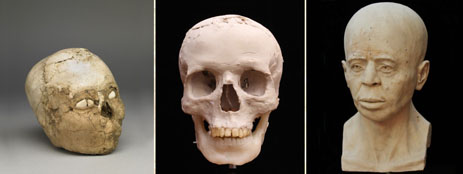 This
is a face reconstruction of a plastered skull from Jericho from 9,500
years ago. It is considered as Neolithic. This skull was CT scanned and
the extracted dimensions were used to create a 3D printed replica. The
face was built up using clay that was applied in layers to produce the
correct depth of skin, tissue and muscle. As you can see the resulting
sculpture is very modern looking. The cult of head removal has its
first example in Natufian culture during the Epipalaeolithic and became more wide spread
later on.
This person would have been a Natufian or as I would put it, an
Andite.
(http://www.cnn.com/2017/01/06/arts/jericho-skull-reconstruction-british-museum/index.html)
This
is a face reconstruction of a plastered skull from Jericho from 9,500
years ago. It is considered as Neolithic. This skull was CT scanned and
the extracted dimensions were used to create a 3D printed replica. The
face was built up using clay that was applied in layers to produce the
correct depth of skin, tissue and muscle. As you can see the resulting
sculpture is very modern looking. The cult of head removal has its
first example in Natufian culture during the Epipalaeolithic and became more wide spread
later on.
This person would have been a Natufian or as I would put it, an
Andite.
(http://www.cnn.com/2017/01/06/arts/jericho-skull-reconstruction-british-museum/index.html)
The above map is a rough indication of where the Andites were most prevalent over a long span of time (Polynesia and the Americas not included). It would look very different depending which slice of time you are referencing. They first appear on the rim of Mesopotamia. They migrate into Central Asia and from there into India, China and north into Siberia. From the Russian Steppes they travel west into eastern Europe over land and via the Danube into western Europe. A secondary route was across Anatolia into Greece and the Balkans. They also traveled south into Egypt along the Nile and from the delta northward to Crete and then Greece. They too pushed north and some went west across the Balkans. A smaller number traveled across northern Africa and reached the Atlantic coast at Lixus Morocco and down along the Atlantic coast but very few traveled into Africa itself. Then there was a small group that made it to Japan and then to South America from where their influence made its way to Central America and finally up into Mexico. The two main avenues into Europe were the northern route about the northern shores of the Caspian Sea into eastern Europe and the second by crossing the Aegean to Greece, then into the Balkans and into Europe.
The Neolithic Revolution appeared because of the Andites and was a result of their ingenuity, coping with their environment, willingness to experiment and hard work. Their forefathers, the Nodites, were semi divine which means they were one of the most able of the planetary stocks. They both had excellent genes. The Adamites from the Garden of Eden were a second infusion of superior genes. The Adamites, also known as the violet race, produced advanced technologies such as ceramics, metal working, agriculture, animal husbandry and writing which was subsequently lost. It is because of where the Andites evolved on the fringe of Mesopotamia that we see the beginning of agriculture, animal domestication and one of the places for metallurgy. The Andites are, as the author of the Epic of Gilgamesh would write, two thirds gods and one third human. That contains a reference to the Nephilim (who on this site are the Nodites), the Adamites from the Garden and evolutionary man which by this time are both the Sangiks, the tribes of the evolutionary races of color, and the Andonites. The Andites as a race are invisible to all academia and the world at large but some do question if a lost advanced civilization of an unknown people did exist in distant antiquity.
Climate
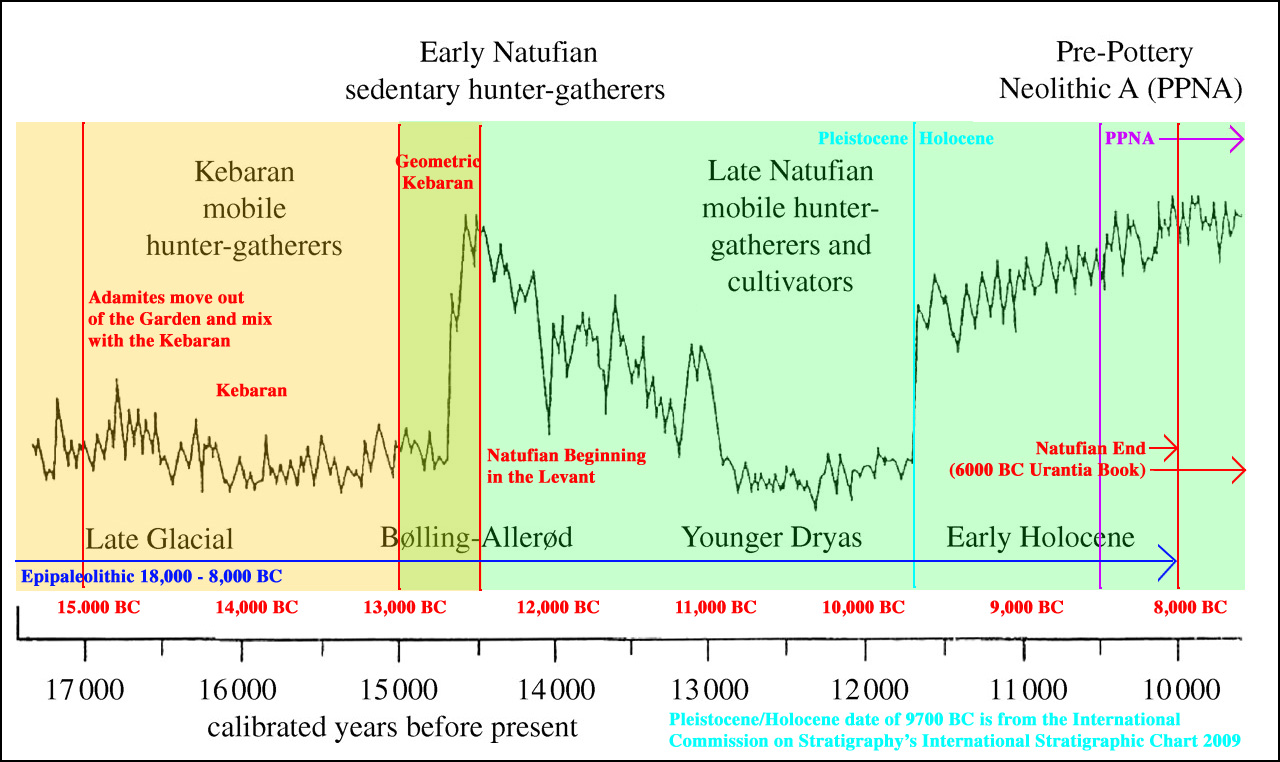 The end date for the Natufians of 8000
BC is thought by a minority of
scholars to be
because of two reasons (Bar-Yosef gives 7500 BC which
is closer to the actual date).
First
their cultural artifacts start to disappear at about this time
indicating they
were no longer present in any great numbers. Second is what is called
the “Younger
Dryas” in which the temperature became colder again and put a
halt to
growing cereals. Some support the claim that during this period there
was wide spread famine. But the UB says the Andites migrated away from
the
areas where they were living because of "the pressure of the hill
tribes to the east and the harassment of the plainsmen of the west."
(UB 873) There
is no mention of climate change for this migration. That made me
wonder just how close
are climatologists on their projections of temperature during this span
of time because it also brings up other questions, especially for UB
readers,
about the Garden of Eden (located due east) which if the climate
assumptions were accurate it would have been too cold for agriculture.
If I remember correctly the temperatures that you see in climate charts
are based on core samples from Greenland, the epicenter of the glacial
periods. That's fine for Greenland but I am skeptical of applying that
data to southwestern Asia. So I do not fully trust these
charts as it applies to the Levant. Second, the assumed reason by some
for
the migrations away from the Levant at 8,000 BC
is the "Younger Dryas" when it became too cold to grow crops. If you
look at the chart this period it is as cold as the end of the late
glacial. However,
using their own dates for the cultures and overlaying their climate
data
their conclusion is obviously wrong. There is, by
their own accord, a warming period called the Holocene that
predates the Natufian
departure by about one thousand five hundred years. Therefore it is
impossible that the Natufians were driven out of the Levant by cold
weather. It was nice out. There is one more
group of people, indications of the Kebaran, living at Ohalo on the Sea
of Galilee at
21,500 BC and if they were not growing crops they were certainly
harvesting them from the wild. This dates them to the era of the
LGM the Last Glacial Maximum. How according to the climate data could a
very
early people living in the Levant be foraging grain at a time when it
is supposed to be too cold to grow? This is during the last great Ice
Age. What I think is that although the climate data from Greenland and
Vostok match fairly closely they do not accurately represent the
projected temperatures for the Levant based on the archaeological
record. So I'm skeptical. One other
point that supports the UB is Jericho,
which is considered as one of the oldest cities, had a central tower
but more importantly a high wall surrounding the city which dates to
8000 BC. Archaeologists have two explanations for the tower and the
wall. The first is it was built to protect against floods and the
second built for defensives purposes which apparently it was. Jericho was Natufian.
It
was abandoned about 7000 BC.
The end date for the Natufians of 8000
BC is thought by a minority of
scholars to be
because of two reasons (Bar-Yosef gives 7500 BC which
is closer to the actual date).
First
their cultural artifacts start to disappear at about this time
indicating they
were no longer present in any great numbers. Second is what is called
the “Younger
Dryas” in which the temperature became colder again and put a
halt to
growing cereals. Some support the claim that during this period there
was wide spread famine. But the UB says the Andites migrated away from
the
areas where they were living because of "the pressure of the hill
tribes to the east and the harassment of the plainsmen of the west."
(UB 873) There
is no mention of climate change for this migration. That made me
wonder just how close
are climatologists on their projections of temperature during this span
of time because it also brings up other questions, especially for UB
readers,
about the Garden of Eden (located due east) which if the climate
assumptions were accurate it would have been too cold for agriculture.
If I remember correctly the temperatures that you see in climate charts
are based on core samples from Greenland, the epicenter of the glacial
periods. That's fine for Greenland but I am skeptical of applying that
data to southwestern Asia. So I do not fully trust these
charts as it applies to the Levant. Second, the assumed reason by some
for
the migrations away from the Levant at 8,000 BC
is the "Younger Dryas" when it became too cold to grow crops. If you
look at the chart this period it is as cold as the end of the late
glacial. However,
using their own dates for the cultures and overlaying their climate
data
their conclusion is obviously wrong. There is, by
their own accord, a warming period called the Holocene that
predates the Natufian
departure by about one thousand five hundred years. Therefore it is
impossible that the Natufians were driven out of the Levant by cold
weather. It was nice out. There is one more
group of people, indications of the Kebaran, living at Ohalo on the Sea
of Galilee at
21,500 BC and if they were not growing crops they were certainly
harvesting them from the wild. This dates them to the era of the
LGM the Last Glacial Maximum. How according to the climate data could a
very
early people living in the Levant be foraging grain at a time when it
is supposed to be too cold to grow? This is during the last great Ice
Age. What I think is that although the climate data from Greenland and
Vostok match fairly closely they do not accurately represent the
projected temperatures for the Levant based on the archaeological
record. So I'm skeptical. One other
point that supports the UB is Jericho,
which is considered as one of the oldest cities, had a central tower
but more importantly a high wall surrounding the city which dates to
8000 BC. Archaeologists have two explanations for the tower and the
wall. The first is it was built to protect against floods and the
second built for defensives purposes which apparently it was. Jericho was Natufian.
It
was abandoned about 7000 BC.(http://www.jstor.org/stable/2743274?seq=1#page_scan_tab_contents) (D. Bar-Yosef and F. Valla, The Natufian Culture and the Origin of the Neolithic in the Levant, University of Chicago Press © 1990) This information from the JSTOR web page, which I trust, doesn't say anything about a too cold climate. If anything it supports a growing season through the Younger Dryas and only remarks that a lesser amount of pollen was found during the period in question.
The best explanation that parallels the UB in terms of having to turn to agriculture, by the "coersion of climate necessity" is this quote:
"Another major crisis was the ‘‘Younger Dryas,’’ a period of cold, dry climatic conditions that lasted for centuries. Rapid reduction in the size of the lushest vegetation belts as well as reduction in the yields of natural stands of C3 plants such as cereals forced certain human groups to change their organizational strategies, including the ways they obtained carbohydrate resources. Experimental planting, shifts in the location of settlements, and the clearing of land patches resulted in establishment of the Early Neolithic (commonly labeled PPNA) villages, first in the western part, or the Levantine wing, of the Fertile Crescent." (http://www.columbia.edu/itc/anthropology/v1007/baryo.pdf) In other words at first because of climate it was easy to simply harvest wild grain. But during the Younger Dryas there wasn't as much as before and the population had grown as indicated by settlement size. So they were forced to grow their own crops as a matter of survival. They had become reliant on cereals as their staple food but complimented their diet with a more broad-spectrum hunting.
When the Natufians migrated out from the Levant they would have continued going north as indicated by various archaeological digs as their homeland kept stretching northward. Those who went north most would have turned west into Anatolia following the vegetation with some of them settling at Çatalhöyük starting at 7400 BC (ucl.ac.uk). Cultures such as the Khiamian in Syria north of Mesopotamia and the Levant "is placed in the continuity of the Natufian." Others, such as the Harifians, would have traveled south into Egypt, the Nile River Valley. Dates are approximate. Bar-Yosef's has 7500 BC for the end of the Natufians in the Levant. I would go by the date of 7000 BC for the Levant because that is about when Jericho was abandoned. The final dispensation for the Andites has an end date of 6000 BC in the UB.
"To help him figure out the basis for the settlement's apparent prosperity, Mellaart put out the call to some of the world's leading specialists.
One of the first to show up was paleobotanist Hans Helback, an expert in fossil plant remains from the Danish National Museum in Copenhagen. Helback had earlier worked with Robert Braidwood at Jarmo, where he found the burnt remains of the earliest known domesticated wheat and barley. Helback was bowled over by the abundance of domesticated plants he found at Çatalhöyük." (The Goddess and the Bull: Çatalhöyük: An Archaeological Journey to the Dawn..., Michael Balter, Free Press © 2005 Michael Balter)
Mellaart is the archaeologist who discovered Çatalhöyük and thereby confirmed that there were Neolithic settlements in Anatolia when it was the fashion to deny such a possibility. He found a type of obsidian at Çatalhöyük that was also used at Jericho in the Natufian heartland. Before excavating Çatalhöyük Mellaart had discovered Hacilar a slightly later Neolithic Tell. It was to the west - the same direction the Natufians were moving. Çatalhöyük was the second new experiment of these people, the first being farming. This second experiment was the first urban life. Çatalhöyük was packed together houses and no streets. Access was through a roof opening. There is another settlement, Ashilki Höyük, that has most of the characteristics of Çatalhöyük and may have been the location for their obsidian. Trade from this region in obsidian to Jericho has been recorded as early as 12,000 BC. so the Natufians knew of this area before migrating.
The decorating of skulls referenced above by mathilda37 (Mathilda's Anthropology Blog) seems to be for Çatalhöyük and this is comparable to the culture at Jericho. "They seem to share some cultural ties to the Turkish culture of the time, such as removing and decorating skulls, and burying their dead inside their houses." These two locations have other cultural commonalities as well. The detachment or dearticulation of the skull from the body was a common feature in the various cultures and may indicate ancestral veneration. This skull separation is a late Natufian practice which means it arose within the Andite culture for whatever reason and should not be linked to the "Watchers" or Nephilim, their forefathers.
 The
Andite-Natufians move westward
The
Andite-Natufians move westward
Those
Andites who were moving out of the Levant were going mainly north and
then west. This is Mehmet Özdogan's map
showing the Neolithic movement towards the west into Greece and then
into the Balkans after 7000 BC. Click on
the map for a larger view.
"Today, not
only the
southeastern parts of Turkey but also a large section of the Central
Anatolian plateau are incorporated into the Near Eastern core area of
early agricultural development, on a par with developments further
south in the Levant. However, until about two decades ago, the
Anatolian peninsula was not considered to be part of the primary zone
of neolithization in western Asia. It was assumed that the Neolithic
way of life was brought to Anatolia from the southern Levant during the
late phases of the Pre-Pottery Neolithic A. Accordingly, during the
early 1990s, the earliest Neolithic horizon in Anatolia was regarded as
a result of “secondary neolithization” (Cauvin
1988;
BarYosef & Belfer-Cohen 1992). However, in spite of the current
increase in the number of Neolithic excavations in Anatolia, the
question of defining the ultimate origins of the Anatolian Neolithic
still remains unanswered. In the southern Levant, the Final Paleolithic
cultural sequence from the Kebaran to the end of the Natufian
(c.21–11.5 kya) clearly indicates that Pre-Pottery Neolithic
cultures developed locally from Paleolithic forebears in that region."
(http://www.academia.edu/4178697/Anatolia_and_the_Balkans_Archaeology -
pdf file)
There is a bit of
ethnocentrism in Özdogan's
quote, which happens frequently with other archaeologists as well, but
that aside he does a very good job of explaining the westward movement
across Anatolia to the Aegean, to Greece and then northwards to the
Balkans. What you are seeing here is the beginning of the Neolithization of Europe by
those early Andite farmers and those cultic mother worshipers who are
not necessarily Andite.
The Great Migrations
"TRANSFORMATION
AND THE CERAMIC NEOLITHIC Throughout Southwest Asia there is a marked
discontinuity between the earlier, aceramic Neolithic and the later,
ceramic Neolithic, not limited to the addition of pottery.
The Levant
in only a few
centuries after intensified farming began, a total system collapse or a
major social transformation occurred in the Levant. Jericho and many
late aceramic Neolithic settlements were abandoned during the later 8th
millennium BC, and were replaced with only a few small, ephemeral
sites, in contrast to the substantial aceramic Neolithic sites."
"Along with these changes, the rich architecture, imagery and symbolism
of the aceramic Neolithic period also disappeared."
(http://college.thamesandhudsonusa.com/web/humanpast/summaries/ch06.html)
Farming did not
disappear but
the richness of the Natufian-Andite culture did. The above quote is
about the Levant but the article goes on to say it happened in Syria,
Turkey, Iraq and Iran. This situation reflects what the UB has to say
about the Andite exodus from the Middle East into Central Asia and
Europe. "The
migratory conquests of the Andites continued on down to their final
dispersions, from 8000 to 6000 B.C. As they poured
out of Mesopotamia, they continuously depleted the biologic
reserves of their homelands while markedly strengthening the
surrounding peoples." (UB 873)
"In the central Zagros
the details of the occupation after 6000 B.C. are not too
clear.
The area was certainly inhabited, as is demonstrated by important sites
at Tepe Giyan, Tepe Siabid near Kermanshah, and Godin Tepe (periods VII
and VI), but it had apparently lost its former lead in Iranian cultural
development."
(http://www.penn.museum/sites/expedition/iran-9000-4000-b-c/)
"During the
sixth
millennium, contemporary with the development of the Hajji Firuz
ceramic tradition, distinct regional styles evolved within the
previously homogeneous Zagros group tradition."
(Mary M.
Voigt, Hasanlu, Volume
I: Hajji Firuz Tepe, Iran - - The Neolithic Settlement,
The
University Museum University of Pennsylvania © 1983 The
University Museum University of Pennsylvania)
"The succeeding PPNB period (6800-6000 BC) represents further
development of the Early Neolithic in the Levant with indications of
closer contact and more formal trading of obsidian, turquoise, jadeite,
flint.
This was also a time when the Neolithic expands
beyond the areas
of initial settlement (Levant) into the areas of the Kopet Dagh
(Jeitun) and Mergahr in the Baluchi Highlands. While these
areas
are very distant from the main developments of the Fertile Crescent,
they probably represent diffusion rather than independent innovation
with connecting sites of the Iranian Plateau still to be found."
(www.unm.edu/~gbawden/328.../328-neo2.doc)
"The period from 9000 to 6000 BC has left very little in the way of
archaeological evidence. Around 6000 BC, Neolithic settlements appear
all over Egypt. Studies based
on morphological genetic, and archaeological data have
attributed these settlements to migrants from the Fertile
Crescent returning during the Egyptian and North
African
Neolithic, possibly bringing agriculture to the
region."
(http://www.alwaysegypt.com/prehistoric-egypt/)
We can see
by the above that
there were fundamental changes occurring in the region at about 6000
BC.
The creative
energy of the Neolithic was losing its bloom in the Fertile Crescent.
The population was
becoming less homogeneous, more varied, as the Neolithic moved into
Turkmenistan,
across Iran and into India. The Zagros Neolithic begins about 7000 BC
and with it cultural changes start to appear such practices
as infant head binding, burial practices such as the use of ossuaries and burial
in open spaces between buildings.
The archaeological and anthropological
records reflect what the UB has to say about the migrations of the
Andites. The
Andites were gone by 6000 BC except for a small band of this race
living at the mouth of the Tigris and Euphrates who refused to leave
their homeland. They would become to be known as the Sumerians.
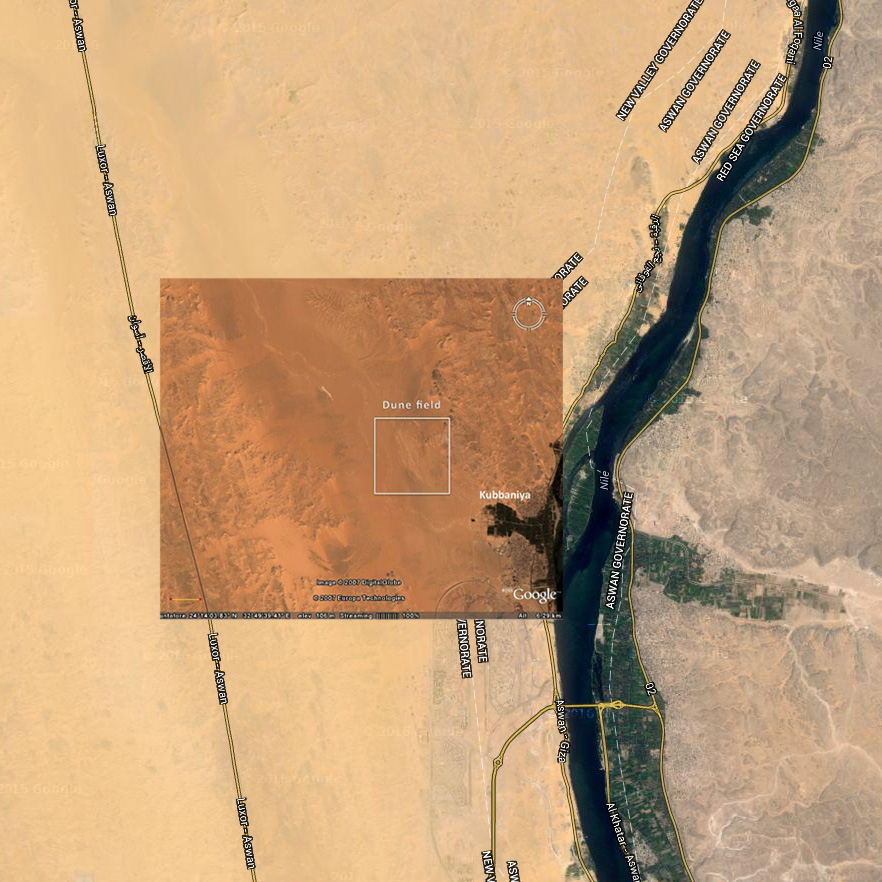 Wadi
Kubbaniya
Wadi
KubbaniyaI consider this site almost as important as Ohalo II because of its evidence of very early agriculture. Both of these very early sites are pre-Natufian which implies a Kebaran culture even this far south. Wadi Kubbaniya is located just northwest of present day Nagaa Al Hajar which is south of Kom Umbu. There is nothing there to see from satellite but you can click on the image for a larger view. The controversy for this early date, one of which is as early as 16,500 BC., is based on whether or not the seeds found are wild or domestic. There was harvesting which is called "plant exploitation" as shown by the seeds at the site, grinding implements and the stone sickles with the tell tale sheen. But it remains inconclusive for farming as the seed sample is not large enough for that determination. Wild seeds have a smooth base where it joins the stem and domesticated seeds have a jagged base. Fred Wendorf who was in charge of excavating this site (along with his colleague Romuald Schild) in answer to his critics said that even if the cereals are determined to be wild that it is the behavior that is most important which lead to the Neolithic revolution. "We've been looking at the wrong thing," he says. "It would seem that what needs to be explained is not the beginnings of food production; I think that was a normal and natural response to new food resources. What we need to explain is the shift in emphasis to dependence on cereals—the increased emphasis on cereals as a source of food which ultimately led to the Neolithic revolution." (www.mosaicsciencemagazine.org/pdf/m13_04_82_01.pdf)
 Isna
Isna"...something highly unusual really did take place in Egypt sometime between 13,000 and 12,000 BC. At four Isnan sites on the Upper Nile - at Isna (from which the culture takes its name), at Naqada, at Dishna, and at Tushka, 125 miles up river from Aswan - palaeontologists have unearthed clear evidence that these ancient peoples selected and grew their own cereal crops. Stone sickle blades were used to reap the harvests, while grinding-stones were employed to extract the maximum amount of grain. Not only did the Isnan possess a primitive form of agriculture, they would also appear to have mastered animal domestication and to have possessed a highly advanced microblade technology." (http://humanpast.net/food/food13k.htm)
These dates are also earlier than the Natufians. So it would appear that these people were Nodites and could be comparable to the Kebaran culture at Ohalo II which also has evidence of processing cereals before the Natufians. Just south of the Kebaran were the Mushabian (and or the Ramonian) people at 16,000 - 12,5000 BC. These people I would consider as the southern Kebaran. Given this evidence, that Nodites made it at least this far into Egypt we can conclude then, it could be one more place from which Egyptian influence made its way back northward probably through trade and marriage. It would appear that the farming culture of Wadi Kubbaniya had expanded to include these Isnan communities or that these communities may be a new population migrating south from the Levant. Some of the Adamites in their early expansion did make it to the Nile Valley and the Sahara. The UB does not say if they had any impact on agriculture. It would be at the end of the Andite migrations from Mesopotamia that the greatest number of Andites traveled to this river valley.
"The broad-headed Nodite-Andonite Syrians very early introduced pottery and agriculture in connection with their settlements on the slowly rising Nile delta. They also imported sheep, goats, cattle, and other domesticated animals and brought in greatly improved methods of metalworking, Syria then being the center of that industry." (UB 889)
The Saharans
"As mentioned above, materials such as stone from Arabia, obsidian from Anatolia and shell from the Nile valley show contacts with people over several hundred kilometers away. But other evidence, such as stone blade shaping techniques derived from north Africa and some evidence for north African genes in the population suggests that people may also have come in from some distance. Additionally there is tenuous evidence for the import of a type of fig from north Africa."
(http://armchairprehistory.com/2010/06/11/what-happened-in-the-natufian/)
Not unexpected. The north African gene could be partly a result of an Egyptian endowment. The Harifian have a connection to an Oasis in Egypt called El-Fayyum. Egypt had a relationship with the Kebaran even earlier. Egyptian influence is felt as far north as Tel es-Sa'idiyeh by 5000 BC (Bronze Age). There are claims that two seven foot female skeletons were found at es-Sa'idiyeh. This is not true. The archaeologist Johnathan Tubbs to whom this claim is attributed and who excavated at Tel es Sa'idiyeh denied outright that there ever were such skeletons (The Unseen Realm: Recovering the Supernatural Worldview of the Bible by Michael Heiser). Many archaeologists are of the opinion that the African gene is Saharan. This is most likely the case as the Nodites had lived in the eastern Mediterranean basin and did mingle in those early years with the Saharans.
"In the eastern trough of the Mediterranean the Nodites had established one of their most extensive cultures and from those centers had penetrated somewhat into southern Europe but more especially into northern Africa. The broad headed Nodite-Andonite Syrians very early introduced pottery and agriculture in connection with their settlements on the slowly rising Nile delta. They also imported sheep, goats, cattle and other domesticated animals and brought in greatly improved methods of metal working, Syria then being the center of that industry." (UB 889)
This could be a reason for the earliest harvesting of cereals and animal domestication at Isna and perhaps Wadi Kubbaniya. Since this predates the Natufians it has to be the mixed Kebaran-Nodites. Earlier there were Nodites living in the Mediterranean basin. With the retreating ice sheet the rising waters of the Atlantic broke through at Gilbralter and the Mediterranean rose closer to its present level. The Nodite center in the Mediterranean basin was wiped out by this flood at about 32,000 years ago. This rise in sea level also submerged the land bridge from Europe to England. The real mixing happened before this flood and with the dramatic climate change that was taking place. The cloud carrying winds shifted northward and brought a drought to the Saharan landscape. This drove the Saharans into Spain, southward into Africa and east to Egypt, Arabia and to India. It is another answer to the question of the Saharan gene appearing in the Levantine population.
 Karanis
Nearby the ancient city of El-Fayyum known today as Faiyum is the tell Dimeh Al-Siba also known as Karanis.
"Early Natufian peoples were accomplished stone masons, responsible for the construction of the Neolithic city of Jericho, with its famous stone defensive tower built sometime between 8350 BC to 7370 BC. Agriculture in this region goes back to 12,000 BP (before present), although the key nerve center for the spread of advanced technology in the Near East was unquestionably southeast Turkey, where Pre-pottery Neolithic sites such as Gobekli Tepe and Nevali Cori catalysed an unprecedented epoch of art, architecture and technological advancement on a level not seen before.
Thus the most likely builders of the Karanis Neolithic city were Natufian settlers from Palestine, who had migrated to Egypt between 5500 and 5000 BC."
"Might the city have been ruled by descendants of the
Watchers and Nephilim of the book of Genesis and the book of Enoch?
Egypt's Neolithic city would have possessed a ruling elite, a dynasty of individuals, who were most probably among the country's earliest rulers, or kings. If they were of Natufian stock, then it is possible that this elite were descendants of those who constructed the Pre-pottery Neolithic cult complexes of Gobekli Tepe and Nevali Cori in southeast Turkey, which was the site of the biblical Garden of Eden. The Watchers, and their ledendary (sic) offspring the Nephilim, are said to have lived in 'Eden', and there is overwhelming evidence that they were in fact a shamanic or ruling elite attached to southeast Turkey's earliest cult centres. The descendants of these earliest Neolithic peoples of the Near East were also responsible for Catal Huyuk, the ancient world's oldest city near Konya, in southern-central Turkey. It dates to c. 7000-5500 BC, and here we find depictions of its priestly or ruling elite as shamans in coats made from the feathers of the vulture, a bird associated with the transmigration of the soul into the afterlife. It is possible that similar influences might have permeated through the Natufian peoples into Egypt, c. 5500 BC, meaning that, yes, the descendants of the Watchers and Nephilim might well have constituted the ruling elite of Karanis's Neolithic city."
(http://www.crawford2000.co.uk/7000.htm from a report by Andrew Collins)
I always take Andrew Collins with a grain of salt. But he does come up with some interesting information. His conclusion and my own are parallel as far as considering the Natufian as descendants of the Nephilim. As to the Watchers and Nephilim as a ruling shamanic elite that is dubious in my opinion as Shamanism was world wide and was ruled by Shaman of an evolutionary order maybe even before the Watchers even touched down. You did not have to be a Watcher or Nephilim to be a Shaman. If anything Shaman often had some type of physical deformity or some kind of mental illness - an indication of "spirit possession" or the ability to speak with the unseen. Those descendants of the Watchers were more than likely to be political or military leaders than Shaman. Shamanism is an evolutionary religion. The Nephilim - the Nodites - carried a different idea that was linked to heaven which is confirmed in the writings of the Sumerians. But they too had Shaman within their communities. They were not immune from the forces of evolutionary religion. There is a second statement he makes about the Natufians that is just as interesting: "Early Natufian peoples were accomplished stone masons, responsible for the construction of the Neolithic city of Jericho, with its famous stone defensive tower built sometime between 8350 BC to 7370 BC." There are several trails that lead back to the Andites and one of them is their expertise in constructing architecture and monuments in stone. Very important as it lays the foundation of the shortly appearing Megalithic Age. But Karanis is not Neolithic as stated above. It is Greco-Roman. "Karanis, or "the Lord's Town", was one of the largest Greco-Roman cities in the Fayoum. It was founded in the third century BC, probably by Ptolemy II Philadelphus, and was originally inhabited by the mercenaries of his army." (http://www.touregypt.net/featurestories/karanis.htm) The Neolithic, which ended with dates for the end in the Levant as early as 3700 BC., and ends with the age of metals starting with copper is called the Chalcolithic. Andrew Collins would have been much more on target had he mention instead the oasis Fayum also known as the Faiyum where evidence of early farming at about 5200 BC has been uncovered. The Crawford 2000 web site no longer hosts this page.


 "
The Andites built the first stone structures in Egypt. The
first
and most exquisite of the stone pyramids was erected by Imhotep, an
Andite architectural genius, while serving as prime minister." (UB 894)
To
the left is a picture of that pyramid and the bust of Imhotep the
Andite. The pyramid is called the pyramid of Djoser and is located at
Saqqara which is just south of Giza.
"
The Andites built the first stone structures in Egypt. The
first
and most exquisite of the stone pyramids was erected by Imhotep, an
Andite architectural genius, while serving as prime minister." (UB 894)
To
the left is a picture of that pyramid and the bust of Imhotep the
Andite. The pyramid is called the pyramid of Djoser and is located at
Saqqara which is just south of Giza.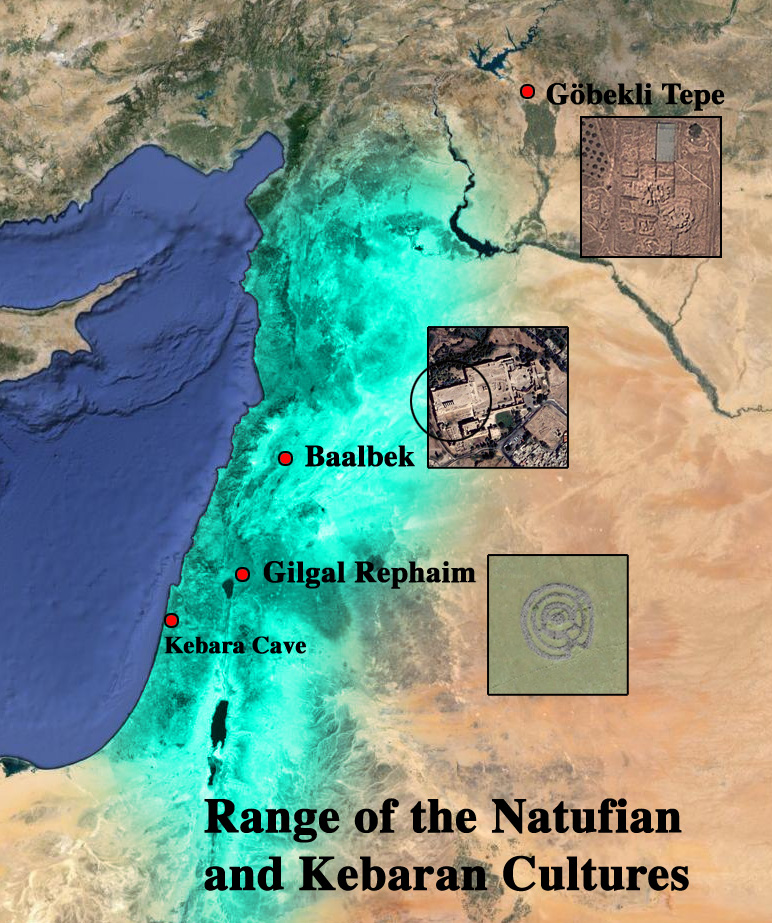 This map shows the locations of
Göbekli
Tepe, Baalbek, Gilgal Rephaim and where the earlier Natufians and
Kebarans lived.
Click on it for a larger view. Legend/folklore has it that
Baalbek was built by the Nephilim with one named individual being
Djenoun. They could be right. It is located smack dab in the center of
the Kebaran-Natufian homeland. Göbekli
Tepe and Baalbek
are two of the most mysterious
places on earth. Both of
these structures are considered megalithic and both are considered as
places for religious ceremony. The elevation for both is the high
ground which is to be expected. They do not display any identifying
marks as to who built them. The timing of the construction for Göbekli
Tepe has one proposed date of 9500 BC and another is 10,000 BC which
puts it firmly within the Natufian time frame. But
I would not be surprised if the Andites were not also considered as
Nephilim just like their ancestors. There weren't many archaeologists
back then to help make that distinction. Just
a quick mention here of Gilgal Rephaim which is just north of Jericho.
That makes three related and mysterious
structures in
and
about the Kebaran/Natufian homeland. Gilgal was built much later
during the Iron Age and is most likely not a Natufian structure. There are no dates for Baalbek.
The abandonment of Göbekli
Tepe is at the time of the migration of the Natufians away from the
Levant. They buried it before leaving for the west. What is striking
about these
immense structures is that they symbolize a religious declaration. If
you are interested in Gilgal Rephaim and the biblical person of Og the kingly Nephilim giant, click here: Stories of
the Nephilim and Rephaim
This map shows the locations of
Göbekli
Tepe, Baalbek, Gilgal Rephaim and where the earlier Natufians and
Kebarans lived.
Click on it for a larger view. Legend/folklore has it that
Baalbek was built by the Nephilim with one named individual being
Djenoun. They could be right. It is located smack dab in the center of
the Kebaran-Natufian homeland. Göbekli
Tepe and Baalbek
are two of the most mysterious
places on earth. Both of
these structures are considered megalithic and both are considered as
places for religious ceremony. The elevation for both is the high
ground which is to be expected. They do not display any identifying
marks as to who built them. The timing of the construction for Göbekli
Tepe has one proposed date of 9500 BC and another is 10,000 BC which
puts it firmly within the Natufian time frame. But
I would not be surprised if the Andites were not also considered as
Nephilim just like their ancestors. There weren't many archaeologists
back then to help make that distinction. Just
a quick mention here of Gilgal Rephaim which is just north of Jericho.
That makes three related and mysterious
structures in
and
about the Kebaran/Natufian homeland. Gilgal was built much later
during the Iron Age and is most likely not a Natufian structure. There are no dates for Baalbek.
The abandonment of Göbekli
Tepe is at the time of the migration of the Natufians away from the
Levant. They buried it before leaving for the west. What is striking
about these
immense structures is that they symbolize a religious declaration. If
you are interested in Gilgal Rephaim and the biblical person of Og the kingly Nephilim giant, click here: Stories of
the Nephilim and RephaimBaalbek's importance as a religious shrine goes far back into the prehistoric. We know it was held in such reverence over a vast period of time that the Romans built their most spectacular temple to Jupiter on the platform. You can still see the columns of the temple to Jupiter on it. The circle in the above image is the original platform. The rest of the complex is Roman. The Egyptians supposedly had high priests there and named it after their own Heliopolis. According to Ambrosius Theodosius Macrobius a Roman grammarian and Neoplatonist philosopher wrote in his work called Saturnalia that there was an Egyptian priest colony at Baalbek and hence the Ptolemaic name of Heliopolis. Ancient Heliopolis was one of the most sacred cities in Egypt and was located at present day Cairo. Muslims also built a mosque at the site. It was also renown for its oracles. What was originally on the great platform at Baalbek is gone. Whatever was there was most likely reused by the Romans. There is almost universal agreement that Baalbek was dedicated to the Canaanite god Baal. One connection of Baalbek with Çatalhöyük is the Bull Cult. Baalism is associated with the bull. But Baalbek and Göbekli Tepe in some ways couldn't be more different.
The original Baalbek was a rectangular stone platform unadorned and high up. I think Baalbek could very well be Kebaran-Nephilim. My argument is this: Whoever built it had knowledge of engineering which the Nodites apparently had in their endeavor to build the tower of Babel. They worked on the tower for four and a half years before falling into a devastating war over what it was suppose to represent. It wasn't the hard work but the contested symbolism that ended the project. This idea of monumental architecture must have been deeply embedded within the Kebaran and Natufian cultures. The later Andites also tried to build a second tower but it "fell of its own pretentious weight." (UB 859) Both Göbekli Tepe and Baalbek are monumental architectural much like the later megalithic traditions and embody a religious context. Also Baalbek was built to a very high standard. But I am not so sure that it was for a religious reason alone. It could be the Nodites finally did build their monument to remember their roots, that glorified past they were so obsessed with. Theirs was a building so audacious as to be remembered for eternity. That didn't happen. Eventually the memory of who built it, why it was built and when it was built was forgotten. By the time of the invention of writing, thousands of years later, it had become Baalbek, associated with the Canaanite god and widely known as a revered religious center. That is my rational for a Nephilim construction of Baalbek. The UB is mute on the subject. The one problem I have with Baalbek is that it has a more modern or recent appearance. It is squared off and very clean looking. But the ability to move and place such large blocks of stone is not recent. That technique is lost to a far away antiquity. I am of the opinion that it is Kebaran/Nephilim built but I have nothing substantial to back it up. Therefore any theory on who built it must remain just that - a theory.
Göbekli Tepe is more like Natufian construction being subterranean, oval with stone foundations and lots of art. There are murals from Çatalhöyük with vultures and there are vultures in bas relief from Göbekli Tepe. There is one image of the "splayed figure" that is found at Göbekli Tepe and at Çatalhöyük. This image is unusual and identical to both locations. But the clincher is the lime plaster floors found in a rectangular building at Göbekli Tepe. There is clear evidence of plaster floors at Natufian sites sometimes painted. In some instances we know that these plastered floors were polished and maintained. Think of it - perfectly flat, level and polished floors were the floors in some of their very early huts at about 9000 BC. During the Neolithic this construction was very popular. Dirt floors were so yesterday.
The evidence is heavily weighed towards a Natufian-Andite origin although it is not out of the question than another "cultural entity" could have built it. But the Natufians were by far the dominant culture at this time and another reason is sheer numbers and man power. Another culture building it is unlikely. Also there is architectural evidence of buildings for ritualistic purposes in Natufian material culture and that Natufians had "substantial ritual behaviors." (D.T.Potts, A Comparison to the Archaeology of the Ancient Near East, © 2012 Blackwell Publishing Ltd. p137). Very often the term "oldest known temple" or "oldest known example of monumental architecture" is used to describe it. Maybe they completely disregard Baalbek because it cannot be dated or they ascribe to the belief that it is Roman. You will rarely, if ever, see it mentioned in relation to Göbekli Tepe. The construction of the complex at Göbekli Tepe demonstrates a puzzle for archaeologists and that is the older sections are better built that the later sections. As UB readers we know why. The further you go back into the Paleolithic the higher the quality which is shown at Göbekli Tepe and perhaps Baalbek. This defies all the beliefs of an evolutionary explanation. Just the opposite. Also the original builders left for the west leaving the later monument building to the mixed tribes who came later. This same deterioration is also true of some pottery. This is because as those earlier artists and builders began to have more evolutionary blood there occurred that drop off in quality. It is quite evident that the buildings at Göbekli Tepe went through this process.
"These civilizations of the Andite age cannot always be traced by the stages of their pottery or other arts. The smooth course of human evolution was tremendously complicated by the regimes of both Dalamatia and Eden. It often occurs that the latter vases and implements are inferior products of the pure Andite peoples." (UB 903)
The Epic of Baal
Before the Romans arrived the great platform of Baalbek stood alone. It was a monument unto itself. One important feature at that time was the so-called crevice located to the front of the platform where the Romans would later build their courtyard. Hardly anyone mentions this feature but it has to be important. One more thing about the crevice, it is located near the center of the courtyard. That is something worth noting. But what is peculiar about all of this is that Baalbek is off due east and west and that the platform is centered on the crevice. So Baalbek has been rotated to that position for an astronomical alignment from the podium to the horizon and inline with the crevice. I believe this marks the "resurrection" of Baal and therefore the crevice is his symbolic grave. At first I thought it was a solstice alignment but came to the conclusion it was not. What is left is a constellation or more likely a heliacal rising star. My choice is Sirius the dog star of Orion. At the bottom of this crevice, to which there are no stairs only rocks to step down on, is a stone hewn alter. It has no markings. In other words it is a sanctuary reached only from above. It is deep enough that you would need lighting of some sort. The Romans built their sacrificial alter directly over it. They could have built it anywhere in the courtyard but chose that spot for their own reasons. This alter, which faced their temple of Jupiter, was one of the most complicated pieces of architecture that the Romans ever built, which is saying a lot. I find all of this very intriguing. They knew something about the history of Baalbek that we don't. But it goes further than that and now we come to the god Baal. In the Canaanite "Epic of Baal" the god is killed and then resurrected, a cycle that academics refer to as the Ugaritic Baal Cycle, the reoccurring cycle of the seasons. It is during Baal's death that we find an allusion to the Lucifer Rebellion. More on that can be found on the page Lucifer. An image of Baalbek's podium with the Roman alter can be found here . The epic continues:
Woe to the people of Dagon's son!
Woe to the multitudes of Athar-Baal!
"Let us go down into the earth."
With Her goes down the Torch of the Gods, Shapash.
Until She is sated with weeping, She drinks tears like wine.
Aloud She cries to the Torch of the Gods, Shapash: "Load Aliyan Baal on to Me!"
The Torch of the Gods, Shapash, hearkens.
She lifts Aliyan Baal,
On the shoulders of Anath She places Him,
She raises Him into the heights of Saphon.
She weeps for Him and buries Him.
She puts Him in the grave of the Gods of the earth.
His feet He sets on the footstool.
He cracks a smile and laughs.
He lifts His voice And shouts: "Let Me sit and rest, And let My soul repose in My breast.
For Aliyan Baal is resurrected, For the Prince, Lord of Earth, exists."
Upon Her return to the world above, She carries Great Baal with Her.
Baal goes into the heights of Saphon. He confronts Mavet, the Hero.
Baal seizes the son of Asherah.
The great one He smites on the shoulder. The tyrant He smites with a stick.
Mavet is vanquished, Reaches earth.
She attacks mankind."
"But is not satisfied. She had smitten in the valley [some have plain], fought between the two cities."
"Anath guts their liver with laughter. Her heart is filled with joy, for Anath's hand is victory.
For knee-deep She plunges in the blood of soldiery, Up to the neck in the gore of troops [some have Heros]."
The UB says the Andites tried a second time to build the tower but failed. That means they were building after the passing of the Kebaran or some eastern Kebaran tribe as they were rebuilding over the original structure at about 10,000 BC. which is just about the time Göbekli Tepe. It also means Baalbek is not that location for the tower but rather it is somewhere in the foothills of the Zagros and probably south of Ali Kosh maybe Susa. Another thing it shows is the memory of their forefathers was still alive in Andite culture and that there lingered that passion to rebuild the tower of Babel even though at that time they had been hunters and gathers over the passing millennia, just like the hunter gathers that built Göbekli Tepe.
-------------------------------------------
 Added
March 2017
Added
March 2017I could be persuaded that Baalbek is Neolithic which means two things. First it is Andite not Nephilim and second, it was built after Göbekli Tepe. The window of time is very narrow to consider this theory. There are several polygonal stones in the walls of Baalbek but that is not enough evidence for a Neolithic construction. If Baalbek is Natufian, it certainly is different. As stated above I thought the alignment was for the solstice but it is too far off. If it is Neolithic it could have an Egyptian influence. The star Sirius is associated with the flooding of the Nile and thus an agricultural explanation. The Egyptians did have a close relationship with the Phoenicians who were Canaanites. In fact some think Baalbek is Phoenician. I do not think so. The Phoenicians did build temples but not on this scale. That tells me that megalithic architecture on the order of Baalbek was no longer being built even for their own purposes.
The Epic of Baal reminds me of another epic: Inana's Descent to the Nether World. It too has several themes within the same story. The Sumerian epic includes the seasonal theme, a goddess of the dead - Ereškigal, death and resurrection with Shamanic rituals which I write about on page Shamanism and Revealed Religion. The Canaanite epic involves a seasonal theme, a god of the dead - Mot, death and resurrection and at least two of the earlier Nephilim legends. These complexities seems to elude most scholars who see only the agricultural element. So in the end, I like the idea that Baalbek could be Nephilim built but if more info comes forward for an Andite monument, I could embrace that as well. There you go, the mystery continues.
---------------------------------------------
 One
thing I did not mention, which I believe is important, is where the
Baal Epic comes from: Lebanon which borders Syria. Home to the Phoenicians who
were
Canaanites and one of the locations for the northern
Emiran, Ahmarian, Kebaran and Natufians. The Epic of Baal
is Canaanite literature. As mentioned above, this location was
part of a
wider general
area where those migrants from the Land of Nod who sought shelter away
from the warring Eastern Nodites settled down as hunter gathers to
raise their families. There were others living here first. The Vanites
which includes Amadonites
and those loyal Nodites all of whom were well versed in the events of
the rebellion. So now you have in one location three elements involved
directly with the Lucifer Rebellion. Those are the Amadonites who are H.erectus
but culturally Vannic, Northern Nodites who very early split away from
the rebel Nodites to follow Van and those migrating Western Nodites
from what would later become Elam. Van himself was most likely living
at his head quarters in Turkmenistan at this time. So it is no surprise
that those early events became incorporated into the pneumonic Epic of Baal.
One
thing I did not mention, which I believe is important, is where the
Baal Epic comes from: Lebanon which borders Syria. Home to the Phoenicians who
were
Canaanites and one of the locations for the northern
Emiran, Ahmarian, Kebaran and Natufians. The Epic of Baal
is Canaanite literature. As mentioned above, this location was
part of a
wider general
area where those migrants from the Land of Nod who sought shelter away
from the warring Eastern Nodites settled down as hunter gathers to
raise their families. There were others living here first. The Vanites
which includes Amadonites
and those loyal Nodites all of whom were well versed in the events of
the rebellion. So now you have in one location three elements involved
directly with the Lucifer Rebellion. Those are the Amadonites who are H.erectus
but culturally Vannic, Northern Nodites who very early split away from
the rebel Nodites to follow Van and those migrating Western Nodites
from what would later become Elam. Van himself was most likely living
at his head quarters in Turkmenistan at this time. So it is no surprise
that those early events became incorporated into the pneumonic Epic of Baal.Another topic that involves those above but in particular the ethnic character of the Canaanites is religion. The Canaanite religion, which the Hebrew prophets riled against, has multiple connections with Judaism and not the least is with El. But let me back up a little to put this into a more relatable context. At Üçagızlı Cave, which is in present day Turkey but almost in Syria on the eastern Mediterranean coast, have been found lithics and perforated shells used as body ornaments. The earliest estimate for this time frame is about 47,000 ya. and is at the time cultural artifacts begin to show up. These assemblages "resembles some examples of the early Kebaran from the northern Levant". (http://web.arizona.edu/~hatayup/pubs/Kuhn2002.pdf) These people are dated to the IUP which means they are considered archaic Homo sapiens, Sangiks. "These [western Syrian] Nodites had freely mated with the Sangik races and left behind an able progeny." (UB 822) For me that indicates a lineage from the IUP back to those earlier Nodites and consequently to include their religious beliefs. All of this migrates to the southern Levant and home to three of the world's major religions. "Only the Nodites and Amadonites was there persistence of the traditions of Dalamatia and the culture of the Planetary Prince." (UB 821)
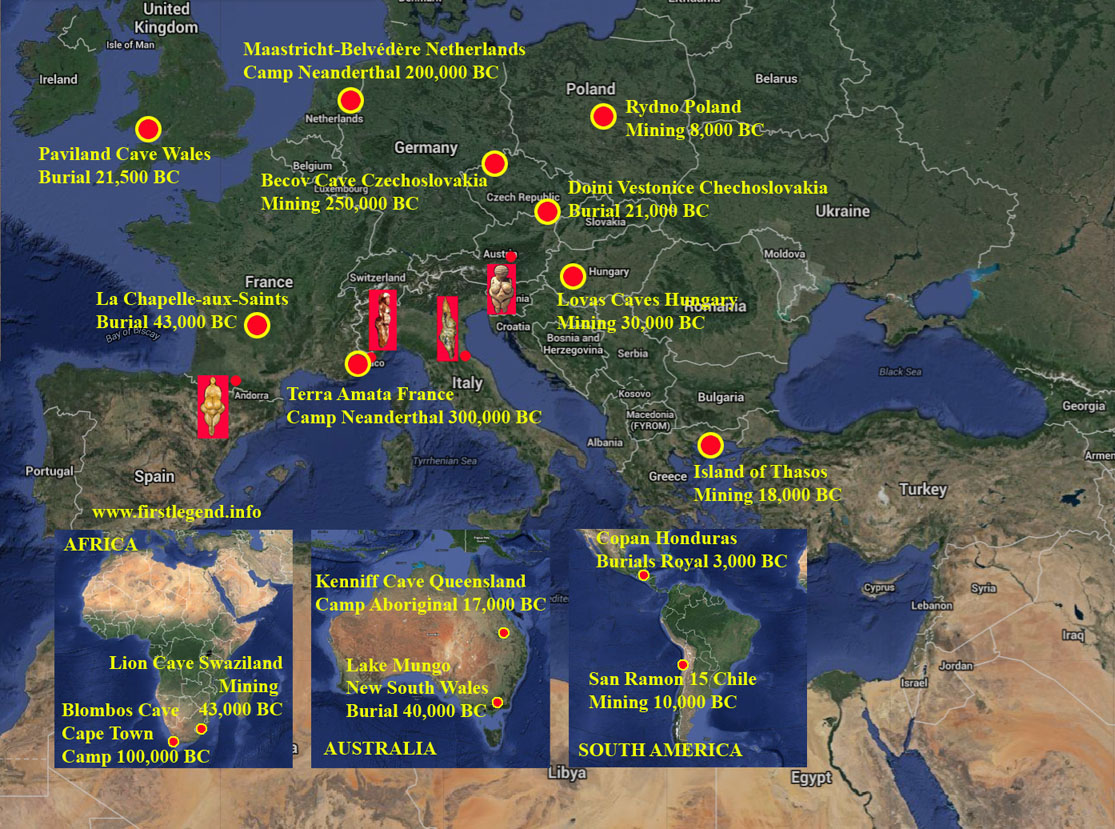 Before
discussing the Sumerians I would like to end this section with a short
presentation on the subject of red ochre. You probably do not know it
but the mining of red ochre was the worlds first industry on a
phenomenal scale. It says a lot about the primitive mind set (as in
early). Red ochre is a mineral, an oxide
that had no major purpose other than ritual. You could not eat it and
beyond symbolic use there only a couple of theoretical uses. Used as a
body paint it may have been discovered as an antibacterial agent and
deterring insect bites. That is if they were able to connect cause and
effect. (This is further complicated as the use of some clays which do
the
same thing. See: Denise Schmandt-Besserat, penn.museum) However the
ritual component was seemingly universal. The
use of red ochre is not Andite but they too were using it. Red ochre
was a symbolic material
hundreds of thousands of years before the appearance of the Andites.
And
at that stretch into antiquity it is easily the time of the first
archaic Homo
sapiens. Some
dates go back to Homo
erectus. Certainly
Neanderthal is included. There are Neanderthal workshops that produced
red ochre powder from the raw ore. Everyone wanted it and everyone used
it. Apparently everyone needed it. It was mined in unbelievable
quantities. At Lion Cavern alone it is
estimated 1200 tons were removed. That's just one of countless mines
and I believe it was the world's first
money preceding both metal and obsidian. In that context it was an
item of trade. It
was important stuff. It was carried over vast distances by those who
traded it or by those who traveled to get it. We know of its use as a
pigment not only for body
decoration (which is still being used today) but also for painting
images on the walls of caves. That use hardly explains the massive
quantities that was mined. We also know it was used in mortuary
practices. Archaic Homo
sapiens, Homo heidelbergensis
and Neanderthals used it as part of the burial ritual. Some would
include Homo erectus
but that is inconclusive as far as burial practices go. This mortuary practice
also extended to inanimate objects. The Venus
figurines and items such as axe heads have been found with traces of
it. "Excavations
at this site [Port au Choix, Newfoundland] yielded a dazzling array of
objects - animal effigies, bone needles, antler combs, shell beads,
wale-bone foreshafts, quartz crystals, bird-bone whistles or drinking
tubes, ground-stone adzes, axes and bayonets, pendants and even dog
burials - all covered in red ochre." (Donald H. Holly Jr., History
in the Making: The Archaeology of the Eastern Subartic, AltaMira Press
© 2013 by AltaMira Press) There is one grave most
likely of a Shaman who is literally buried in the
stuff. Think ten bags of concrete. So much so it even stained all the ground
surrounding the remains. Most believe that red ochre is linked to
blood. If you were to stumble upon some red ochre at ground
level after a rain storm it would look like blood. There are a number
of cultures who still use red ochre in ceremony and they will tell you
it is linked to blood. Its a good bet that early man had the same
concepts.
Before
discussing the Sumerians I would like to end this section with a short
presentation on the subject of red ochre. You probably do not know it
but the mining of red ochre was the worlds first industry on a
phenomenal scale. It says a lot about the primitive mind set (as in
early). Red ochre is a mineral, an oxide
that had no major purpose other than ritual. You could not eat it and
beyond symbolic use there only a couple of theoretical uses. Used as a
body paint it may have been discovered as an antibacterial agent and
deterring insect bites. That is if they were able to connect cause and
effect. (This is further complicated as the use of some clays which do
the
same thing. See: Denise Schmandt-Besserat, penn.museum) However the
ritual component was seemingly universal. The
use of red ochre is not Andite but they too were using it. Red ochre
was a symbolic material
hundreds of thousands of years before the appearance of the Andites.
And
at that stretch into antiquity it is easily the time of the first
archaic Homo
sapiens. Some
dates go back to Homo
erectus. Certainly
Neanderthal is included. There are Neanderthal workshops that produced
red ochre powder from the raw ore. Everyone wanted it and everyone used
it. Apparently everyone needed it. It was mined in unbelievable
quantities. At Lion Cavern alone it is
estimated 1200 tons were removed. That's just one of countless mines
and I believe it was the world's first
money preceding both metal and obsidian. In that context it was an
item of trade. It
was important stuff. It was carried over vast distances by those who
traded it or by those who traveled to get it. We know of its use as a
pigment not only for body
decoration (which is still being used today) but also for painting
images on the walls of caves. That use hardly explains the massive
quantities that was mined. We also know it was used in mortuary
practices. Archaic Homo
sapiens, Homo heidelbergensis
and Neanderthals used it as part of the burial ritual. Some would
include Homo erectus
but that is inconclusive as far as burial practices go. This mortuary practice
also extended to inanimate objects. The Venus
figurines and items such as axe heads have been found with traces of
it. "Excavations
at this site [Port au Choix, Newfoundland] yielded a dazzling array of
objects - animal effigies, bone needles, antler combs, shell beads,
wale-bone foreshafts, quartz crystals, bird-bone whistles or drinking
tubes, ground-stone adzes, axes and bayonets, pendants and even dog
burials - all covered in red ochre." (Donald H. Holly Jr., History
in the Making: The Archaeology of the Eastern Subartic, AltaMira Press
© 2013 by AltaMira Press) There is one grave most
likely of a Shaman who is literally buried in the
stuff. Think ten bags of concrete. So much so it even stained all the ground
surrounding the remains. Most believe that red ochre is linked to
blood. If you were to stumble upon some red ochre at ground
level after a rain storm it would look like blood. There are a number
of cultures who still use red ochre in ceremony and they will tell you
it is linked to blood. Its a good bet that early man had the same
concepts.
"The
use of red as a universal, protective power has also been documented
historically and cross-culturally, and often in association with blood
symbolism. Herbert Kenyon (1926: 29-35) systematically listed red items
and substances used as protective agents throughout historical times
beginning with lamb's blood to protect the Children of Israel, (sic)
through the use of hematite for soldiers suffering from loss of blood
in battle, to the extension of protection to inanimate objects. He also
noted redness was a distinguishing mark of shamans and that more
importantly the power of red was due to its obvious association with
fire. He concluded red through fire became a representation of divine
power, a sacred symbol, and thus the one color having "the greatest
magical properties" (1926: 35). Such magical powers have also been
observed for Northwest coast societies. McLaren (1978: 18) has stated
that red paint was a "principal media of restoring the dead to life"
and that "red as a color symbolized supernatural intervention and
curing." Ritchie suggested much the same for the use of red ochre
in burial
features of
the Northeast. He felt that red ochre, in its representation as blood,
perhaps acted as a magical restorer of life or vitalizer (1955: 64)."
(http://www.ontarioarchaeology.on.ca/Resources/Publications/oa33-1-williamson.pdf)
"Among
every "primitive" society studied by anthropologists a preoccupation
with blood has been noted. A principle of anthropology that applies
here is: The wider the distribution of a trait, the older it is. Since
the use of red ochre as a symbol of blood is virtually universal, we
may conclude that it is very old and that the earliest populations
regarded blood as a primal substance akin to water.
(http://jandyongenesis.blogspot.com/2007/10/mining-blood.html)
There
are at least two world wide phenomena that seem to go together: red
ochre and Shamanism. This was not only an Eurasian custom but it is
found around the world including the southwestern part of the United
States. In David Anderson and
Robert Mainfort's book The
Woodland Southwest they have identified some of the
Paleoindian burial practices. "The
use of red ochre in burials is associated with the practice of
shamanism and in eastern North America has been identified
archaeologically in Late Archaic contents (J. Brown 1997:473)."
Homo
erectus
"During
laboratory examination of the finds under a stereoscopic light
microscope, a quartzite hammerstone was shown to have a
peculiar
line of reddish ochre along a well-defined and particularly striking
side. Natural sediment retention in the cobble itself was excluded, and
it suddenly became obvious that what was being observed, was the
outline of the ball and thumb of a 500,000 year-old hand.
The use surface was compatible with it being held in such a way that
the hand would have covered the rest of the cobble, leaving only a
partial outline in red ochre, echoing the famous hand prints in the
cave paintings of France and Spain.
The hammerstone user was right-handed and the resulting curved trace of
colour on the stone was caused by trituration (the process for reducing
particle size of a substance by grinding) of ochre with liquid, showing
Homo erectus was undoubtedly using this as a form of paint at the site
of Lehberg. (Lehberg
is in lower Austria near the Danube River and Haidershofen.)
Constant use of the hammerstone in the same way and for the same
purpose allowed the ochre particles to become ingrained along the same
point where the hand would have rubbed against the stone."
(http://www.pasthorizonspr.com/index.php/archives/12/2013/ochre-hand-imprint-homo-erectus-revealed)
The above quote shows the use of red ochre is at least as old as a half million years and Homo erectus was processing it. That is important because red ochre was not just being used in its natural state but ground to a powder for a specific use. Some authorities put cognitive human behavior as late as 60,000 years ago which is a ridiculously late date. Red ochre is physical evidence that points to an early human capacity to derive a symbolic meaning and an understanding for general abstraction. Use of red ochre also suggests a use of language to be able to communicate what the symbolism of what red ochre represents and why. In the Levant burials with red ochre as old as 100,000 years ago have been found. At this time Archaic Homo sapiens, a category that is still in dispute, had made their appearance.
Neanderthal
and Mining
"The
mining evidence is
most likely of the early Upper Palaeolithic or of the Mousterian
(Mousterian occupation evidence is present in the cave). " The
Mousterian is the culture which has clearly been demonstrated to belong
to the Neanderthal. Interestingly, one can not say that this mining is
definitely due to modern humans even if it were early Upper
Paleolithic. As Smith, (1991, p. 224) notes, no modern human fossils
have ever been found with the early Upper Paleolithic tools, in spite
of a century and a half of searching. The early Aurignacian (Upper
Paleolithic) occurs in deposits dated to 35,000 years and greater.
Clearly mankind was mining from cave walls prior to the
occurrence of the first anatomically modern human in SW France. Modern
man is not found in France until 5,000 years later than the artwork.
Modern man did not appear in France until 28-30,000 years ago. (Smith,
1991, p.223)
In
eastern Europe, the
evidence for mining goes even further back in time. Gabori-Csank has
reported chert mining from a cave in Hungary in which Mousterian
(Neandertal-style) pickaxes were found! Mousterian tools in Europe are
always associated with Neanderthals and date prior to 40,000 years B.P.
Thus, Neanderthal engaged in subterranean mining. (Gabori-Csank, 1988)"
(http://www.aulis.com/twothirds8.htm)
"Abstract
The use of manganese and iron oxides by late Neandertals is well
documented in Europe, especially for the period 60–40 ya.
Such
finds often have been interpreted as pigments even though their exact
function is largely unknown. Here we report significantly older iron
oxide finds that constitute the earliest documented use of red ochre by
Neandertals. These finds were small concentrates of red material
retrieved during excavations at
Maastricht-Belvédère, The
Netherlands. The excavations exposed a series of well-preserved flint
artifact (and occasionally bone) scatters, formed in a river valley
setting during a late Middle Pleistocene full interglacial period.
Samples of the reddish material were submitted to various forms of
analyses to study their physical properties. All analyses identified
the red material as hematite. This is a nonlocal material that was
imported to the site, possibly over dozens of kilometers.
Identification of the Maastricht-Belvédère finds
as
hematite pushes the use of red ochre by (early) Neandertals back in
time significantly, to minimally 200–250 ya (i.e., to the
same
time range as the early ochre use in the African record).
(http://phys.org/news/2012-01-team-evidence-red-ochre-neanderthals.html)
Neanderthal's mining and using red ochre in burials up to 250,000 years ago is an incredibly early date. If true and I assume this date is in the ballpark then Neanderthal was using a symbolic material before the arrival of anatomically modern humans by as much as 50,000 years. So they did not get the idea from them. Modern science puts the beginning of Neanderthal at about 500,000 years ago and the UB has it at 800,000. There is one more player in this scenario and that is archaic Homo sapiens who arrives at about 500,000 ya. There is some dispute about accepting this category. But back to Neanderthal who raises a host of questions. Was Neanderthal influenced by Homo erectus who was using it? A spiritual use is doubtful. "The Neanderthalers really had no religion beyond a shameful superstition." (UB 721-2) Or is this a case of copy cat without the understanding of a deeper significance? I guess that it is up to you to decide.

The Arrival of the Sumerians
 Archaeologists
contend that
the Sumerians were not indigenous to Mesopotamia. But the fact is they
were always in Mesopotamia. Not as Sumerians per se but first as
Nodites and later as Andites from
which the later appearing Sumerians would emerge. The Andites came into
being thousands of years
before the Sumerians.
Evolutionary man lived in
the region as well. Evidence going back as far as to Homo erectus has
been found at Tel Ubeidiya which is close to the south of the
Sea of Galilee.
Dating favors an African origin over an Asian one. The dating indicates
that this H. erectus
is not related to us. Further evidence of an African origin is a
lower incisor, labeled as UB 335,
and a molar, labeled UB 1701, tentatively suggests affinities with Homo egaster.
(Miriam Belmaker, Journal
of Human Evolution
(2002). An African H.
erectus
is certainly the answer. At this point in time the Arabian plate at
this location was still under the expanded Mediterranean. But Tel
Ubeidiya was on the thin peninsula of the very northeastern segment of
the African plate. Later the Arabian plate would rise up and connect to
Africa at about 400,000 ya. This UB date is much later than the
accepted date for the rise of the Arabian plate.
Archaeologists
contend that
the Sumerians were not indigenous to Mesopotamia. But the fact is they
were always in Mesopotamia. Not as Sumerians per se but first as
Nodites and later as Andites from
which the later appearing Sumerians would emerge. The Andites came into
being thousands of years
before the Sumerians.
Evolutionary man lived in
the region as well. Evidence going back as far as to Homo erectus has
been found at Tel Ubeidiya which is close to the south of the
Sea of Galilee.
Dating favors an African origin over an Asian one. The dating indicates
that this H. erectus
is not related to us. Further evidence of an African origin is a
lower incisor, labeled as UB 335,
and a molar, labeled UB 1701, tentatively suggests affinities with Homo egaster.
(Miriam Belmaker, Journal
of Human Evolution
(2002). An African H.
erectus
is certainly the answer. At this point in time the Arabian plate at
this location was still under the expanded Mediterranean. But Tel
Ubeidiya was on the thin peninsula of the very northeastern segment of
the African plate. Later the Arabian plate would rise up and connect to
Africa at about 400,000 ya. This UB date is much later than the
accepted date for the rise of the Arabian plate. "In the last few decades, discoveries from East Africa of firmly dated finds have established the clear presence of Homo erectus by 1.8 mya. Some researchers see several anatomical differences between these African hominins and their Asian cousins (the latter recognized by almost everybody as Homo erectus). Thus, they place the African fossils into a separate species, one they call Homo ergaster (Andrews, 1984; Wood, 1991). While there are some anatomical differences between the African specimens and those from Asia, they are all clearly closely related and quite possibly represent geographical varieties of a single species. We’ll thus refer to all these hominins as Homo erectus" (http://anthropology.msu.edu/iss220-fs12/files/2012/08/understanding_humans_ch10.pdf)
"The taxonomy (the naming and assignment of species) of Homo erectus is controversial. Some scholars maintain that important differences exist between the Asian and African representatives of this species. In particular, these scientists contend that features in the cranium (skull minus lower jaw)—e.g., large teeth, sagittal keels (narrow areas of thickened bone extending from just behind the brows to the back of the skull) and massiveness of the neurocranium (the part of the skull that covers and protects the brain) and face—are found only in Asian H. erectus fossils. To these paleoanthropologists, this evidence suggests that the Asian and African sample represent separate species; the name ‘Homo ergaster’ is given to the African fossils to formalize this species-level distinction. However, as other scholars argue, many of these traits are also found in some H. erectus fossils in Africa, suggesting that the entire sample constitutes a single species, Homo erectus. On this website (and for the remainder of this essay), the latter interpretation will be employed—i.e., ‘Homo erectus’ will be used to describe the entire sample (African and Asian)." (http://www.becominghuman.org/node/homo-erectus-0)
There has always been a population of some sort living in this general location. Another later group of people that lived in very early Mesopotamia were the Adamites whose bloodline mixed with the Nodites and early man. The accepted belief of academia that the Sumerians came from somewhere else is unsupported as there is virtuously no evidence of where this fictitious homeland was located. Mesopotamia has been and always shall be the homeland of the Sumerians.
Ubadians
The culture of the Ubadians brings us up to the edge of the Sumerians. The UB indicates that Andites were living in Mesopotamia although their greatest numbers by this time had migrated elsewhere. The Sumerians are the last of the Andites. Scholars are coming around to recognizing that the Ubadians were the forerunners to the Sumerians. There still are many Internet sites that state "the Sumerians were not indigenous to Mesopotamia but that no one knows where they came from." The Ubadians are somewhat famous for their art, the "Lizard Goddess" figurines. Jarmo also had figurines just like those which are found at Ubaid and at Ur, Uruk and Eridu. And this indicates that the "Lizard-like People" was a common artistic style for this region at that time. The culture of Jarmo is Natufian and therefore Andite or at this late date perhaps mixed Andite. The Ubadians developed some of the first villages in the alluvial plains of Sumeria. They were growing wheat and barley, had irrigation and domesticated animals. Looking at where they were living it seems that those are the places we know as Sumerian cities like Ur, Uruk, Eridu and Lagash. Given that information it would seem that yes, the Ubadians were the earlier Sumerians and differ basically at that time in name only. The Sumerians, of course, went on to bigger and better things. The Ubadians are the first culture to be presently documented in southern Mesopotamia. Previous to the Ubaid Period starting at 6500 BC there are no traces of other cultures. In fact, archaeologists believe there was practically no one living in Mesopotamia previous to the Ubaidians.
"The earliest culture of Mesopotamia is called the Ubaid culture, which occurred around the same time as the flooding of the Black Sea basin, around 5,500 to 5,000 BC. There are some uncertainties about whether the Ubaid culture was Sumerian, but in general there is a peaceful evolution from the Ubaid culture to the Sumerian one, so its probably the same. Some have suggested that the Ubaid people were to be identified with the Subarians, which remained for a long time in Northern Mesopotamia. The Subarians were also not Semitic nor Indo-European and were probably similar in language to the Sumerians, even if not identical. We really don't know if that difference was only an archaic dialectical variation or a related language type. They also came from the north, from the same direction as the Sumerians and are mentioned by the Assyrians as "supri", the aboriginals of Mesopotamia, since they were there before the coming of the Semites from Arabia. They were also called the SU by Sumerians." (http://users.cwnet.com/millenia/Sumer-origins.htm)
Looking at different maps of Mesopotamia the conclusion drawn of the Ubaid/Sumerians coming from the north looks well founded. However, the UB speaks of these Nodites, these pre-Sumerians, as "Central Nodites" living at the mouth of the Tigris and Euphrates, which means they were from the south. It is questionable to include the Subarians as the Ubadians. Of the Subarians very little is known but what tantalizing bits we do know are very interesting. As for language the Sumerian language is an "language isolate" and as far as we know the Subarians spoke Hurrian another language isolate. They were speaking in two different languages. I believe these people are related to the Vanites or the Amadonites. If you are a UB reader then the following information may be more persuasive. "Most scholars suggest that Subartu is an early name for Assyria proper on the Tigris and westward, although there are various other theories placing it sometimes a little farther to the east and/or north. Its precise location has not been identified." "There are various alternate theories associating the ancient Subartu with one or more modern cultures found in the region, including Armenian or Kurdish tribes." (https://en.wikipedia.org/wiki/Subartu) We know of the connection of the Vanites with the Assyrians. The connection to Armenia is via the Urartians of Van. Both of these theories about the Subarians lead back to Lake Van. More information can be found on this subject on page Van. I never intended to write this but mixing the Ubadians with the Subarians is in error and I felt I had to clarify the comments from my own perspective. The root of all of this speculation is because no one knows where the Ubadians came from. The north looks like a good location and the Assyrians label the Subarians as the "aboriginals of Mesopotamia". Since it is believed that the Ubadians were the first to live in Mesopotamia they would be by default the "aboriginals of Mesopotamia" and by deduction the Subarians. That's what I gather from how the above quote is written. The funny thing is that the Subarians were the aboriginals of (upper) Mesopotamia. And so were the Sumerians to the south. Other archaeologists believe the Ubadians were from the Zagros, Jarmo, based on the strange art pieces with the reptilian-like appearance. All this speculation is known as the "Sumerian Problem."
So what do the Sumerians say about themselves? Well, that they were always there and lets say that if they were there even a fraction of the time line as stated in the King List then it is a long time indeed. The list of kings extends well into the past before the flood which means the Sumerians have basically written that they are the Ubadians. The length of time their kings ruled from inception (first king) to the writing of the list is about a half million years. It is divided by the much later "world wide" or the antediluvian flood which, for as the Sumerians write, it was catastrophic. And it was. It would include the Garden of Eden too. We know it as Noah's flood.
An important factor contributing to the "lost" evidence of a Sumerian homeland is the fact of a changing geology. "This deficiency is probably owed to a combination of postdepositional factors, first and foremost the massive sedimentation of the Tigris and Euphrates, and Karun river systems responsible for covering the Mesopotamian floodplain in tens of meters of alluvium, effectively masking the Late Pleistocene landscape surface." (https://archive.org/stream/NewLightOnHumanPrehistoryInThePersianGulfOasis/657397#page/n7/mode/2up)
For more information on the "Hurrian-Subarian problem" see page Van. It details several archaeological viewpoints on the subject of whether or not the Subarians are the Hurrians. So who, the Subarians or the Hurrians, are the most likely descendants of the Vanites? For more information (and my answer) concerning this question of the Subarians and the Hurrians see page The Vanites.
The Flood
"The dates of Sumer's early history have always been surrounded with uncertainty, and they have not been satisfactorily settled by tests with the new method of radiocarbon dating. According to the best present estimates, the first settlers occupied the area some time before 4000 B.C.; new geological evidence indicates that the lower Tigris-Euphrates Valley, once covered by the Persian Gulf, became inhabitable land well before that date." (http://cliojournal.wikispaces.com/file/view/Kramer+The+Sumerians.pdf - 1957)
The Sumerian King List states that there were five cities before the flood. The UB also says there were cities before the flood and that means both sources support basically that the Ubadians are the Sumerians.
"For thousands of years after the submergence of the first Eden the mountains about the eastern coast of the Mediterranean and those to the northwest and northeast of Mesopotamia continued to rise. This elevation of the highlands was greatly accelerated about 5000 B.C., and this, together with greatly increased rainfall on the northern mountains, caused unprecedented floods each spring throughout the Euphrates Valley. These spring floods grew increasingly worse so that eventually the inhabitants of the river regions were driven to the eastern highlands. For almost a thousand years scores of cities were practically deserted because of these extensive deluges. (UB 874 - 1955)
At Ur there is Flood stratum between the Ubaid period and the Sumerian as discovered by Leonard Woolley in 1925 but this stratum is inconsistent across southern Mesopotamia. What emerges from the flood data is that there were a number of local floods occurring but no "blockbuster" flood. The most common date for the the flood is 3000 BC. which is 2000 years later than the UB date. But there are some match ups: The Ubadians appear at about 6000 BC (it is contested as usual), the UB flood date is about 5000 - 4000 BC with the archaeological record having the Sumerians appearing no earlier than 4000 BC which puts these dates in sync. The UB does not say that there was a massive flood but that there was flooding "throughout the Euphrates Valley" which is consistent with the evidence. It also addresses why there is a cultural difference between the Ubaid and the Sumerian periods. That would be the thousand year "hole" in the sequence between the two. I actually had to search for this information as the discussions on this Ubadian-to-Sumerian question almost never includes the fact that there was any kind of flood between these two periods.
"The endemic character of flooding in southern Mesopotamia may well have been sufficient to generate the story about a supreme Flood, and the attachment of that story to a specific, long-passed, ill-known historical context may, in fact, be late and unreliable. The earliest edition of the Sumerian King List certainly includes no list of antediluvian kings, and the presence of reference to the Flood is in doubt. It may first have been added much later, during a period in which the Flood story was popular (Civil, 1969, p. 139). Ultimately, the search for a local Mesopotamian flood upon which a rationalization of the Bible story can be based may prove as illusionary as the search for Noah's ark." (http://ncse.com/cej/8/2/flood-mesopotamian-archaeological-evidence)
The above quote may need a little explaining. The earlier list of kings was added later on to the first compiled King List and separated by the flood story. Most of the King Lists do have both periods of time. They do not match entirely probably reflecting local politics. The antediluvian names numbering between eight and ten kings are the kings who have the remarkable longevity. The particular list the author is referring to is the earliest edition but later lists do include the first kings before the flood. This author, David MacDonald, is of the opinion that due to inconsistencies in the King List and that it casts a doubt if there ever was a flood.
The evidence of flooding reveals some contradictory facts which may explain why it is so difficult to figure this thing out. As an example Leonard Woolley: "Woolley's first test pit was very small, so during that and the next season he had dug a number of other test shafts, including an enormous pit, seventy-five feet by sixty feet and sixty-four feet deep. In this main pit, he encountered a deposit of clean, apparently water-laid soil up to eleven feet thick. Evidence of the Flood was absent from several shafts and uncertain or disturbed in a number of others. But in many, Woolley felt he had certain evidence of the Flood (1955)."
(http://ncse.com/cej/8/2/flood-mesopotamian-archaeological-evidence)
The problem with Woolley's assessment is not that as he states, that it is evidence of the Biblical flood, but that this stratum only covers part of the mound of Ur. That is a real puzzle as Iraq's alluvial plane is flat and any flood of that magnitude would have to leave at least some evidence of a greater area of flooding than just part of the mound. But apparently this is not the case. "The Mesopotamian strata, whether at Ur or at Kish and Suruppak, testify only to a local flood which clearly left behind survivors and significant cultural continuity. The Ur flood apparently did not even cover the entire mound of Ur." (http://ncse.com/cej/8/2/flood-mesopotamian-archaeological-evidence)
While looking for the source of flooding which I assumed was from the Tigris and Euphrates there is another event that could be an alternate source or contributing factor to this Ur flood and that is the Flandrian Transgression:
 This
map shows the changed shoreline due to the Flandrian
Transgression. It intrudes further north up to Ur and other Sumerian
cities. This extension of
the Persian Gulf basin would be refilled with sediment from the rivers
back to where the shoreline is today. We know from the Sumerian tablets
that Ur was a port city sometime in the past.
This
map shows the changed shoreline due to the Flandrian
Transgression. It intrudes further north up to Ur and other Sumerian
cities. This extension of
the Persian Gulf basin would be refilled with sediment from the rivers
back to where the shoreline is today. We know from the Sumerian tablets
that Ur was a port city sometime in the past."In his important book Eden in the East Oppenheimer argues that what happened in the Gulf at this time, between approximately 6000 and 5500 years ago (4000-3500 BC), was the local effect of a worldwide episode of rapid, relatively short-term flooding known as the Flandrian transgression - which had a significant impact not only along the shores of the Gulf but in many other parts of Asia as well."
"c. 5000-4000 BC A 'second' flood strikes the Mesopotamian plains in the form of a series of localized inundations. The memory of these events is confused with much earlier traditions concerning a deluge accompanying the cessation of the last Ice Age, c. 9500 - 9000 BC. They are remembered as the 'Flood of Noah' by the Yezidis of Kurdistan."
(http://humanpast.net/environment/environment4k.htm)
Woolley's eleven feet of alluvium at Ur may indicate where the Persian Gulf shoreline was located due to the Flandrian Transgression. A shoreline was next to Ur at some time past and that over the centuries deposits of sediment from the Euphrates filled the area down to its present position allowing Ur to be built or further rebuilt over this sediment. That situation of where the Persian Gulf had flooded up stream would also back up any flooding coming from the rivers themselves. But since there is no consensus on either the flooding or the transgression it could be these events did not happen at the same time. It does, however, seem a plausible explanation. Dates vary as usual but Oppenheimer's date even though a bit early is close to the UB considering how far off dating by archaeologists can be. There was a "cultural continuity" evident because there were some who never left. They lived in those cities that survived and were repopulated after the flooding ended. Those cities may have been further north and not quite as affected as the more southern cities. And thus we see the peaceful transition from the Ubadian period to the Sumerian culture.
"Long before Genesis was written, Zarins believes, the physical Eden had vanished under the waters of the Gulf. Man had lived happily there. But then, about 5000 to 4000 B.C. came a worldwide phenomenon called the Flandrian Transgression, which caused a sudden rise in sea level. The Gulf began to fill with water and actually reached its modern-day level about 4000 B.C., having swallowed Eden and all the settlements along the coastline of the Gulf. But it didn't stop there. It kept right on rising, moving upward into the southern legions of today's Iraq and Iran.
“The Sumerians always claimed that their ancestors came 'out of the sea,' and I believe they literally did,” says Zarins. “They retreated northward into Mesopotamia from the encroaching waters of the Gulf, where they had lived for thousands of years.”
Their original “Eden” was gone but a new one called Dilmun, on higher ground along the eastern coast of Arabia, enters the epics and the poems in the third millennium i.e. The by then ancient mythology of a land of plenty, of eternal life and peace, had lodged firmly in the collective mind and in a specific geographical area." (http://www.mega.nu/ampp/eden/roots.html)
I have not been able to locate this "out of the sea" claim by professor Juris Zarins and I have seen it mentioned elsewhere and almost always in connection with him. Never is the Sumerian document mentioned from which this quote is referencing. This is his suspect quote:
"Before the so-called Flandrian Transgression," Zarins told The Report, referring to a worldwide rise in sea level between 5000 and 4000 BCE, "the land used to be completely dry all the way to the Strait of Hormuz, and as in the Biblical description, the four rivers seemed to merge into one at what's now the top of the Gulf. The Sumerians always insisted their ancestors had come out of the sea. To them, Eden was not a story; it was the living tradition of their origins."
What this is really about is his claim in having discovered the location of the Garden of Eden more so than the origin of the Sumerians.
I am doubtful that the Sumerians ever wrote that their ancestors were from the sea as there does not seem to be any document that substantiates that statement. The above quote by Zarins on the dating of the Flandrian Transgression, however, does match the UB but not the "swallowed Eden" as he states. Remnants of the destroyed Dalamatia would have been submerged and that's the closest you can come as to having the forefathers of the Sumerians as having "come from the sea." The Babylonians did have the "fishman" Oannes as coming from the sea to teach the foundations of civilization. And Dilmun was not on the eastern coast of Arabia as Zarins claims which is southwest of Sumeria because the Sumerians wrote that Dilmun was located where "the sun rises" which is to the east, the location of the Zagros mountains. It is well known that Eden and Dilmun are considered as different by the Sumerians. Eden may have been a plain to the Sumerians, which it was, but Dilmun was the abode of the gods, and considered by some as the Sumerian paradise. According to Sumerian tradition the only human ever to live in Dilmun was Ziusudra their version of Noah. It, "the garden of the gods", was however visited by the epic hero Gilgamesh. With such obvious mistakes by an archaeologist I give Zarins a failing mark on Sumerian history.
The Sumerians: First Literature, First Legends
The amazing thing is the broad swath of inventiveness that the period of the Sumerians encompasses. The following is a very short listing of what was happening in Anatolia and Mesopotamia at the end of the Neolithic, the New Stone Age. As usual different scholars have their own preference for dates. On this site the date for the beginning of the Neolithic is 8000 BC. which is at the start of the Pre-Pottery Neolithic. It ends at about 4000 BC overlapping the beginning of the Age of Copper, the Chalcolithic, and is based on Anatolian/Mesopotamian dates. Dating the Ages differs the further away you get from here.
The Urantia Book in part tells the story of civilization. Archaeologists continue to look for its source. As they dig up the ancient clay tablets from the sands of Iraq they encounter fantastic tales of the gods from heaven interacting with the men of earth. But their history has been heaped onto the “myth pile” and disregarded as just folk tales. The fantastic stories of gods coming down from heaven just does not fit in with contemporary thought.
"The origin of the Sumerians, a broad-headed people, who were physically and linguistically quite different from the Semites, is one of the great unsolved problems of history." (http://www.mystae.com/restricted/streams/scripts/dilmun.html)
"As late as two hundred
years ago, the existence of
Sumer was unknown. Scholars searching the Middle East for traces of the
ancient civilizations of Babylon and Assyria known to them from Greek
classics and biblical references began discovering evidence of the
seminal Sumerian civilization from which much of ancient and even
modern civilization has evolved.
We now know
the Sumerians first appeared about 4800 B.C. at a place
called Al-Ubaid. During the next few centuries they established other
cities primarily along the southern half of the Mesopotamian river
system.
They were
not indigenous: from where they originated is debated by
scholars. What is known is that they were a tremendously gifted and
imaginative people. Their language, linguistically related to no other,
ancient or modern, is preserved for us through the thousands of clay
tablets on which they inscribed and developed the first writing as yet
known to man.
Fortunately,
the Sumerians were prolific writers and meticulous record-keepers:
these tablets richly describe their existence. With the
invention of writing the simple village life could evolve into complex
civilization. They developed schools for an educated elite and for the
many scribes who were needed for all the record-keeping and
letter-writing they liked to do. Not only business records were written
down but also the first numbers, calendars, literature, laws,
agricultural methods, pharmacopoeias, personal notes, maps, jokes,
curses, religious practices, and thousands of lists and inventories of
all manner of human interests.
These
cuneiform tablets show the Sumerians established great city
states at Ur and elsewhere, absorbing the indigenous peoples and
extending their influence beyond Mesopotamia to the Mediterranean
Coast, the Arabian Peninsula, to Egypt, and India.
Theirs was
an urban civilization in which architects were familiar with
all the basic architectural principles known to us today, the artist
possessed the highest skills and standards of excellence, and the metal
worker had a knowledge of metallurgy and technical skill which few
ancient people ever rivaled. The merchant carried on a far-flung trade
facilitated by the development of the wheel and axle and the
sail-driven boat. The armed forces were well organized and victorious.
Agriculture was productive and prosperous. Indeed, the great wealth
accumulated by their civilization enabled the Sumerians to live in
relative luxury for some 2000 years or more."
(http://www.iraqi-mission.org/historical.htm)
 Agriculture
"The
great majority of the cultivated plants of the
world trace their origin to Asia. Out of 640 important cultivated
plants, about 500 originated in Southern Asia. In Asia alone we have
established five of the principle regions of cultivated plants.... The
fifth region of origin in Asia is the Southwestern Asiatic centre and
includes Asia Minor, Trans-Caucasia, Iran and Western Turkmenistan.
This region is remarkable, first of all, for its richness in numbers of
species of wheat resistant to different diseases...There is no doubt
that Armenia is the chief home of cultivated wheat. Asia Minor and
Trans-Caucasia gave origin to rye which is represented here by a great
number of varieties and species....
Our studies show definitely that Asia
is not only the home of the
majority of modern cultivated plants, but also of our chief
domesticated animals such as the cow, the yak, the buffalo, sheep,
goat, horse, and pig...The chief home of the cow and other cattle, the
Oriental type of horse, the goat and the sheep is specifically Iran....
As the result of a brilliant work of
Dr. Sinskaya, the discovery was
recently made that the home of alfalfa, the world's most important
forage crop, is located in Trans-Caucasia and Iran....
From all these definitely established
facts the importance of Asia as
the primary home of the greatest majority of cultivated plants and
domesticated animals is quite clear."
The above quotes from the book by Vavilov, N. , "Asia: Source of
Species" in Asia, February 1937, p. 113, indicate a long held belief by
many that cradle of civilization was in the hills of Armenia. Also the
location of the Garden of Eden and the location of the flood and the
landing place of the Ark of Noah! More recent studies conducted by
Melinda A Zeder and Brian Hesse (Science 287 (2000) 2254-57) place the
initial domestication of goats to the Zagros Mountains at about 10,000
years ago. And Manfred Heun's (Science 278 (1997) 1312-14) studies
indicate that large scale wheat cultivation began from 8,000 to 9,000
years ago near the Karacadag Mountains. Both areas are very near where
the Tigris and Euphrates Rivers come close together."
(http://www.discoveringarchaeology.com/
articles/
060100-turkeyfarm.shtml)
 The
Karacadag
Mountains are located northeast of Göbekli
Tepe and are the location for the first domesticated einkorn wheat
(which today is the accepted theory).
It is also the approximate location for where the Adamites were
cultivating grain mainly wheat and barley, the two main grains of the
earliest farmers.
The
Karacadag
Mountains are located northeast of Göbekli
Tepe and are the location for the first domesticated einkorn wheat
(which today is the accepted theory).
It is also the approximate location for where the Adamites were
cultivating grain mainly wheat and barley, the two main grains of the
earliest farmers.
Metallurgy
Anatolia has some of the earliest examples
of the use
of
native copper the first of the metals. At
Aşıklı Höyük native
copper beads dating from about 8000 BC have been found. At Çayönü early copper items dated from
7200 BC have been found. It
would be
another 3000 years before smelting was invented. Anatolia is not the
only place where metallurgy started. Another is in the Balkans just
west of the Black Sea. It would come from the Vinča culture so named
for Vinča-Belo
Brdo in Serbia. But although copper was produced by this culture it was
only limited in use. Which is true for much of the earliest uses of
this metal. It was not the game changer as originally thought. Stone
tools
were still in abundance and used as before. It is because of this
overlapping that the line between the Neolithic and the Chalcolithic is
blurred. Serbia was the most western location where the earliest
evidence of
copper smelting occurred from 5000 BC at a Rudnik mountain site
called Belovode. Vinča-Belo Brdo borders the Danube River. For
more information about the Danube and its relationship to the Andites
see the page The Venus Cult.
"We know that the Sumerians were early users of copper--perhaps as early as 5000 BC. By 4500 BC they were casting copper into molds to make various tools and art objects." (http://www.newgenevacenter.org/west/sumer.htm) According to this quote the Sumerians were also at the forefront of smelting copper just as they were becoming historically documented. Their neighbor to the east, the Elamites, were also making metal. It may be helpful to understand how such a wide area from the Balkans to the Zagros involved in smelting copper came to be at about the same time. The simple answer is ceramics. The firing of pottery had been around for about a thousand years so kiln technology was quite well understood. "The earliest kilns yet recorded in Mesopotamia, in the sixth millennium BC at Yarim Tepe in what appears to be a clearly defined manufacturing area of the settlement, already indicate a well-developed firing technique (Oates and Oates 1976: 101) (Peter Roger Stuart Moorey, Ancient Mesopotamian Materials and Industries: The Archaeological Evidence, Oxford University Press © 1994 P.S. Moorey, p151) Its not only the high temperatures you need to smelt metal but you need a container for the molten metal and that was fulfilled by the ceramic crucible. Both technologies were known at 5000 BC and available for the new metal industry.
 Astronomy
and Mathematics
Astronomy
and Mathematics
"In
the imagination of the Mesopotamians (the
Sumerians, Elamites, Babylonians and Assyrians), the earth was a flat
disc, surrounded by a rim of mountains and floating on an ocean of
sweet water. Resting on these mountains was the hemispherical vault of
the sky, across which moved the stars, the planets, the sun and the
moon. Under the earth was another hemisphere containing the spirits of
the dead. The Mesopotamians visualized the whole spherical
world-universe as being immersed like a bubble in a limitless ocean of
salt water. By contrast with their somewhat primitive cosmology, both
their mathematics and astronomy of the Mesopotamians were startlingly
advanced. Their number system was positional, like ours, and was based
on six and sixty. We can still see traces of it in our present method
of measuring angles in degrees and minutes, and also in our method of
measuring time in hours, minutes and seconds. The Mesopotamians were
acquainted with square roots and cube roots, and they could solve
quadratic equations. They also were aware of exponential and
logarithmic relationships. They seemed to value mathematics for its own
sake, for the sake of enjoyment and recreation, as much as for its
practical applications. On the whole, their algebra was more advanced
than their geometry. They knew some of the properties of triangles and
circles, but did not prove them in a systematic way."
(http://kl4www.ki.ku.dk/Samfund/Book.pdf)
" 'Dingir' is a divine determinative
found before
the name of a god or goddess. Here it appears before Nanna's name to
indicate that Nanna the Moon God is being referred to rather than the
moon, which is also called 'nanna'."
(http://xoomer.virgilio.it/bxpoma/akkadeng/dingir.htm)
"At
the risk of some redundancy, you will notice
quickly that Nibiru is preceded by both “d” and
“MUL”, and so is referred to as a deity and a star.
As Sitchin himself notes on various occasions (and this is common
knowledge to ancient near eastern scholars), ancient people often
identified the stars or planets as gods, as though the stars were
deified beings. This is one reason why even in the Old Testament the
sons of God are referred to as stars (cf. Job 38:7-8)."
(http://www.michaelsheiser.com/)
It is commonly thought that the ancients believed that the stars, planets, moons and other celestial occurrences were the gods themselves. Some in ancient time may have thought so but since the Sumerians knew what they were looking at and used these bodies in a symbolic way it is probable that most of the others that followed had similar concepts.
 Astronomy
has its earliest preservation in two stone circles although many were
created these are the two earliest we know of. The first is the circle
at Nabta Playa Egypt and is positioned on the Tropic of Cancer and
dates to
about 4500 BC. The second is located at Karahoonj in Armenia and dated
to 4200 BC. (A. Collins dates it to 5700 BC). Stonehenge by comparison
is dated in its current form to
about 2100 BC but its initial construction with standing stones dates
back to about
4400 BC. It is a Johnny come lately but well worth the wait.
Astronomy
has its earliest preservation in two stone circles although many were
created these are the two earliest we know of. The first is the circle
at Nabta Playa Egypt and is positioned on the Tropic of Cancer and
dates to
about 4500 BC. The second is located at Karahoonj in Armenia and dated
to 4200 BC. (A. Collins dates it to 5700 BC). Stonehenge by comparison
is dated in its current form to
about 2100 BC but its initial construction with standing stones dates
back to about
4400 BC. It is a Johnny come lately but well worth the wait.
"Stonehenge
lies on the exact latitude at which the Midsummer Sunrise and Sunsets
are at 90° of the Moons Northerly setting and
Southerly
rising. This particular phenomena is only possible within a
band of less than one degree, of which Stonehenge lies in the
middle-third." (http://www.ancient-wisdom.com/englandstonehenge.htm)
(Latitude for
Stonehenge is: 51° 11' 25.494". Information is from
Google Maps GPS Coordinates.)
The above quote demonstrates the level of astronomical sophistication these people had. Stonehenge was as much a temple as an observatory which tracked both solar and lunar cycles and could predict eclipses seen and unseen. That's a trick. Also notice the distance between these sites located as they are in different countries with different cultures but using the same technology all with initial construction of several hundred years of one another.
There are four pillars or technologies in my opinion that you need for an advanced civilization. Agriculture, Metallurgy and Math are the first three all of which were present at the beginning of the Sumerians. The fourth and perhaps the most important is writing. There were a number of scripts being used at that time but they were not true writing. It would be the Sumerians who accomplished that task.
 Writing
"The
Sumerians
started out by making a sign for every object but quickly realized this
was completely impractical. Even so, at this point in time they had
already accumulated more than 700 signs, of which about 600 were in
common use. So the Sumerians began to write words phonetically, by
combining existing signs with the desired pronunciation for each
syllable. For example, if a scribe were to hear the English word
"ensue", of course he wouldn't have a sign for it, but he could "spell
it out" using the signs en and su. Even though the literal definition
of
the signs together didn't add up to the meaning of the word, a new word
was formed based on the pronunciation alone. This is what makes
Sumerian writing the first true writing in the world. It is abstract
symbols used to represent the sound of a word rather than simply being
a "picture" of the word's meaning."
(http://sumerianshakespeare.com/30301.html)
Although it was the Sumerians who invented writing it was the Babylonians who preserved their memory. The four subjects above are the most important but the list of what the Sumerians invented is a long one.
 The
Epic of Gilgamesh
The
Epic of Gilgamesh
"The
epic
was written on clay tablets, a photo of one of these many tablets is
shown below in the Akkadian language and in the cuneiform script [1].
There is debate amongst some scholars about the time in which these
writings were made. Some believe that this epic was written during the
Third Dynasty of Ur, which was from around 2119 to 2004 B.C.E. The
goddess Inanna (who in Akkadian is the goddess Ishtar) and other gods
of the Mesopotamian pantheon are present in the stories. The story of
Utnapishtim and the Flood may remind many of the Judeo-Christian myth
of Noah and the Flood."
(http://ant3145-mesopotamia.wikispaces.com/Languages+of+Ancient+Mesopotamia
By Andrea Zuvich)
"The
development of writing led the Sumerians to compose on of the
oldest known literary works, The Epic of Gilgamesh. This collection of
stories about a Sumerian hero laid the groundwork for the early epic
poems such as the Iliad, the Odyssey, and the Aeneid, and led to the
development to poetry and prose writing."
(http://ancienthistory.suite101.com/article.cfm/sumerian_invention_and_innovation)
"Another
important Sumerian legacy was the
recording of literature. The most famous Sumerian epic and the one that
has survived in the most nearly complete form is the epic of Gilgamesh.
The story of Gilgamesh, who actually was king of the city-state of Uruk
in approximately 2700 B.C., is a moving story of the ruler's deep
sorrow at the death of his friend and of his consequent search for
immortality. Other central themes of the story are a devastating flood
and the tenuous nature of man's existence. Laden with complex
abstractions and emotional expressions, the epic of Gilgamesh reflects
the intellectual sophistication of the Sumerians, and it has served as
the prototype for all Near Eastern inundation stories."
(http://reference.allrefer.com/country-guide-study/iraq/iraq8.html)
 The
Epic of Gilgamesh is the world's first literature. The page Gilgamesh
has a link to the epic that you can read if you want to.
The
Epic of Gilgamesh is the world's first literature. The page Gilgamesh
has a link to the epic that you can read if you want to.
For more on Gilgamesh click here: Gilgamesh
Conclusion:
It makes a big difference to give the Nephilim and the Andites a
historical reference because we can now understand much more about
them. We can look deeper into who they were and as a people someone we
can relate to. They are no longer an abstraction, something unknowable.
We are also privileged that we can reference the Urantia Book to fill
in some of the gaps and get a sense of direction. Even though their
roots are in a legendary time they became us. They were transformed by
the evolutionary forces of man and nature. Shamans, red ochre, burial
and
reverence of the dead were parts of their culture indistinguishable
from their neighbors. In those regards they blended in seamlessly.
We
first meet the Natufians in the Levant where they live on the coast of
the Mediterranean, inland in the Jordan Valley and in the Sinai
Peninsula. This newly appearing race is clearly different from their
forefathers. They built Jericho one of the very first cities but
abandon
it
at the start of the Neolithic. They go on to build Çatalhöyük
and eventually press onwards to the west and begin to settle Europe.
Pre-historically they get kudos for being the first farmers.
They
left their mark on the land. They build Göbekli
Tepe with most likely the help of other surrounding tribes one of which
was from Jerf el Ahmar among others. (Plaquettes from Göbekli
Tepe contain some of the same symbols from Jerf el Ahmar.) They bury
their dead under the household floor and later create the first
cemeteries. The Natufian culture eventually spreads south into Egypt
and
curving around northern Mesopotamia and then down the range of the
Zagros
mountains. They
usher in the
New Stone Age, the Neolithic. Then the Natufians disappear from their
homeland as the Neolithic takes hold in Mesopotamia. Multiple sites
emerge across Anatolia, Iran, Egypt and Turkmenistan starting at 7500
BC and the
continuing trail leads to Europe to the west and into Central Asia and
beyond to the east.
The Andites appear between the second Garden of Eden and the Sumerians. Close enough to actually touch them and far away enough to still be ethereal. They are between the real and the legendary on that edge separating fact from speculation. Its that cusp thing again.
Thank you
for reading.


 The Old
Ones
The Old
Ones