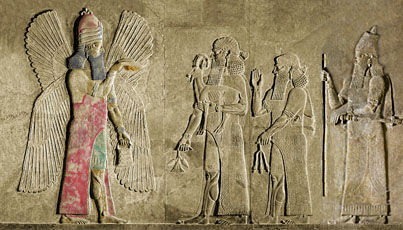
Enki. The Winged Disk. Urartu.
Expanded April 2014
Hero of
the Rebellion
If
one
had to pick the most valiant person in our planet's history it would
have to be Van. Even today if you look at a map of present day Turkey
you will see
Lake Van. Its ancient name immortalizes Van the steadfast. The kingdom
of Urartu translates as “the kingdom of Van." It is
one of the possible locations where the Tree of Life was guarded for
millenniums waiting for the arrival of Adam and Eve. At the outbreak of
the rebellion Van and his followers removed the Tree of Life from
southern Mesopotamia and transplanted it to somewhere in the mountains
of Afghanistan. Later the Tree of Life would be transplanted in an area
of the western part of the Kopet Dagh. This location would become the
eastern most boundary for the later appearing Kingdom of Van. It was
Van
who enlisted and
organized the local inhabitants to help with the creation of the Garden
of Eden. He stood up against Lucifer, Satan and Caligastia - huge
celestial personalities - and defended the divine plan that was to
advance the culture of earth. He and his human associate, Amadon, are
the genii
depicted with the Tree of Life so
familiar across Mesopotamia. There are a number of symbols associated
with Van who as the Sumerian god Enki can be seen in Mesopotamian art,
cosmology and literature. These symbols have been discussed elsewhere
on this site and are presented here again to give the fullest account
that I can on this subject. You may have missed some of it.
A Comparison of Van to the Historical Enki from the Sumerian tablets with my remarks based on the Urantia Book:
Van
as Enki the Serpent
Van may be found in ancient Sumerian texts as the god Enki as
represented as the serpent of Akkadian and Babylonian Ea:
"Professor Kramer on Enki's
fruit tree garden at Eridu, note that Enki (Ea) is described as a
WALKING, TALKING, GREAT USHUMGAL "_SERPENT/DRAGON_," WHO IS _CUNNING
AND
WISE_ AND ASSOCIATED WITH PLANTING A GARDEN OF FRUIT-TREES AT ERIDU
WHERE LIVES ADAPA. Eden's serpent could walk and talk and was
associated with a garden full of fruit trees planted on the earth by
_a_ god (Yahweh) and the serpent (the New Testament's "serpent/dragon")
famed for his "cunning" and "wisdom" (cf. Matthew 10:16 "...be ye
therefore WISE AS A SERPENT..."). Perhaps the mes-tree planted by the
CUNNING and WISE GREAT USHUMGAL has been transformed by the Hebrews
into the "Tree of Knowledge of Good and Evil"?
"Lord who walks nobly on heaven and earth, self-reliant,
father Enki, engendered by a bull,
begotten by a wild bull...king, who turned out the mes-tree in the Abzu,
raised it up over all the lands,
GREAT USHUMGAL,
who planted it in Eridu-
its shade spreading over heaven and earth-
A GROVE OF FRUIT TREES stretching over the land...
Enki...lord of wisdom...you have given the people a place to live...you
have looked after them...
Enki, king of the Abzu, celebrates his own magnificence
as is right...
I AM CUNNING AND WISE IN THE LANDS...
I am lord, I am the one whose word endures.
I am eternal..."
(pp. 39-41. "Enki and Inanna: The Organization of the Earth and Its
Cultural Processes." Samuel Noah Kramer and John Maier. Myths of Enki,
the Crafty God. New York & Oxford. Oxford University Press.
1989)
Note: Another hymn speaks of the mes-tree as being "the flesh of the
gods." Perhaps what is meant is that at times statues of the gods were
carved from its wood ? If so, then to the degree that gods were
understood to be "immortal" the mes-tree would be associated with
"immortality"? That is to say the mes-tree might be what is behind
Eden's "Tree of Life" which confers immortality on human flesh ? The
above hymn's mention of a "grove of fruit trees" planted by Ea the
Ushumgal at Eridu, may be the source of Genesis' notion that Adam and
Eve have access to fruits from trees planted by God in his garden
before their creation."
(http://www.homestead.com/bibleorigins*net/AdapaAdam.html)
This was the first definite connection I had seen between Van and Enki. Although I have long suspected that it was so. One reason is that Enki favored mankind, Enlil did not. Enki and Enlil in the Sumerian pantheon are half brothers. The UB does not state whether or not Van and Nod were brothers. Almost certainly not. One meaning of their "sibling" animosity could be that they represent the split at the time of the rebellion. It was the time of choosing which side you were on. So important was the value of choice - free will - that only after the very last person declared their choice did the rebellion officially begin. That debate between the loyalists and those seeking independence lasted seven years. After that is when those who remained loyal and chose to leave were transported back by the seraphim. The system circuits went silent earlier when the declaration was first made, so there was no outside counsel or help during this time of debate. The planet was in isolation and still is. It was abrupt. Even visitors marooned here due to that loss of communication had to choose which side they supported. Van and Nod at this point probably did not particularly like one another. That's understandable being on opposite sides of the rebellion. Another reference to this "family split" may be found in the different mother's theme. Enlil was the elder son with Enki his junior. In Sumerian mythology (according to one myth) Ki was Enlil's mother and Antu was Enki's mother. Both mothers were the sisters/wives of An. However, Antu was the senior sister mother of Enki and there's the rub. Does higher authority flow through the differing status of the sisters or through the first born? Very clever, for stories written five thousand years ago. It went to the first born, Enlil. The top three gods of the Sumerian pantheon are An with his sons Enlil and Enki. So, Enlil is considered above Enki in rank.
The
above excerpt by Kramer has to do with two things. The
first is the planting of the Tree of Life but known as the
Tree of Knowledge - the mes-tree
- by Enki. And second, in reference to that tree, he is the walking,
talking serpent who is all wise and "one whose word endures." He is not
the serpent who tricks Adam and Eve to eat the fruit of the forbidden
tree that became known as the Tree of Life. What is confusing to
scholars is that the mes-tree is actually
the Tree of Knowledge and the Tree of Life. It is Enki's association
which has to do with knowledge (as keeper of the mes) and that
he did plant the Tree of Life in the Garden that causes confusion.
Van
as Enki the god
• Enki possessed the secrets of
the me, the divine laws, leading humanity towards
knowledge.
It
was
Van who was the keeper of the divine law. Only Van had that authority
as he was the titular head of the planet. The
me (pronounced
may) were the evidence of art, culture and
learning. Through these decrees is civilization imparted to the world.
At the onset of the rebellion it was Van who rose to leadership
defending the divine plan and remaining loyal to the universe
government while Lucifer and his closest followers riled against those
"foreign potentates," the
Ancient of Days, as interfering in the affairs of the planet.
Fortunately Van did not have to do all of this alone. He was ably
assisted by a small group of human and divine personalities including
twelve Melchizedeks. It is important to note here that the Amadonities,
named after Amadon, are very crucial to understanding the
origins
of the legends pertaining to the Tree of Life, the person of Van, the
Anunnaki and the events surrounding the rebellion. They are the
indigenous human
carriers of this Andite legend who were in the service of Van at that
time.
The other half of the carriers of the legend are the Nodites, the
Nephilim, those "mighty men and heroes of old." At ten thousand years
after the rebellion these two groups, between which there was much
animosity, lived in separate areas. According to the UB the Vanites
lived north of Mesopotamia while the Nodites lived in a region south of
the Caspian sea (the present day location of Tehran capital of Iran)
and on to the Lake Van area. Just something to think about: this area
today is where many of the Kurds live. Although their traditional range
of occupation has been diminished, particularly by those from Iran,
they are still considered living where the UB says the Nodites lived.
One group within the Kurds cling to a very ancient religion called
Yezidism where they worship the chief angel Malak
Tâwus
better known as Lucifer. (See page Lucifer for more details)
• Enki was associated with plants and trees, in
particular the mes-tree (he planted a mes-tree in Inanna's garden).
Van
was the only one allowed possession of the Tree of
Life with and under the protection of the midwayers. At the time of the
Lucifer Rebellion he and his followers took a cutting from the Tree
with them to the temporary location in the mountains of Afghanistan.
Van eventually replanted it in the vicinity
of the Kopet Dagh.
The location given by the UB is east of the southern end of the Caspian
Sea and a short way up into the foothills. Immortality was granted to
Van and Amadon by
being
able to process the energy from the fruit of the Tree of Life (and with
the help it seems of the Melchizedeks). This is
the main reason the iconography of the Tree of Life was so strong
throughout this region and later influencing the Sumerians, Akkadians,
Assyrians and Babylonians. Another point to consider is that this area
is adjacent to the later appearing trade route the Silk Road. The
legend of the Tree of Life was never
forgotten.
From
the
myth of Inanna
and the Huluppu Tree:
"...
At that time, it was planted, a tree, a single tree, by the banks of
the Great River,
Enki, the Father, did plant the Huluppu-tree,
The God of Wisdom, he planted it by the banks of the Euphrates,
Before he set sail, before the Father departed for the underworld.
...The
whirling South Wind arose and blew upon the tree,
Pulling at its roots and ripping at its branches,
Until the waters of the Euphrates carried it away.
A young woman who walked in fear of no man,
and would not be owned,
Plucked the tree from the river and spoke:
'I shall bring this tree to Uruk.
I shall plant this tree in my holy garden.'"
From the quotes above Enki plants a tree on the banks of the Euphrates river. The tree is uprooted and transplanted in Inanna's "holy garden." When the Caligastia 100 first arrived in the land that was to become Mesopotamia, the Tree of Life was planted to provide the energy of immortality for the 100. It did grow for a very long span of time. At the outbreak of the rebellion Van "uprooted" the tree and carried it eventually to the northern mountains were it would be much later transplanted into the Garden of Eden. Here Enki is noted as planting the Huluppu tree the Tree of Life as a single tree. The sequence is correct: first planted by a Great River, then uprooted and finally replanted in Inanna's holy garden. So the ancients did account for the time between the onset of the rebellion and the Garden of Eden. Also, in this epic is the all important connection of the Huluppu tree to Enki.
• Enki
was tricked by Inanna into giving her the me.
Van when he met with Adam and Eve did in fact hand over the "me". He
relinquished his titular authority to the new world rulers.
Technically, it was the Melchizedeks who formally installed Adam and
Eve. This event was recorded in the Sumerian myth of Inanna and the
God of Wisdom:
"...
Enki and Inanna drank beer together.
They drank more beer together.
They drank more and more beer together.
With their bronze vessels filled to overflowing,
With the vessels of Urash, Mother of the Earth,
They toasted each other; they challenged each other.
Enki, swaying with drink, toasted Inanna:
"In the name of my power! In the name of my holy shrine!
To my daughter Inanna I shall give
The high priesthood! Godship!
The noble, enduring crown! The throne of kingship!"
Inanna
replied:
"I take them!"
This
continues until a drunken Enki gives all the mes to Inanna. Then
Inanna
takes the mes
to Uruk in her Boat of Heaven. After Enki realizes what
has happened he tries in vain to recall the mes. The last lines
has
Enki graciously giving Inanna the mes:
"Then
Enki spoke to Inanna, saying:
"In the name of my power! In the name of my holy shrine!
Let the me you have take with you remain in the holy shrine of your
city.
Let the high priest spend his days at the holy shrine in song.
Let the citizens of your city prosper.
Let the children of Uruk rejoice.
The people of Uruk are allies of the people of Eridu.
Let the city of Uruk be restored to its great place.""
• Enki
was considered a benevolent god.
It
is
quite evident that Van was a benevolent leader. The Nodites were known
for their belligerent behavior. After all they split further into three
smaller groups after falling into quarrellings with one another. So
fierce was the in-fighting that they almost decimated one another. It
is for this reason that one group, the more moderates, left the "Land
of Nod," ventured up northward following the Euphrates to become the
western Syrian Nodites.
• Enki saved humanity from the flood.
Although Van had nothing to do with saving humanity
from a flood the sentiment is appropriate. Van was long gone at the
time of the flood.
• Enki in one of the myths is involved with the
creation of the first humans.
I think this myth of Enki creating the first humans may
be
because of the relationship he had with the Tree of Life. The oldest
account from the Eridu
Genesis
found at Nippur has Enki telling Ninmah (aka Ninhursag and sister of
Enlil and therefore sister to Enki) to pinch off a piece of clay from
the top of the Abzu. According
to Sumerian accounts the Abzu is home to Enki which metaphorically is
located beneath the world tree, the axis mundi - the
Tree of Life. This is not the only god to create humans. Marduk the
Babylonian god and Enlil have this human creation story attributed to
them as well.
• Enki's holy number is 40 (as Ea - Babylonian).
This is truly odd. The number of the faithful was forty, the number of
the rebels is sixty which is Anu's holy number. Anu is of course the
head god of the Anunnaki - the Watchers - the fallen. Enlil's was 50.
These numbers are a numeric value of rank within the Great Circle of
Gods of Heaven and Earth, which is the Supreme Pantheon of the twelve
great deities.
(http://www.bibliotecapleyades.net/sitchin/planeta12/12planeteng_04.htm)
• Enki
was associated with the written word.
Fad under
Van was
the teacher of the written word. And as it becomes
more apparent it is in this region about Lake Van that the first
glimmer of writing is found. There are other locations that also claim
having the first writings. True writing came into existence long after
the departure of Van. There was writing at the time of the Garden of
Eden but was lost to paleolithic antiquity only to surface again with
the Sumerians.
"Enki
is regularly given the epithet "LORD OF WISDOM"...we have chosen to
avoid "wisdom" when the Enki stories seem to demand shrewdness and
cunning, the arts of the trickster. Enki astonishes even the other gods
with shocking solutions to apparently impossible problems...Perhaps
"crafty" is the better term to use for the problem-solving Enki...In
particular, Enki is the father who imparts knowledge to his son. Enki
was, perhaps more than any other ancient deity, essentially identified
with the spoken and the written word."
("Introduction."Samuel
Noah Kramer and John Maier. Myths of Enki, the Crafty God. New York
& Oxford. Oxford University Press. 1989 p. 5)
• Enki
had an assistant named Isimud his minister, vizier and friend. Isimud
is represented with two faces just as Janus is today.
Van also had an assistant named Amadon who was a modified human. Both
Van and Amadon were sustained by the Tree of Life. Amadon was of two
natures, the divine (through modification) and human. There is no
indication that Enki's vizier is a god or even an Anunnaki, just his
messenger. Amadon was neither a god or of the Anunnaki. He was the
human assistant to Van.
• Enki was associated
with Dilmun the "Sumerian Paradise."
Actually there are two Dilmuns in the Sumerian
texts. One
contains a paradise-like narrative and the other is a real place of
commerce. The paradise of Dilmun is unrelated to the Biblical garden
with differences on many issues. Enki has multiple points of contact
with this Dilmun including bringing water to make it flourish, giving
it to his daughter who becomes its goddess and having sex there with
his
(supposed) wife Ninhursag which leads to the story of the plants that
make Enki ill. The paradise-like Dilmun is the ancient
memory of Dalamatia. Van did live there in its earliest days only
moving east at the time of the rebellion. In the epic Enki and Ninhursag
Enki gives Dilmun to Ninkurra his daughter which is something like when
he gave the me
to Inanna his daughter in a different epic. Of all the gods it is Enki
that has the closest affiliation with Dilmun. Also, Isimud Enki's
friend and servant is included in the epic. In Dalamatia the original
city of the celestials, the Anunnaki, Amadon did live with Van as his
associate and helper just as with Isimud and Enki.
From
the epic Enki and Ninhursag:
"Pure are the cities
— and you are the ones to
whom they are allotted. Pure is Dilmun land.
Pure is Sumer — and you are the ones to whom it
is allotted. Pure is Dilmun land. Pure is Dilmun
land. Virginal is Dilmun land. Pristine is Dilmun
land.
After Time had come into being
and the holy
seasons for
growth and rest were finally known,
holy Dilmun, the
land of
the living, the
garden of
the great gods
and earthly paradise, located
eastward in Eden,
was the
place where
Ninhursag,
the exalted lady,
could be found. "
Van
and the Indus Valley
 Van
with the rest of the loyalists settled originally in the highlands west
of India known as Afghanistan and just west of what would become to be
known as the Indus Valley.
Sometimes this area of India is referred to as the Punjab. Today it is
known as Pakistan. Outposts of the Indus
Valley civilization reached as far north as the Oxus River in
Afghanistan. This
civilization
is called Harappan
(about 3200–2600 BC for pre Harappan, c. 2600-1900 B.C. for
Harappan) stands with Sumer and Egypt as one of the oldest. The
civilization of the Indus Valley was ruled by commerce and religion
- not by military strength. There is no evidence of the ritual fire
altars as found with Mesopotamian civilizations neither can any public
building yet found be determined as a temple. Religious practices are
implied mainly from figurines such as female goddesses and the
bull horned male figures. The Harappans did bury their dead with
provisions for the afterlife. The Pipal tree was used as a religious
symbol (later known as the Bodhi tree under which the Buddha gained
enlightenment). As
of yet the written language of this civilization has not been
deciphered. It would be the later appearing Andites that most likely
had the greatest effect on those early peoples. This civilization is
called Harappan but the political
center seems to have been at Mohenjo-Daro, Harappa's sister city to the
south. The
Aryan invaders disrupted much
of the agricultural advancements of the later Harappan culture and
may have led to its ultimate decline along with deforestation and with
other natural disasters.
Van
with the rest of the loyalists settled originally in the highlands west
of India known as Afghanistan and just west of what would become to be
known as the Indus Valley.
Sometimes this area of India is referred to as the Punjab. Today it is
known as Pakistan. Outposts of the Indus
Valley civilization reached as far north as the Oxus River in
Afghanistan. This
civilization
is called Harappan
(about 3200–2600 BC for pre Harappan, c. 2600-1900 B.C. for
Harappan) stands with Sumer and Egypt as one of the oldest. The
civilization of the Indus Valley was ruled by commerce and religion
- not by military strength. There is no evidence of the ritual fire
altars as found with Mesopotamian civilizations neither can any public
building yet found be determined as a temple. Religious practices are
implied mainly from figurines such as female goddesses and the
bull horned male figures. The Harappans did bury their dead with
provisions for the afterlife. The Pipal tree was used as a religious
symbol (later known as the Bodhi tree under which the Buddha gained
enlightenment). As
of yet the written language of this civilization has not been
deciphered. It would be the later appearing Andites that most likely
had the greatest effect on those early peoples. This civilization is
called Harappan but the political
center seems to have been at Mohenjo-Daro, Harappa's sister city to the
south. The
Aryan invaders disrupted much
of the agricultural advancements of the later Harappan culture and
may have led to its ultimate decline along with deforestation and with
other natural disasters.
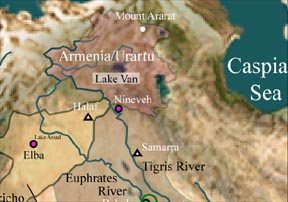 There
is evidence that it was in the mountains and plateaus north of
Sumer where the earliest achievements would have an impact on the
Sumerians. The area around Lake Van is rich in volcanic minerals which
were converted into metal implements of art and war making
them into a very powerful nation. As mentioned
before the first of the Sumerian words may have been discovered in this
region. Loan words from these highlands did enter into the Sumerian
vocabulary. The start of agriculture also had its roots in eastern
and central Anatolia. Also the UB states that the Andites
emerged from the
population on the far edge of the Mesopotamian landscape. Looking at
map of the fertile crescent this area would
substantiate that claim. Another thing about this area north of Sumeria
is where the Sumerians themselves said they came from. It is from the
Epic of Gilgamesh that mentions Aratta. Written and composed between
2,700 and 600 BC, which include both Sumerian and Babylonian tablets,
it predates the historical name Urartu. Aratta is generally assumed to
be the
Armenian highlands. From the
archaeological evidence man has been in Mesopotamia and beyond almost
from the beginning.
Not only early human remains have been unearthed but Neanderthal and Homo erectus as
well. Given that I think we can deduce that the Sumerian have always
been in Mesopotamia but that the Andite culture that came from the
north reinforced existing Sumerian culture.
I see it as new blood which indeed they were. You have two game
changing developments coming from these northern
highlands. Agriculture and metal. A third would be astronomy with the
assumption if you have astronomy you also have math. Although there
seems to be a precursor to writing in the forms of scripts true writing
is Sumerian. Writing is the fourth pillar of the Sumerian civilization.
There
is evidence that it was in the mountains and plateaus north of
Sumer where the earliest achievements would have an impact on the
Sumerians. The area around Lake Van is rich in volcanic minerals which
were converted into metal implements of art and war making
them into a very powerful nation. As mentioned
before the first of the Sumerian words may have been discovered in this
region. Loan words from these highlands did enter into the Sumerian
vocabulary. The start of agriculture also had its roots in eastern
and central Anatolia. Also the UB states that the Andites
emerged from the
population on the far edge of the Mesopotamian landscape. Looking at
map of the fertile crescent this area would
substantiate that claim. Another thing about this area north of Sumeria
is where the Sumerians themselves said they came from. It is from the
Epic of Gilgamesh that mentions Aratta. Written and composed between
2,700 and 600 BC, which include both Sumerian and Babylonian tablets,
it predates the historical name Urartu. Aratta is generally assumed to
be the
Armenian highlands. From the
archaeological evidence man has been in Mesopotamia and beyond almost
from the beginning.
Not only early human remains have been unearthed but Neanderthal and Homo erectus as
well. Given that I think we can deduce that the Sumerian have always
been in Mesopotamia but that the Andite culture that came from the
north reinforced existing Sumerian culture.
I see it as new blood which indeed they were. You have two game
changing developments coming from these northern
highlands. Agriculture and metal. A third would be astronomy with the
assumption if you have astronomy you also have math. Although there
seems to be a precursor to writing in the forms of scripts true writing
is Sumerian. Writing is the fourth pillar of the Sumerian civilization.
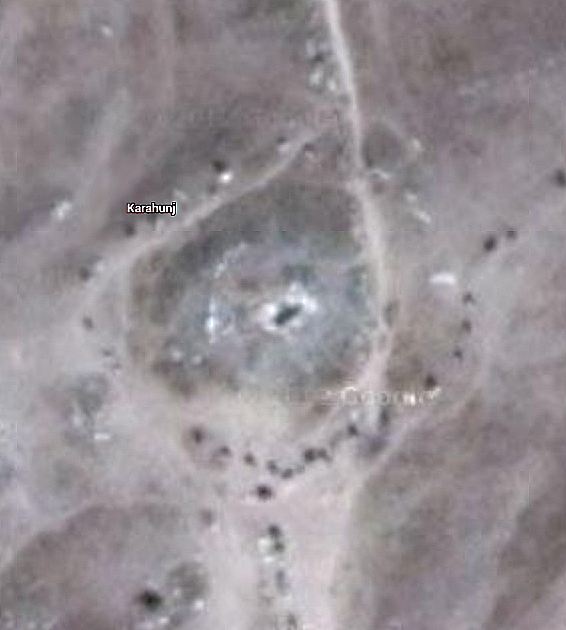 One
comment on astronomy. There is an observatory called Karahunj. It is a
circle of rocks laid out for examining and measuring the skies
much on the order
of Stonehenge only much older. It is the oldest stone circle in this
capacity that we know of. Some scholars have remarked on the similarity
of "hunj" and "henge" in reference to this type of structure and that
these words may be
related.
One
comment on astronomy. There is an observatory called Karahunj. It is a
circle of rocks laid out for examining and measuring the skies
much on the order
of Stonehenge only much older. It is the oldest stone circle in this
capacity that we know of. Some scholars have remarked on the similarity
of "hunj" and "henge" in reference to this type of structure and that
these words may be
related.
"The
oldest
known observatories are located in Armenia. Dated as early as 4200 BCE,
Karahunj and the ca. 2800 BCE observatory at Metsamor allowed Ancestral
Armenians to develop geometry to such a level they could measure
distances, latitude and longitudes, envision the world as round, and
were predicting solar and lunar eclipses about 1000 years before the
Egyptians began doing the same."
(hyeforum.com/index.php?showtopic=39602)
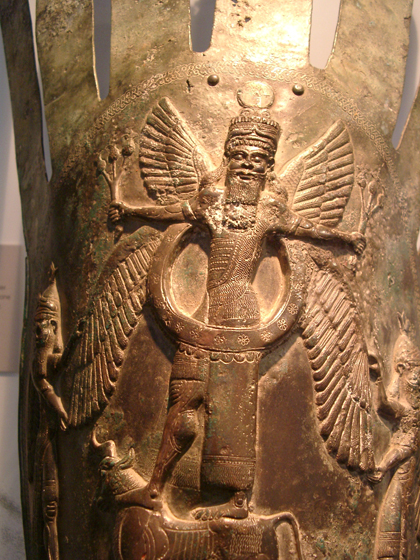 The
image to the left is from Urartu, the kingdom of Van, and shows a
figure of divinity
atop a bull. He wears the horned cap of divinity, has the wings of
divinity, a pattern of rosettes the symbol of the Tree of Life
surrounds him, holds the 3 segmented fruit from the Tree of Life and on
top of his cap is a representation of the winged disk. Each of the
fruits is debossed with a rosette. This is the ultimate image of
divinity. There is only one person who could be surrounded by these
icons and that is Van.
One of the most interesting
features of this
metal relief is the rim which the figure stands within.
The
image to the left is from Urartu, the kingdom of Van, and shows a
figure of divinity
atop a bull. He wears the horned cap of divinity, has the wings of
divinity, a pattern of rosettes the symbol of the Tree of Life
surrounds him, holds the 3 segmented fruit from the Tree of Life and on
top of his cap is a representation of the winged disk. Each of the
fruits is debossed with a rosette. This is the ultimate image of
divinity. There is only one person who could be surrounded by these
icons and that is Van.
One of the most interesting
features of this
metal relief is the rim which the figure stands within. 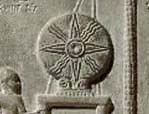 Notice
how the
wings are attached to the rim rather than directly to the figure.
This same arrangement is how the winged disk is represented.
The
Assyrians
show Ashur
their national god in much the same way.
The circular rim with attached wings is a representation of the winged
disk and is called the solar disk. I do not believe that the winged
disk and the solar disk, like the symbol of Shamash, are the same thing
but those in academia do. There
is a purpose in the obvious
difference between them. But these two images are related and can be
shown to have
the same source. Although
I believe this image is related to the legendary person of Van and
after all I have said regarding it - it is more
than likely in this context to relate to the third person of the
Urartian pantheon Shivini. The
real sun disk, the sun disk of Shamash, is the smaller image of the
stone disk. Look closely and you can see the rim with what appears as
an empty center. There are pros and cons as to who is the origin of Shivini. Later I will address this question.
Notice
how the
wings are attached to the rim rather than directly to the figure.
This same arrangement is how the winged disk is represented.
The
Assyrians
show Ashur
their national god in much the same way.
The circular rim with attached wings is a representation of the winged
disk and is called the solar disk. I do not believe that the winged
disk and the solar disk, like the symbol of Shamash, are the same thing
but those in academia do. There
is a purpose in the obvious
difference between them. But these two images are related and can be
shown to have
the same source. Although
I believe this image is related to the legendary person of Van and
after all I have said regarding it - it is more
than likely in this context to relate to the third person of the
Urartian pantheon Shivini. The
real sun disk, the sun disk of Shamash, is the smaller image of the
stone disk. Look closely and you can see the rim with what appears as
an empty center. There are pros and cons as to who is the origin of Shivini. Later I will address this question.
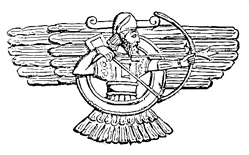 The Assyrian god
Ashur inside the
rim of the winged disk. Note the arrowhead. It is
the fleur-de-lys. He is a sun god. The Assyrian god
Ashur inside the
rim of the winged disk. Note the arrowhead. It is
the fleur-de-lys. He is a sun god. |
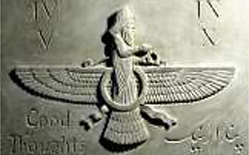 This
example from Iranian art (Zoroastrian) is
known as the
"Faravahar". The root word This
example from Iranian art (Zoroastrian) is
known as the
"Faravahar". The root word for Faravahar is khvarenah which means "shining" another word for the sun. Another origin for Faravahar is "I choose." The Faravahar is the visual aspect of Ahura Mazda the "wise lord" the one God. He is not a sun god. |
The
Name Van - A Brief History of the City and Influences
Right
now the history of civilization in Anatolia begins at a place called
Göbekli Tepe
weighing in at 9000 BC. It predates just about everything
except
maybe astronomy. It is south west of Van at about 450 miles. It may
have actually been a part of the Urartian empire at its greatest. It
has been called the worlds first temple and clearly shows an example of
pre-civilization. Those who carved the stones did not merely carve into
the stone they did it in bas
relief. This
is much more sophisticated than you would expect Neolithic hunters to
be
capable of. It appears the roots of civilization go much deeper in time
than what we have been taught. The markings on the T shaped monumental
supports are almost certainly constellations with other sky related
aspects.
The
next date is for the observatory of Karahunj at about 5500 BC.
according to Gerald. S. Hawkins. In this area are megalithic monuments
such as the standing menhirs and dolmens. Located just north of Sisian
it
is east of Van, north of lake Urmia and close to the border with
Azerbaijan. It is in Armenia.
Next date would be 5000 BC. The archaeological evidence indicates an ancient history from the Van Province at the Tilkitepe Mound near Lake Van. It is the only source of information about the oldest culture of Van. These very early people could be the ancestors of the Nairi tribes. We do not know. Pottery found is similar to the pottery found at Tel Halaf in Syria which is south just across the border. It comes from the oldest strata and represents a Halaf culture at early Van. The next strata up would represent a time contemporary with the Ubaid culture in very southern Mesopotamia. The Ubaid mound is within sight distance of Ur. With this ancient pottery is associated the trade in obsidian. This trade was quite extensive and as the history of commerce goes I would put it in importance only second to red ochre of which tons upon tons were mined in the Paleolithic. Another thing about the obsidian trade is that one major avenue was due south all the way to Egypt. It became later known as part of the "Kings Highway" and wars were fought to control its riches. Archaeologists and others would use the term Levantine Corridor for the length of this route. With early obsidian we are at a period known as PPNA which stands for Pre-Pottery Neolithic "A" 9500 - 8500 BC. The date for Tel Halaf is 6100 - 5400 BC which is very close to the assumed date of the beginning of pottery that is about 6000 BC. So perhaps the 5000 BC date could be older but it is still in the ballpark. At 5000 BC there would have been pottery available.
"With
the aid of these archaeological criteria, Reade as well as Michael Roaf
(archaeologist and former director of the British School of Archaeology
in Iraq, and now at the University of California, Berkeley) have
determined the boundaries of Halaf culture. They coincide almost
exactly with the area ethnic Kurds still call home: from Kirmanshah to
Adyaman, and from Afrin near the Mediterranean Sea to northern areas of
Lake Van. The distribution of Halaf pottery and the distribution of
ethnic Kurds today are a near-perfect match."
(http://www.xs4all.nl/~tank/kurdish/htdocs/his/orig.html)
Aratta
- Gilgamesh could be as early as 2700 BC. from the Sumerian records but
unconfirmed as to when written. Later Urartu would also be referred to
as Aratta by the Hebrews. Of all the names for this region Ararat would
be the most important and the most ancient. Those followers and their
descendants of Van believed that Van and Amadon were taken to heaven
while alive and while in worship from Mount Ararat. (UB p. 860)
"Enmerkar, the
grandfather of
the hero Gilgamesh lived around 2,750 BC and the King of Aratta through
his herald sent a message to Enmerkar stating that Inanna had not
abandoned neither Aratta nor her house therein — the Ziggurat
Temple that was a primordial astronomical observatory and an origin
site of metal smelting foundries…"
(http://narinnamkn.wordpress.com/2012/11/29/armenian-wheel-of-eternity-six-pointed-star-svastika/)
The
earliest name we have from Assyrian history for this region is "People
of the Nairi" at or about 2000 BC. and somewhat later the name Uruatru.
"In
an inscription of the Assyrian Assurbelkala (1077‑1060 B.C.), first
appears the name Uruatru."
(http://penelope.uchicago.edu/Thayer/E/Gazetteer/Places/Asia/Armenia/_Texts/KURARM/7*.html)
"Tushpa
(Armenian: Տոսպ Tosp, Assyrian: Turuspa, Turkish: Tuşpa) was the
9th-century BC capital of Urartu, later becoming known as Van.
(http://en.wikipedia.org/wiki/Tushpa)
Tushpuea
is an Araratian (Urartian) goddess from which the city of Tushpa
derived its name. She may have been the wife of the solar god Shivini
as both are listed as third, in the list of male and female deities on
the Mheri-Dur inscription. It is hypothesized that the winged female
figures on Urartian ornaments and cauldrons depict this goddess."
(http://en.wikipedia.org/wiki/Tushpuea)
A
deviation by Tiglath-Pileser III is
Turupas. He was an Assyrian King at the time of Sarduri 2 King of
Urartu. At this time the Urartian capital was named Dhuspas by
the Urartians, which is very important.
"The
country is called Biaina or Biana in the [Vannic] inscriptions, and the
name
given to its capital, the present Van, is Dhuspas or Dhuspaes."
(The Cuneiform Inscriptions of Van
Deciphered and Translated "Published
in the Journal of the Royal Asiatic Society (1882, NS. vol XIV, pp.
377-732) by Archibald Sayce, the renowned Assyriologist and linguist
(1846-1933). Sayce was the first to decipher the language of the Van
inscriptions, now called Urartian, and which he termed
Vannic." (https://archive.org/details/TheCuneiformInscriptionsOfVanDecipheredAndTranslated
P.
338 Sayce)
But the Assyrians did not
call this region Biaina and Urardhu is not
found in the Vannic inscriptions. The closest name in Assyrian
inscriptions is Mannai. But this is not a reference to Biaina. There
is one name that is found in Assyrian which is Bitanu/Bitan or Bit-ani
- "the house of Anu." Later the
capital city became known as Van which comes from the
native name Biaina. At the
time the Urartians referred to themselves as the Biainili. Another
name for Van is Thospia
a name that comes from Ptolemy. Just
in case you run across it. Thospia is probably just a Hellenized
version to the Assyrian Tushpa. This brings us to the Classical Period
as Ptolemy was a Greco-Roman writer from Egypt.
The classical writers would have known of Semiramis who we encounter
now as the story
continues.
The very beginning of this story begins with the early Greek writers who wrote of the legendary Assyrian Queen Semiramis married to King Ninus. This is legend as King Ninus is not listed in the Assyrian kings list. Even so she was very famous in antiquity and it is said ("Diodorus Siculus (Library of History), a Greek historian about the same time as Julius Caesa") that her name was on the gate of Babylon (read here: the Gate of Ishtar). This queen has quite an exaggerated and tangled history, even as the Queen of Babylon, but we are only interested in her connection to Urartu. One legend of Semiramis concerns an Armenian king named Ara who she fell in love with. But it was not reciprocated as he was married and thus being spurned, this great, beautiful and legendary Assyrian Queen went to war during which Ara was killed. The myth continues with Semiramis tricking the Armenians into thinking that her gods had brought him back to life. There is a Mesopotamian connect in all of this. "At Tushpa, the Babylonian goddess, Ishtar, the mother-goddess and the embodiment of the reproductive energies of nature, was worshipped in her own right. She was called Sari and, in course of time, she appears in the legends of Indo-European Armenia of Semieramis or Shamiriram" (The Kingdom of Armenia, A History, M. Chahin, Curzon Press copyright 2001 p.144) Ishtar is the Babylonian goddess who in Sumerian is Inanna.
"The Armenians called Van "the
city of Šamiram," "built by
Šamiram," while in Urartu it was called Tušpa and
was the
worship center of the goddess Tušpuea, the wife of the sun
god,
which testifies to the heredity Tušpuea -
Šamiram. One of
the two historical prototypes of the mythical
Šamiram/Semiramis
was Nak‟ia, the wife of the Assyrian king Sennacherib. 68 She directly
corresponds to Covinar, the progenitress of the daredevils of Sasun,
the wife of Senek„erim (= Sennacherib). Thus, the great gods
of
the Urartian epoch survived in the epic tradition of the south of
Armenia."
(http://www.scribd.com/doc/87090471/STATE-PANTHEON-OF-GREATER-ARMENIA)
This Greek legend of Semiramis lead the French into believing that some of the places mentioned must still be in existence. In 1826 the French Asiatic Society sent Prof. Fr. Ed. Schulz, a young German scholar, to Armenia to investigate. Schulz visited Van and its neighbors and discovered forty two inscriptions. They were published in 1840 but not by Schulz who unfortunately was murdered and never returned. Thirty nine of these inscriptions were of unknown origin. And that is the beginning of the discovery of the civilization of Urartu.
The Assyrians were the direct descendants of the mixed Vanites and western Syrian Nodites. (UB p.859) In fact, the area that the original Vanites inhabited was adjacent to or overlapped the kingdom of Assyria in the Paleolithic. The capital of Assyria, Nineveh, was next to the boundaries of Urartu from which Armenia emerged. So, the Assyrians could be the last of the people who were followers of Van. However, the term "Vanites" is cultural and not racial. It would be more accurate to say Nodites - who were also followers of Van. I would caution from drawing the conclusion that these early Vanites/Nodites are the later appearing Urartians even if it could be true (but probably is). A chasm of time has intervened between the times of Van and the emergence of the "kingdom of Van" Urartu. Urartu is considered an Iron Age civilization and therefore if we use the first historical reference of the kingdom of Urartu at 883 BC then they are "late comers." Egyptian dynastic rule starts around 3000 BC, Assyria 2200 BC, Babylon 1830 BC and Sumeria 4100 BC for the Uruk Period/5300 BC if we include the Ubaid Period but they are considered as pre-Sumerian. If we look at the time line of the Vanites at the time of Van's departure we are looking at about 36,000 BC. So at the most modest speculation we are talking about is a period of roughly 30,000 years which is plenty of time for change. At the time of the establishment of Urartu major groups of people were already settled in the area such as the Assyrians, Hittite descendants, Mitanni (now considered as the Hurrians) and the Subarians. From what linguists have learned the Urartians were speaking a Hurro-Uratian language, one that had a strong Hurrian influence. The languages and cultures change but the base legend does not which is so old it predates all history. It is because of the veneration of this distant history that it survived across multicultural boundaries. Which is why I think it is indigenous to these various peoples and not "myths" that are borrowed. That observation answers the question of the homogeneous nature of the various pantheons. The name Van emerges in modern times because of the Armenians who inherited the lands of Urartu."Armenians called that city "Van". It came from the word Biayna (which was the central region of Urartian kingdom). In Armenian the meaning of Van is "a place of living", "settlement". Therefore other Armenian cities which were established later had in the end of their names the word "Van" (Ervand-a-van, Arshak-a-van, Zareh-a-van, Nakhch-a-van, Vane-van, etc)."
(http://www.armenian-history.com/Capitals/Tushpa_Van_History_eng.htm)
Armenia and a
History of Flags
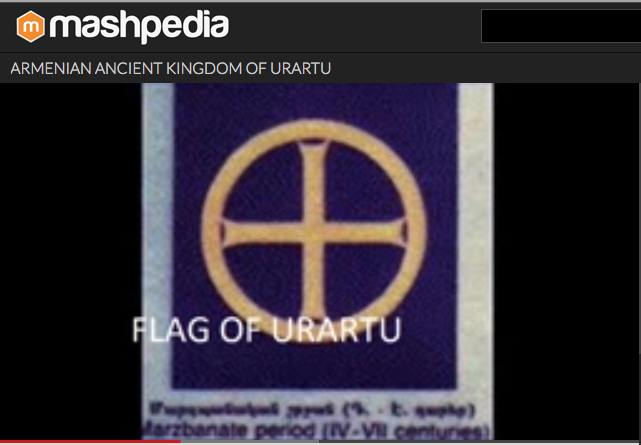 I ran into to this
graphic the "Flag of Urartu" to the left while looking for more
evidence of Enki as Van through an Armenian connection. What
is interesting is that it is very difficult to find any information
about this image. It is a screen shot from an Armenian video. As far as
I have investigated there is no historical use of the cross in a
circle that
pertains to Urartu. What I did find was a second Flag of Urartu:
I ran into to this
graphic the "Flag of Urartu" to the left while looking for more
evidence of Enki as Van through an Armenian connection. What
is interesting is that it is very difficult to find any information
about this image. It is a screen shot from an Armenian video. As far as
I have investigated there is no historical use of the cross in a
circle that
pertains to Urartu. What I did find was a second Flag of Urartu:
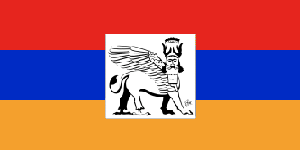 This
flag is called The Flag of Urartu Saint Muhammad. It has the graphic of
a traditional sphinx which looks more Assyrian than Urartian. It is
modern. Urartu is Assyrian and Biainili
is what the Urartians
called themselves. The use of the sphinx is also
depicted in Urartian art on various walls, stone engravings
and jewelry.
This
flag is called The Flag of Urartu Saint Muhammad. It has the graphic of
a traditional sphinx which looks more Assyrian than Urartian. It is
modern. Urartu is Assyrian and Biainili
is what the Urartians
called themselves. The use of the sphinx is also
depicted in Urartian art on various walls, stone engravings
and jewelry.
But
getting back to the cross in a circle. As far as the
Sumerians were concerned it is at least one symbol for Enki and that's
why it got my attention. This is
not the conventional Enki symbol as the cross is separate from the
circle.
Notice that the ends of the cross have two small extensions per arm. It
belies a 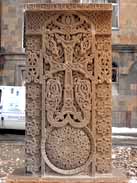 Christian
heritage. The traditional Armenian
Christian cross does have these extensions
Christian
heritage. The traditional Armenian
Christian cross does have these extensions 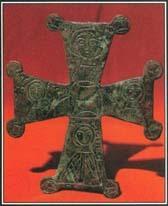 which
are quite prominent.
See to the far left. The one next to it is the equilateral cross just
like
the one in the circle. Eventually I did find one page on the Internet
that
contained information on this flag with its cross in a circle. Turns
out it is
one of a number of flags in the evolution of the Armenian flag. As you
can see it was the flag during the Marzbariate period. The three
previous flag images contained an eagle, lion and dragon. Of these four
symbols three can be traced back to Eden. All four if you include the
sometimes appearing lion at the foot of Inanna. I am not so sure that
those involved in the flag's design (over a long period of time) were
aware of what this group of icons together meant. But the inclusion of
an Enki-like symbol is very interesting. Just to mention something off
topic,
this cross has eight points and so does the splayed cross of the
Templars which some do call it the eight pointed cross. We also know
that this symbol of the cross in a circle is one of the oldest
religious symbols on the planet. But why label this particular flag,
which is Armenian, as the Flag of Urartu? Some background information
is in order. There is and has been for some time a debate (with
expletives) on the "true" history of the origin of the Armenians. I am
neutral on all of this just to let you know. Very very briefly some
Armenians wish to include those of Urartu in their genetic heritage.
There are others who for their own reasons do not. For reasons not
discussed here (involves Babylonian history) they could be right.
Either side could be right. The fighting is
particularly intense between the Armenians and the Turks as expected.
And the
Georgians.
And those from Azerbaijan. The mix of
people (Hurrians, Armen, Nairi and Hay to name a few) that are most
likely in the family tree is impressive, some of which I had never
heard about. So there is a mix of opinions about Armenian history. What
I am driving at is that if you believe the
Urartians are your distant relatives and are associated with Armenia
then naming the Armenian flag as being of Urartu could make sense. For
all I know there may be an attempt to connect the location of Armenia
with the Garden of Eden. There are a number of videos that say just
that with a seemingly academic reason behind it. It should not come as
a surprise then that there is a perceived connection of Armenia and the
Garden in that there is a belief that Armenia was the location for
Eden.
This is a belief that is shared by some non Armenians as well. Don't
forget
Mount Ararat is believed by some as the final resting place for Noah's
ark which is in
Armenia. Still this symbol of the cross in a circle could be just a
strange coincidence. Considering the background of history of this flag
and the symbols used on it there may be more to to this story whether
it be unconscious or deliberate. I offer up this information because I
find it intriguing and you might also.
which
are quite prominent.
See to the far left. The one next to it is the equilateral cross just
like
the one in the circle. Eventually I did find one page on the Internet
that
contained information on this flag with its cross in a circle. Turns
out it is
one of a number of flags in the evolution of the Armenian flag. As you
can see it was the flag during the Marzbariate period. The three
previous flag images contained an eagle, lion and dragon. Of these four
symbols three can be traced back to Eden. All four if you include the
sometimes appearing lion at the foot of Inanna. I am not so sure that
those involved in the flag's design (over a long period of time) were
aware of what this group of icons together meant. But the inclusion of
an Enki-like symbol is very interesting. Just to mention something off
topic,
this cross has eight points and so does the splayed cross of the
Templars which some do call it the eight pointed cross. We also know
that this symbol of the cross in a circle is one of the oldest
religious symbols on the planet. But why label this particular flag,
which is Armenian, as the Flag of Urartu? Some background information
is in order. There is and has been for some time a debate (with
expletives) on the "true" history of the origin of the Armenians. I am
neutral on all of this just to let you know. Very very briefly some
Armenians wish to include those of Urartu in their genetic heritage.
There are others who for their own reasons do not. For reasons not
discussed here (involves Babylonian history) they could be right.
Either side could be right. The fighting is
particularly intense between the Armenians and the Turks as expected.
And the
Georgians.
And those from Azerbaijan. The mix of
people (Hurrians, Armen, Nairi and Hay to name a few) that are most
likely in the family tree is impressive, some of which I had never
heard about. So there is a mix of opinions about Armenian history. What
I am driving at is that if you believe the
Urartians are your distant relatives and are associated with Armenia
then naming the Armenian flag as being of Urartu could make sense. For
all I know there may be an attempt to connect the location of Armenia
with the Garden of Eden. There are a number of videos that say just
that with a seemingly academic reason behind it. It should not come as
a surprise then that there is a perceived connection of Armenia and the
Garden in that there is a belief that Armenia was the location for
Eden.
This is a belief that is shared by some non Armenians as well. Don't
forget
Mount Ararat is believed by some as the final resting place for Noah's
ark which is in
Armenia. Still this symbol of the cross in a circle could be just a
strange coincidence. Considering the background of history of this flag
and the symbols used on it there may be more to to this story whether
it be unconscious or deliberate. I offer up this information because I
find it intriguing and you might also.
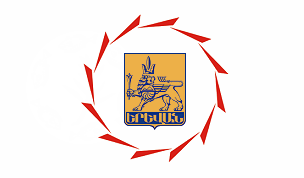
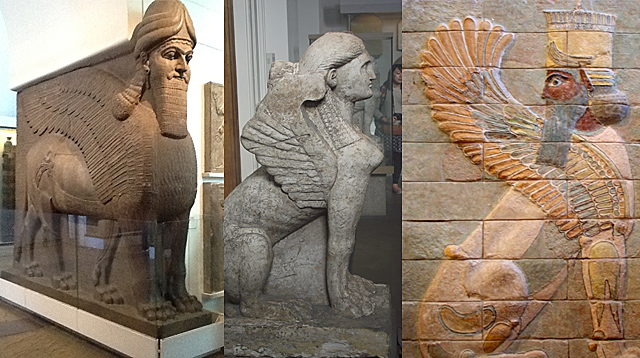 Here
is one last flag. It is the flag of Yerevan which is the capital of
Armenia and is one of the oldest continuously inhabited cities in the
world. As you can see it too has the sphinx at its center. Actually I
began my search into this subject of Enki/Van/Urartu by comparing the
different examples of the sphinx from Babylon, Assyria and Urartu.
General opinion is that these mythological figures represent spirits.
Could be. They do come in a variety such as bulls, women and lions. The
one thing they have in common is their
association with the Tree of Life. Two most telling symbols attached to
the sphinx are the
horned crown and wings. Often you will see rosettes and in the Yerevan
flag and others the fleur-de-lys. All of which comes out of Sumeria -
including
the sphinx. On many Sumerian cylinders you will see the sphinx usually
as a griffin. As to whether these divine inspired figures are
protectors or antagonists is open to interpretation. But they do appear
elsewhere in conjunction with the Tree of Life. Even in Urartu.
Here
is one last flag. It is the flag of Yerevan which is the capital of
Armenia and is one of the oldest continuously inhabited cities in the
world. As you can see it too has the sphinx at its center. Actually I
began my search into this subject of Enki/Van/Urartu by comparing the
different examples of the sphinx from Babylon, Assyria and Urartu.
General opinion is that these mythological figures represent spirits.
Could be. They do come in a variety such as bulls, women and lions. The
one thing they have in common is their
association with the Tree of Life. Two most telling symbols attached to
the sphinx are the
horned crown and wings. Often you will see rosettes and in the Yerevan
flag and others the fleur-de-lys. All of which comes out of Sumeria -
including
the sphinx. On many Sumerian cylinders you will see the sphinx usually
as a griffin. As to whether these divine inspired figures are
protectors or antagonists is open to interpretation. But they do appear
elsewhere in conjunction with the Tree of Life. Even in Urartu.
"The Bronze Age in Armenia is told through the story of the first state forged in the highlands, the kingdom of Urartu. That is the name by which the powerful Assyrians called the region. The Urartians called their country Nairi. The difference in nomenclature has to do with the fact that Urartu started as a confederation of lesser monarchies based in the highlands, with its earliest center, dating back to the 11th century B.C., found west of Lake Urmia (presently northern Iran) possibly based around the temple, later used as a main treasury, of Musasir."
(Historical Dictionary of Armenia, Rouben Paul Adalian Copyright 2010 p. 9)
"Four times in all Adad-niarai invaded what, reviving an old expression, he calls the "lands of Nairi", including in it once again Khabkhu. This text, however is significant as providing the first occasion that Nairi and Ur(u)atri, later Urartu, are mentioned together (as is frequent later) that is, as in some way coexistent but mutually independent, and it certainly seems to show that the original homeland of the people later called Urartians was well to the south-east of Lake Van, an area from which they seem to have moved to concentrate around the more easily defensible area of the lake itself."
(The Cambridge Ancient History III Part 1 The Balkans; the Middle East and the Agean World, Tenth to Eight Centuries B.C. Copyright 1982 Cambridge University Press p. 332)
The Nairi predate the Urartians but the origin of the Nairi (tribes) is uncertain. Another way to deal with classification is linguistic. The Assyrians were Semitic. Those of Urartu were not Semitic, nor Indo-European. Also the language of Urartu does not seem to relate to Armenian which is IE. The earliest known spoken language was Hurrian now extinct which it appears that it was also spoken by those of Urartu which is called Hurro-Urartian.
I could not find any Armenian legends that dealt directly with Enki but I did discover that the Armenian religious vocabulary is almost entirely Iranian with a very strong Zoroastrian influence which also includes a reverence for the Tree of Life. (http://www.iranicaonline.org/articles/armenia-iii) Just as there was a Zoroastrian influence on the Jewish faith during the intertestamental period there was also an influence on religious thinking to the north. It was the Mede who eventually conquered the Urartians. But the IE loan words pre-date the Medes and when they entered the Hurrian lexicon is unknown.
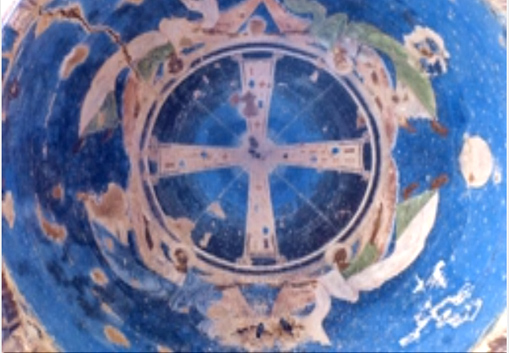 Then
I ran across this photo. It is the ruin of a Georgian
church in Tao-Klarjeti. This picture showed up quite by chance on a
video about ancient Georgian churches and as
you can see it is the same cross as the "Flag of Urartu." Click on it
for a larger view. The cross is known as a budded cross of which there
is a fair number of variations. Now with the same two crosses in a
circle one in Armenia and one in Georgia means it cannot be the flag of
Urartu. It is an early Christian symbol post-Urartu that apparently
existed for
only a short span of time. I say that because there is a long history
and a wide variety of crosses but this particular cross has
practically no information on it. So much for Enki's symbol being a
Urartian symbol. But that is not to say the trail is cold. In Sumeria
they had a triad of gods at the top of their pantheon. They were An,
Enlil and Enki. Enki was third in rank. The Urartians also had a triad
at the head of their pantheon. They were Khaldi (Haldi/Hayk) of Ardini,
Theispas (Teisheba) of Kumenu and Shivini (Artin) of Tushpa. Here's
what interesting. The people of Urartu named themselves after their top
god Khaldi (according to the classical period Greeks) but their capital
city was Tushpa whose patron god was Shivini
- third in line. For me one question is why would you have a
third in line god to represent
your capital city? Famed Russian archaeologist Boris Piotrovsky says
Shivini was a sun god. He is not alone in this assertion. The following
quote is from: http://en.wikipedia.org/wiki/Urartu.
"Shivini or Artinis (the present form of the name is Artin, meaning
"sun rising" or to "awake", was a solar god in the mythology of the
Urartu, a prehistoric Iron Age kingdom. He is the third god in a triad
with Khaldi and Theispas and is cognate with the triad in Hinduism
called Shivam. The Assyrian god Shamash is a counterpart to Shivini. He
was depicted as a man on his knees, holding up a solar disc. His wife
was most likely a goddess called Tushpuea who is listed as the third
goddess on the Mheri-Dur inscription. Shivini is generally considered a
good god, like that of the Egyptian solar god, Aten, and unlike the
solar god of the Assyrians, Ashur to whom sometimes human sacrifices
were made."
Then
I ran across this photo. It is the ruin of a Georgian
church in Tao-Klarjeti. This picture showed up quite by chance on a
video about ancient Georgian churches and as
you can see it is the same cross as the "Flag of Urartu." Click on it
for a larger view. The cross is known as a budded cross of which there
is a fair number of variations. Now with the same two crosses in a
circle one in Armenia and one in Georgia means it cannot be the flag of
Urartu. It is an early Christian symbol post-Urartu that apparently
existed for
only a short span of time. I say that because there is a long history
and a wide variety of crosses but this particular cross has
practically no information on it. So much for Enki's symbol being a
Urartian symbol. But that is not to say the trail is cold. In Sumeria
they had a triad of gods at the top of their pantheon. They were An,
Enlil and Enki. Enki was third in rank. The Urartians also had a triad
at the head of their pantheon. They were Khaldi (Haldi/Hayk) of Ardini,
Theispas (Teisheba) of Kumenu and Shivini (Artin) of Tushpa. Here's
what interesting. The people of Urartu named themselves after their top
god Khaldi (according to the classical period Greeks) but their capital
city was Tushpa whose patron god was Shivini
- third in line. For me one question is why would you have a
third in line god to represent
your capital city? Famed Russian archaeologist Boris Piotrovsky says
Shivini was a sun god. He is not alone in this assertion. The following
quote is from: http://en.wikipedia.org/wiki/Urartu.
"Shivini or Artinis (the present form of the name is Artin, meaning
"sun rising" or to "awake", was a solar god in the mythology of the
Urartu, a prehistoric Iron Age kingdom. He is the third god in a triad
with Khaldi and Theispas and is cognate with the triad in Hinduism
called Shivam. The Assyrian god Shamash is a counterpart to Shivini. He
was depicted as a man on his knees, holding up a solar disc. His wife
was most likely a goddess called Tushpuea who is listed as the third
goddess on the Mheri-Dur inscription. Shivini is generally considered a
good god, like that of the Egyptian solar god, Aten, and unlike the
solar god of the Assyrians, Ashur to whom sometimes human sacrifices
were made." The Mitanni and the Question of Indo-European Influence
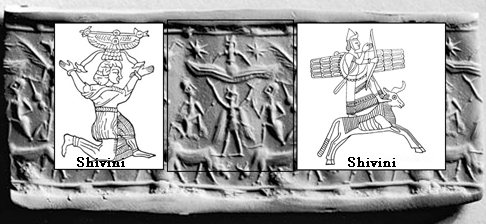
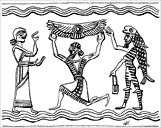
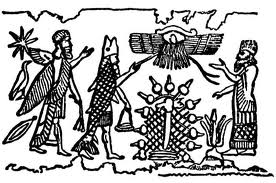 According
to the above quote
Shivini is a sun god because he holds up a solar disk. Others,
including Wikipedia, has copied Piotrovsky quote. I can
understand this
accepted opinion of the winged disk being called a
solar disk. But in fact he
is not holding up a solar disk, his arms are only raised up to
the winged disk without holding on to it. Compare the Shivini image
with the next one of the same posture. It is a ritual pose. There are
examples where the
figure actually holds onto the "leg" of the winged disk. See above as
Oannes, the Babylonian Enki, holds onto the winged disk. It also
demonstrates the direct connection of Enki to this symbol which dominates
the Urartian religious beliefs
and all others across Mesopotamia. A comparison to the Godhead of
India also cannot
be made because they are not individuals per se but
Shiva does have a close affinity to Enki.
According
to the above quote
Shivini is a sun god because he holds up a solar disk. Others,
including Wikipedia, has copied Piotrovsky quote. I can
understand this
accepted opinion of the winged disk being called a
solar disk. But in fact he
is not holding up a solar disk, his arms are only raised up to
the winged disk without holding on to it. Compare the Shivini image
with the next one of the same posture. It is a ritual pose. There are
examples where the
figure actually holds onto the "leg" of the winged disk. See above as
Oannes, the Babylonian Enki, holds onto the winged disk. It also
demonstrates the direct connection of Enki to this symbol which dominates
the Urartian religious beliefs
and all others across Mesopotamia. A comparison to the Godhead of
India also cannot
be made because they are not individuals per se but
Shiva does have a close affinity to Enki. 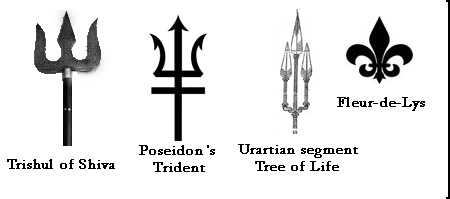 The
following are three reasons Shiva is connected to Enki. 1) The most
obvious would be the trident or trishula of Shiva. The western
classical equivalent would be Neptune-Poseidon's trident. Going back
further would be the fleur-de-lys, another Eden/Enki/Inanna symbol. You
could insert the Babylonian "fish-man", Ea/Oannes, with the emphasis of
this
argument being the water connection. It would be the symbolic
bridge between Enki and his later appearing manifestation as
Poseidon. The shape of these tridents reflect the "three segmented
fruit" I describe elsewhere on this site. You can see the Urartian
example of this with the two tridents. The trident is not a weapon in
this sense, it is a standard which goes all the way back to Sumeria. It
is a symbol of authority much like a scepter. The standard of Mitanni
is
the winged disk. 2) Water springs from the hair piece of Shiva and
likewise from
the shoulders of Enki. This assures us he is not a sun god because his
association is with water as in the Abzu. 3) And finally both have a
connection to the
serpent. For instance the Greeks
did include the serpent wrapped
around the trident of Poseidon in some sculptures. But there is
something odd in all of this. Shiva is
Indo-European
but the Urartian Shivini is non Indo-European. I believe that
there is a connection but as of yet have to discover the "academic"
link. The
problem is the connection between Shiva and Shivini in the way scholars
assert: "He is the third god in a triad
with Khaldi and Theispas and is cognate with the triad in Hinduism
called Shivam." In linguistics cognate words have
a common etymological origin. Scholars
say the Indo-European influence came after Urartu was a kingdom but the
gods pre-date that by quite a stretch. You simply cannot say these two
words are connected by origin if the connection is made well after the
fact. Another definition for cognate is "Cognates
are words inferred to have a common historical origin because of
systematic sound correspondences and clear similarities in form and
meaning. Despite some initial enthusiasm, the method has been heavily
criticized and is now largely discredited," and "substantial borrowing
of lexical items between languages makes tree-based methods
inappropriate."
(http://dienekes.blogspot.com/2010/12/solution-to-problem-of-indo-aryan.html)
This definition, I believe, explains the
situation. I looked at Hurrian as an answer
but that language is non IE as well. So, how did the
word Shivini (if Enki) enter
the Urartian pantheon if not through a plausible way of the IE
language (if in fact it is IE)? The Mitanni. Before I go any further
this theory is my own
and is not supported by the academics. My theory is this: The Mitanni
(ruling class) were an IE speaking people, had migrated
from the east as Indo-Iranians (or Indo-Aryans) to a location adjacent
to the future
Urartu and assimilated, they were horsemen and were most likely of the
Aryan tribes who
could have had connections through trade with India. At this time
Mesopotamia did trade with early Indian civilizations. Therefore the
east Indian civilization was known and had commerce with Mesopotamia.
They spoke an Indo-European language.
The caravan routes of old
followed the Silk Road. Remember the Nairi? Those who came before the
Urartians? Well, this is interesting as it could show a very early IE
influence but from the north - yet another theory - the Krugan culture
which is early IE usually called Proto Indo-European. But none of these
theories explain satisfactorily how words that are from the East
Indian continent made their way into the language of the
Hurrians.
The
following are three reasons Shiva is connected to Enki. 1) The most
obvious would be the trident or trishula of Shiva. The western
classical equivalent would be Neptune-Poseidon's trident. Going back
further would be the fleur-de-lys, another Eden/Enki/Inanna symbol. You
could insert the Babylonian "fish-man", Ea/Oannes, with the emphasis of
this
argument being the water connection. It would be the symbolic
bridge between Enki and his later appearing manifestation as
Poseidon. The shape of these tridents reflect the "three segmented
fruit" I describe elsewhere on this site. You can see the Urartian
example of this with the two tridents. The trident is not a weapon in
this sense, it is a standard which goes all the way back to Sumeria. It
is a symbol of authority much like a scepter. The standard of Mitanni
is
the winged disk. 2) Water springs from the hair piece of Shiva and
likewise from
the shoulders of Enki. This assures us he is not a sun god because his
association is with water as in the Abzu. 3) And finally both have a
connection to the
serpent. For instance the Greeks
did include the serpent wrapped
around the trident of Poseidon in some sculptures. But there is
something odd in all of this. Shiva is
Indo-European
but the Urartian Shivini is non Indo-European. I believe that
there is a connection but as of yet have to discover the "academic"
link. The
problem is the connection between Shiva and Shivini in the way scholars
assert: "He is the third god in a triad
with Khaldi and Theispas and is cognate with the triad in Hinduism
called Shivam." In linguistics cognate words have
a common etymological origin. Scholars
say the Indo-European influence came after Urartu was a kingdom but the
gods pre-date that by quite a stretch. You simply cannot say these two
words are connected by origin if the connection is made well after the
fact. Another definition for cognate is "Cognates
are words inferred to have a common historical origin because of
systematic sound correspondences and clear similarities in form and
meaning. Despite some initial enthusiasm, the method has been heavily
criticized and is now largely discredited," and "substantial borrowing
of lexical items between languages makes tree-based methods
inappropriate."
(http://dienekes.blogspot.com/2010/12/solution-to-problem-of-indo-aryan.html)
This definition, I believe, explains the
situation. I looked at Hurrian as an answer
but that language is non IE as well. So, how did the
word Shivini (if Enki) enter
the Urartian pantheon if not through a plausible way of the IE
language (if in fact it is IE)? The Mitanni. Before I go any further
this theory is my own
and is not supported by the academics. My theory is this: The Mitanni
(ruling class) were an IE speaking people, had migrated
from the east as Indo-Iranians (or Indo-Aryans) to a location adjacent
to the future
Urartu and assimilated, they were horsemen and were most likely of the
Aryan tribes who
could have had connections through trade with India. At this time
Mesopotamia did trade with early Indian civilizations. Therefore the
east Indian civilization was known and had commerce with Mesopotamia.
They spoke an Indo-European language.
The caravan routes of old
followed the Silk Road. Remember the Nairi? Those who came before the
Urartians? Well, this is interesting as it could show a very early IE
influence but from the north - yet another theory - the Krugan culture
which is early IE usually called Proto Indo-European. But none of these
theories explain satisfactorily how words that are from the East
Indian continent made their way into the language of the
Hurrians. "Shivini is only one of the three heads of deities. Haldi is the top god of the pantheon from the inscription of Mheri Dur. Haldi's origin seems different from the other two. A home grown god whose center is Musasir, Haldi may have been picked more for political differention that helped define Urartu as different from its neighbors. But Teisheba and Shivini have clear cut parallels in the Hurro-Hitte pantheon. Haldi seems to have Assyrian roots."
(see: https://groups.yahoo.com/neo/groups/AncientBibleHistory/conversations/topics/26974)
As far as the Urantia Book is concerned the Kingdom of Van followed to an extent the Silk Road east to Van's Kopet Dagh location, and if you were to travel to it from Van you would go through the edge of land of the Mitanni (maps are notoriously at odds with one another) and onto the land of the Indo-Aryans. The problem is, these Mitanni were speaking a Hurro-Urartian language - not IE. Yes, that is true but the elite, the ruling class, seemed to have an IE or IA heritage (see Tusratta's Amarna letter to the Egyptian pharaoh Amenhotep III discovered in1887. The IE names and terms however are within a decidedly Hurrian text for the Mitanni people spoke Hurrian). And among the elite are the priests who always were well educated. This theory would help to explain the cognate connection of Shivini/Shiva, the use of the horse for riding and Shivini's depiction of being associated so directly with the winged disk. The above cylinder impression is from Mitanni and shows in the middle a deity or griffin with arms raised to the winged disk.
"Around the 1400 BCE, a group of Hurrian people formed a kingdom called the Mitanni in the areas of modern Kurdistan and eastern Turkey. The Mitannis adopted the Assyrian cuneiform and have thus left us with a few written documents of their civilisation. From these documents and also from an important inscription detailing a Mitanni peace treaty with the Hittites, we know that at least the ruling class of the Mitanni kingdom were from an Indo-European and specifically Indo-Aryan background. A manual for training of horses uses many Indo-European names for horse accessories, and in the aforementioned peace treaty, we have the name of many Indo-Aryan deities included in the pantheon of Mitanni gods. This has for long puzzled the historians, since the distance between the Mitanni and the rest of the Indo-Aryans who at the time lived in Central Asia and Afghanistan is great. Conventional scholarship suggests a migration of Indo-Iranians from the plains of Central Asia to northeastern Iran and then south to the Indus Valley. If this view is accepted, the existence of a semi-isolated Indo-Aryan ruling class in western Iran seems highly confusing. A possible suggested answer is the migration of a branch of Indo-Iranians from the northern plains of the Caspian Sea down the Caucasus and into western Iran. This and other suggestions seem to be kept at the level of theory in the absence of empirical evidence in their support."
(http://www.iranologie.com/history/history1.html)
The last illustration above of Shivini with the bow resembles the Mitanni winged disk to the left in the impression. These deities within the winged disk may be sun gods. But the article goes immediately into a description of the Babylonian sun god Shamash who does have a sun disk as his symbol and who is in fact a legitimate sun god.
This image of Shivini
above matches the
Van image to the left where he is on the bull and within the circle
much like the
Assyrian Ashur. That Shivini image discovered in 1999 confirms my idea
that the
Van image to the left is one of divinity and not another depiction of a
king as a
divine personage. No doubt though that Shivini's bow is an Assyrian
influence. They were neighbors. All these religious symbols trace back
to Sumeria. Enki had been in the literature a thousand years before
Shivini. So do we find Van in the kingdom of Van through the god
Shivini who is Enki who
is Van the Steadfast? Maybe. I believe that the only way you are going
to find Van in the
history of Urartu is through the pantheon just like Sumeria and
everywhere else the Andites brought the legend. And his confirmation
will be through his symbols and countenance. He is the "good" god, he
is among the heads of the pantheon, the winged disk in some way will be
attached to him even if it has changed by culture (as in the feathered
serpent of the Mayas), the Tree of Life, water in some form and even
the serpent. Shivini only has a couple of these attributes. Plus there
is not that much known about him. On a final note it
would be fair to say that obvious symbolism is "easy pickins'" because
all
the early tribes have known these legends and found expression within
their various cultures and pretty much true to their origin. It always
helps to have auxiliary information. And we do.Now for the pros of an Enki being Shivini. It starts with the Hurrian language. It is spoken by the Mitanni whose border is adjacent to Urartu. Hurrian as you know is a non Indo-European language. There should be no IE words in it - but there are and most important several are names of deity. This we know from a letter from a Mitanni king to an Egyptian pharaoh. It is known as the Amarna letter. In it IE words are used but within a text that is Hurrian. These are known as loan words. What it suggests is that the ruling class had an IE influence. The question then would be, from where? Since Shivini has been compared with Shiva, the Harappan civilization is one location. Actually that is not a bad comparison considering how many symbols are shared between the two (trident, a water source and serpent). No worry about a sun god either and it addresses two points. One being Shivini/Shiva are both a deity and the second that four other IE deities in the letter are called upon. Further, placement within the pantheon is the same. Shivini and Shiva are always mentioned as third. Other scholars follow the linguistic trail to the north into the Caucasus mountain region and beyond. Another good location for the IE influence. Unfortunately there is a great difference among the various theories as to from where and how the IE language spread through the ancient world. We can go back further in time in the northern part of the Armenian highlands. A people called the Kurgans were moving south out of the Caucasus mountains, they spoke Indo-European and may be the origin for the domestication of the horse. The only remark I can make is that Armenia emerges from the north and they do speak Indo-European and were known to ride horses.
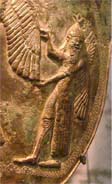 To
the left is another view of what is presumably the metal work image of
Shivini. Actually I have not read of the connection but I assume that
it is true. The strange part is the stereotypical depiction of the genii.
Here we can see one of the two, attending to the larger figure of the
god
on a bull. The helmet of this attending figure has the symbol of
the fleur-de-lys.
It is a given you will almost always find it somewhere
when looking at such images. However there is no Tree of Life, just the
god standing on a bull. All symbolism of the Tree is on the figure, the
rosettes, the
trident representation of the branch with fruit, the elements of the
winged disk and the fleur-de-lys. The two flanking figures, in keeping
with tradition, are in a lock-step representation
that is so
Mesopotamian. But what I really think is going on is the smaller figure
is Amadon and the larger figure is in fact Van the persona behind
Shivini. For one the attendant has the wings of divinity. Second is his
clear association with the larger figure - he is holding on to the
wing. He is not just standing there doing nothing. And lastly he is
smaller, another familiar indication of rank.
Sometimes when there are attending figures to the god they are all the
same size
which I think is a genii/king relationship verses
this genii/attendant relationship.
To
the left is another view of what is presumably the metal work image of
Shivini. Actually I have not read of the connection but I assume that
it is true. The strange part is the stereotypical depiction of the genii.
Here we can see one of the two, attending to the larger figure of the
god
on a bull. The helmet of this attending figure has the symbol of
the fleur-de-lys.
It is a given you will almost always find it somewhere
when looking at such images. However there is no Tree of Life, just the
god standing on a bull. All symbolism of the Tree is on the figure, the
rosettes, the
trident representation of the branch with fruit, the elements of the
winged disk and the fleur-de-lys. The two flanking figures, in keeping
with tradition, are in a lock-step representation
that is so
Mesopotamian. But what I really think is going on is the smaller figure
is Amadon and the larger figure is in fact Van the persona behind
Shivini. For one the attendant has the wings of divinity. Second is his
clear association with the larger figure - he is holding on to the
wing. He is not just standing there doing nothing. And lastly he is
smaller, another familiar indication of rank.
Sometimes when there are attending figures to the god they are all the
same size
which I think is a genii/king relationship verses
this genii/attendant relationship.As far as the god-in-the-solar-disk is concerned as it applies to Shivini it could be another Assyrian influence just like the bow. The Persians never included the bow. It is all together possible because of what I believe to be true. One that the legend is indigenous to all cultures of this area and second cross cultural borrowing was common and thus the "solar disk" and the bow (as a package) have been borrowed from Assyrian sources. Even if you say, "No, that is not true, Shivini is a Urartian god with no outside influence" you still have the problem of Inanna which has been shown to be just the case. She is a cross cultural phenomena with attendant attributes. Which is a great segue back to Urartu. Shivini has a wife who is associated with the winged disk. This conclusion of marriage is accepted because in the list of deities on the Mheri Dur both are listed as third. So the reasoning is since both are third then they are related supposedly as man and wife. In some Sumerian epics Inanna is Enki's daughter and being Edenic automatically has an identification with the winged disk. It was the Babylonians (post-Sumerian but pre-Urartian) who transformed Inanna into Ishtar. Ishtar is not only Babylonian but also Assyrian. The two are exactly the same. Ishtar as Sari shows up in Van but is not a major player. She is listed along with all the other gods on the Mheri Dur, the Door of Mher. We have at this point two seemingly different goddesses who have a link to Inanna. Sari as Ishtar but a fairly low ranking goddess and Semiramis whose exploits dovetail with Inanna. But we know from "cross cultural borrowing" that in all likelihood, Semiramis is Sari and therefore Inanna.
"The irresistible charms of Semiramis, her sexual excesses, and other features of the legend, all bear out the view that she is primarily a form of Astartë, and so fittingly conceived as the great queen of Assyria." (http://www.worldwizzy.com/library/Semiramis_of_Babylon) Astarte is also Inanna.
"The Armenians called Van "the city of Šamiram," "built by Šamiram," while in Urartu it was called Tušpa and was the worship center of the goddess Tušpuea, the wife of the sun god, which testifies to the heredity Tušpuea - Šamiram." Restated as: ...Van was the city of Semiramis, while in Urartu it was called Tuspa and was the center of worship of Tuspucea, wife of the sun god, which testifies to Tuspuea and Semiramis as one and the same. If this were true it would be great but...Tuspuea is very early Urartian and Semiramis is a late comer as testified by the fact she is Armenian and her legend has nothing to do with Shivini. That's what it looks like but the relationship is not from the city name but from something older and deeper, the Sumerian legend of Inanna. This offshoot of conjecture of city names only makes things more confusing and reinforces the fatal mistake that Tushpa was named after Tushpuea which the truth is clearly given by the Assyrian inscription on the Balawat Gate at Nimrud by Salmaneser and the Urartian inscription by Ishpuinis on the Mheri-Dur/Meher Door just above Van.
It makes much more sense to go with Semiramis than with Sari. In Semiramis we have that link to Shivini's wife Tushpuea and both have a connection to the winged disk if the illustrations below hold true. So if Inanna is linked to Semiramis and Semiramis is linked to Tushpuea then Inanna is linked to Shivini, the possible Enki. Given the history of Inanna and the symbolism of Shivini I would declare a match. Tushpuea is Inanna and Shivini is Enki. But husband and wife? In the Sumerian epics Inanna may be Enki's daughter but not his wife. However, Enki does have sex with more than one daughter in the epic Enki and Ninhursag. Therefore Inanna as Ishtar could now be his wife (under an assumed identity). In a turnabout conclusion, given this theory, it would explain how the Urartu capital city could be construed as having been named after Shivini's consort/wife. It ultimately rests on the strength of the Inanna legend.
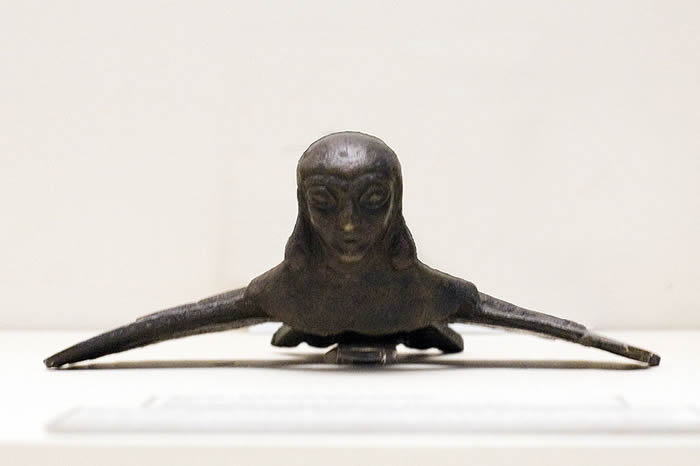 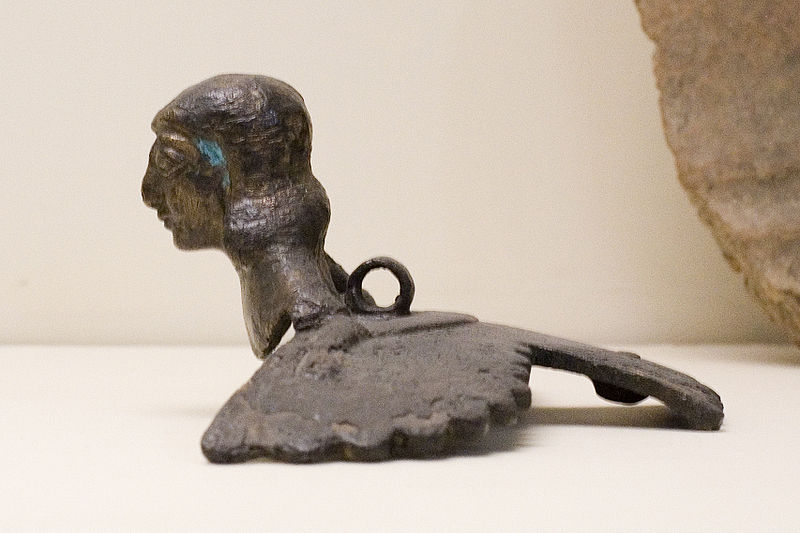 Here are two images of Here are two images ofTushpuea. Originally they were on a cauldron. She is merged with the winged disk. |
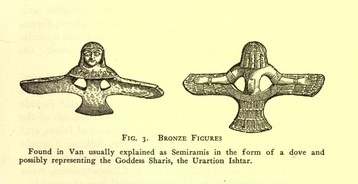 Here is Tushpuea in the Here is Tushpuea in theguise of Semiramis. Note the ring on her back which was used for hanging the cauldron. Click for a slightly
larger image.
|
Earlier I mentioned Aratta and its importance to this history. This addition is about Inanna's connection to Aratta at the time of the Sumerians. In the epic Enmerkar and the Lord of Aratta the goddess Inanna had at one time a residence there. So according to this legend Inanna may have had a temple in Aratta or at least some type of presence. That establishes a connection which could predate Urartu by at least one thousand plus years. Therefore it is not surprising of the connection of Semiramis to Inanna. It also lends support to the theory that Tushpa is named after Tushpuea only because of antiquity but I remain unconvinced due to the historical evidence. However if the Urartian city name of Dhuspas is related to an unknown substrate language for the name of Inanna then everything would click solidly into place.
Semiramis
The more I read about this chameleon of a warrior/lover/queen the more interesting she becomes. One tradition has her as a inn/brothel keeper in the city of Erech aka Uruk which is Inanna's hometown. According to the web site http://www.ldolphin.org/semir.html, Bryce Self postulates: Sammur-amat (Hellenized as Semiramis)>Shinar (the Hebrew form)>Sumeria (todays derivation). That means the name Semiramis equates with Sumeria. An interesting thought. He goes on to say she named her illegitimate son Damu who became the Babylonian Dammuzi. Again very interesting but from my perspective the facts are not straight. It would not be the first time elements from one story become modified in another. On the site http://womenshistory.about.com/od/ancientqueens/a/semiramis.htm, "Some legends have Semiramis raised by doves in the desert, born the daughter of the goddess Atargatis. Her first husband was said to have been the governor of Nineveh, Menones or Omnes." Three things about this quote. First is the dove reference which is a connection to the winged disk. Second, the goddess Atargtis who in some mythologies is the "Lady Goddess of the Sea" a fish goddess (or mermaid) and Omnes who could represent a cloaked Oannes the Babylonian fish-man-god but in name only. The second two statements seem to refer to a behind the scenes Enki.
"Born from the Syrian mermaid goddess Atargatis and a human man, and left on the waterfront by her loveless mother. She was wrapped in the warm wings of a dove, and fed with the dove's milk. Semiramis was then found and educated by the shepherd Simmas until she married Onnes, an old general; but she was then taken away by the Syrian king Ninus who fell in love with her thanks to her beautiful face. This forced Onnes to commit suicide, and after Semiramis earned the favors of the king with original battle plans, she married him and formally became queen. A few days after the marriage, she killed the king with poison, and reigned as a regent over Assyria for the next few decades. This is the oldest case of murder by poisoning in legends."
(http://typemoon.wikia.com/wiki/Assassin_of_Red)
She had a mean streak.
"Ninos repulsed the invasion, and, driving the barbarians back into Bactria, laid siege to it; here, in the tent of one of his captains, he came upon Semiramis, a woman whose past was shrouded in mystery. She was said to be the daughter of an ordinary mortal by a goddess, the Ascalonian Derketô. Exposed immediately after her birth, she was found and adopted by a shepherd named Simas, and later on her beauty aroused the passion of Oannes, governor of Syria."
(http://www.gutenberg.org/files/28876/28876-h/files/17326/17326-h/v6b.htm#image-0028)
Here in the text of the History of Egypt, Chaldea, Syria, Babylonia, and Assyria by G. Maspero and edited by A.H.Sayce is the name Oannes. I mention this because of the relationship of Semiramis/Oannes, Tushpuea/Shivini and Inanna/Enki. This text is taken from Diodorus Siculus.
"Moses of Khorene says that, after the death of Ara the Beautiful, Semiramis passed the rest of her days in Armenia, which place she greatly loved. Here she established the city of Van."
(http://books.google.com/books?id=A05T97qQGK0C&pg=PA129&lpg=PA129&dq=armenian+legend+of+semiramis)
This is one of several references I have seen concerning Semiramis and city building. What we have is clearly a legend that has its roots in Assyria that actually is Sumerian but is expressed in the culture of Armenia. Deriving whether the capital city is named after her or not is problematic when following legend. I defer to the Mheri-Dur.
THE EPIC OF GILGAMESH
Perhaps the most convincing argument of the interconnection of the Inanna/Semiramis legends is the Epic of Gilgamesh. Remember how Aratta is the oldest name for the ancient Armenian highland? Aratta was the destination of Gilgamesh with his trusted friend Enkidu (the "handsome man" of Ara and warrior). He is from Uruk where incidentally Inanna is also. He was going to cut down the cedar forest and kill its protector Humbaba sent there by Enlil. He befriends Enkidu a wild man who becomes civilized who is also his match in strength.
PROLOGUE
When the gods created Gilgamesh they gave him a perfect body. Shamash the glorious sun endowed him with beauty,
Adad the god of the storm endowed him with courage, the great gods made his beauty perfect, surpassing all
others, terrifying like a great wild bull. Two thirds they made him god and one third man.
THE FOREST JOURNEY
At this point in the story Enkidu has become "civilized" and a friend of Gilgamesh. They go to the Cedar forest where they slay Humbaba. Upon their return the god Enlil is angry with Shamush for helping them on their journey.
ISHTAR AND GILGAMESH, AND THE DEATH OF ENKIDU
This is the point at which events are most pertinent to the legend of Semiramis.
Semiramis upon seeing the handsome Ara tries to entice him:
GILGAMESH Washed out his long locks and cleaned his weapons;
he flung back his hair from his shoulders; he
threw off his stained clothes and changed them for new.
He put on his royal robes and made them fast. When Gilgamesh
had put on the crown, glorious Ishtar lifted her
eyes, seeing the beauty of Gilgamesh. She said, ‘Come to me Gilgamesh,
and be my bridegroom; grant me seed of your body, let me be your bride and
you shall be my husband. I will harness for
you a chariot of lapis lazuli and of gold, with wheels of gold and
horns of copper; and you shall have mighty demons of
the storm for draft mules.
Ara rebukes Semiramis:
Gilgamesh opened his mouth and answered glorious Ishtar, ‘If I take you in marriage, what gifts can I give in return?
What ointments and clothing for your body? I would gladly give you bread and all
sorts of food fit for a god. I would give you wine to drink fit for a queen. I would
pour out barley to stuff your granary; but as for making you my wife - that I will not.
How would it go with me? Your lovers have found you like a brazier which smoulders in the cold, a backdoor which
keeps out neither squall of wind nor storm, a castle which crushes the garrison, pitch that blackens the bearer,
a water - skin that chafes the carrier, a stone which falls from the parapet, a battering - ram turned back from the enemy,
a sandal that trips the wearer. Which of your lovers did you ever love for ever? What shepherd of yours has pleased you for all time?
Spurned by Ara Semiramis in a fit of rage decides to get even:
When Ishtar heard this she fell into a bitter rage, she went up to high heaven. Her tears poured down in
front of her father Anu, and Antum her mother. She said, ‘My father, Gilgamesh has heaped insults on me, he has told over all my
abominable behaviour, my foul and hideous acts.' Anu opened his mouth and said, ‘Are you a father of gods? Did not you
quarrel with Gilgamesh the king, so now he has related your abominable behaviour, your foul and hideous acts.'
Ishtar opened her mouth and said again, ‘My father, give me the Bull of Heaven to destroy Gilgamesh. Fill
Gilgamesh, I say, with arrogance to his destruction; but if you refuse to give me the Bull of Heaven I will break
in the doors of hell and smash the bolts; there will be confusion of people, those above with those from the lower depths. I shall
bring up the dead to eat food like the living; and the hosts of dead will out number the living.' Anu said to great Ishtar, ‘If I
do what you desire there will be seven years of drought throughout Uruk when corn will be seedless husks.
...
When Anu heard what Ishtar had said he gave her the Bull of Heaven to lead by the halter down to Uruk: When they
reached the gates of Uruk the Bull went to the river; with his first snort cracks opened in the earth and, a hundred young
men fell down to death.
But the Bull of Heaven is killed by Gilgamesh. Then it is determined by the gods because of Humbaba and the Bull of Heaven - one must die:
When the daylight came Enkidu got up and cried to Gilgamesh, ‘O my brother, such a dream I had last night. Anu,
Enlil, Ea and heavenly Shamash took counsel together, and Anu said to Enlil, "Because they have killed the Bull of
Heaven, and because they have killed Humbaba who guarded the Cedar Mountain one of the two must, die." Then
glorious Shamash answered the hero Enlil, "It was by your command they killed the Bull of Heaven, and killed Humbaba,
and must Enkidu die although innocent?" Enlil flung round in rage at glorious Shamash, "You dare to say this, you who
went about with them every day like one of themselves!"
The death of Ara:
He touched his heart but it did not beat, nor did he lift his eyes again. When Gilgamesh touched his heart it did
not beat. So Gilgamesh laid a veil, as one veils the bride, over his friend. He began to rage like a lion, like a lioness robbed
of her whelps. This way and that he paced round the bed, he tore out his hair and strewed it around. He dragged of his
splendid robes and flung them down as though they were abominations.
Although it is Enkidu that dies rather than Gilgamesh, in the epic it is Enkidu who is the "handsome man" as told by the harlot who "civilizes" him. And in the legend Semiramis is a harlot in that varied background of hers as she plays out the part of Inanna as lover.
THE SEARCH FOR EVERLASTING LIFE
The ending to this story is where Semiramis tricks the Armenians into believing Ara is alive. The attempt at resurrection of Ara is much like Gilgamesh searching for the plant of life:
BITTERLY Gilgamesh wept for his friend Enkidu; he wandered over the wilderness as a hunter, he roamed over
the plains; in his bitterness he cried, ‘How can I rest, how can I be at peace? Despair is in my heart. What my brother is
now, that shall I be when I am dead. Because I am afraid of death I will go as best I can to find Utnapishtim whom they
call the Faraway, for he has entered the assembly of the gods.' So Gilgamesh traveled over the wilderness, he wandered
over the grasslands, a long journey, in search of Utnapishtim, whom the gods took after the deluge; and they set him to
live in the land of Dilmun, in the garden of the sun; and to him alone of men they gave everlasting life.
Gilgamesh finds Utnapishtim who finally reveals the secret to immortality:
I will disclose to you a thing that is hidden, Gilgamesh, I will tell you. There is a plant... like a boxthorn,
whose thorns will prick your hand like a rose. If your hands reach that plant you will become a young man again."
Gilgamesh dives under the waters and finds the 'The Old Man Becomes a Young Man' plant. On his way back home he stops for a bath. A snake finds the plant unattended and makes off with it:
A snake smelled the fragrance of the plant,
silently came up and carried off the plant.
The end of the epic has the death of Gilgamesh just like his friend Enkidu. Both are handsome and both do die.
And Ara, who Semiramis tried to resurrected but failed, remains dead just like his counterparts Enkidu/Gilgamesh.
Gilgamesh in this epic also meets a woman who is an inn-keeper.
My first hypothesis validates the legends of Enki and Inanna as submerged beneath the Assyrian and Armenian stories and brings together two of the greats from the Sumerian pantheon. Now in two places, Sumeria and Urartu, we have the greatest connection to the Tree of Life. The second hypothesis is that Shivini is not really a solar god only that he is shown to have a relationship with the winged disk because of the overlaying of imagery from Assyria. If we accept that, then it is apparent why Shivini's association is with the winged disk - because he is Enki. And I plant my flag.
My map showing locations discussed on this page:
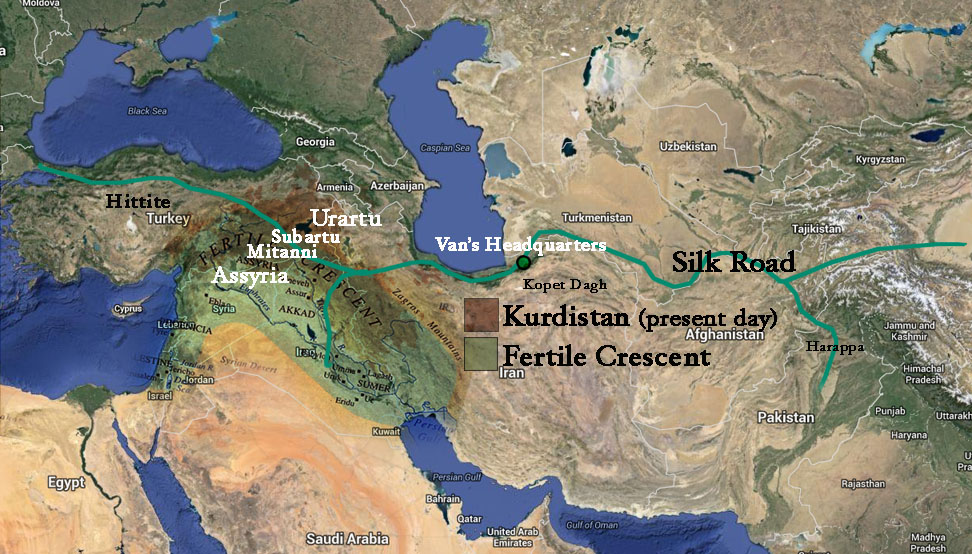
Before ending I want to revisit the problem of language. This subject had become increasingly frustrating. Take the issue of the Hittites from central Anatolia. There is a debate over the question of IE vs. Hurrian. That seems like a very wide gap to me. So I went back to the Urantia Book:
The real answer lies with the Andites. Although their origin is from the lands surrounding Mesopotamia they did migrate. And they did in waves and became the dominate culture and certainly in Eurasia. And within that great area of land of Eurasia is Turkmenistan which we are most interested in. IE was originally referred to as Aryan but in 1813 the term Indo-European was coined which is still in use today. This tongue is a melding of three languages and with the coming of aridity to those then lush green plains of Turkmenistan it forced those Andites to migrate westward across the Balkans into Europe. Remember that the Tree of Life and all those attached legends are Andite. This is how these first legends moved eastward with those earliest migrations. But the Andites were not Aryan, they were pre-Aryan. Although the Urantia Book does not say the exact route into Europe except that the Andites did enter on horseback via the northern avenue of the Caspian Sea, they would have flowed through the area north of the Black Sea and the homeland of the Kurgans. I think some must have also traveled by the even then ancient Silk Road entering Mesopotamia from what is Iran and spreading through the land of the Hurrians, across Anatolia, present day Turkey, and into southern Europe. It would answer a lot of questions. Since their homeland would have been on the Silk Road which entered India at that point, cultural mixing would have happened to include words and concepts. And its not about conquest. It is about trade. Certainly words regarding the culture of the horse would be present. And because of the expanse of time from when those first Andites arrived (with legends) and the later migrating Andites "bouncing back" who now had contact with India (and their legends influenced by the first Andites), are the source of Indo-European loan words found within Hurrian. You find both of these, the horse training words and Indian deities, in the Hurrian of the Mitanni. You find "horse culture" among the Nairi to the north. Finally you have that definite Assyrian influence of Mesopotamia from the south. Taken together these are truly potent influences.
Oh yeah, one last thing: This also solves the question of the Hitties in central Anatolia who were gone before the advent of Urartu. The debate as to what constituted the Hittite language can be resolved this way, with both sides winning. The time of the now returning Eurasian Andites was very early on and really leaving only traces in their ancient wake. They passed into Greece, something that is invisible today, and as with the Hurrian language and its loan words, the "bounce back" IE from Greece as seen today is why there is such a question of origin.
Thanks for reading.


