The Gardens of Eden
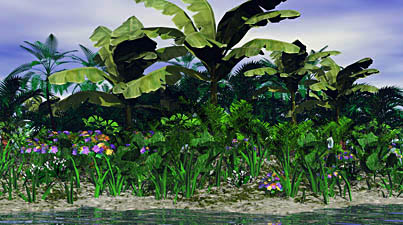
Paradise Lost. Sethite Priesthood. Salt.
The First Eden
The number one problem in identifying the location of the first Garden of Eden is the fact that the Biblical description is for the second garden between the Tigris and Euphrates. That was the garden that Adam and Eve made after they had to leave the first garden. The first garden was only occupied for about 100 years but the second garden lasted thousands. Adam lived for 530 years (930 years Gen 5:5) and Eve lived for 511 (Urantia Book p. 852) Some of Adam and Eve’s children continued to live in the second garden. Eventually the blood line ran out at about 2000 BC (UB 868) (which is within the time frame of Sumerian cuneiform writings). You have Adam and Eve arriving at the location for second garden right near where the rebellion had happened. Confusion is understandable regarding how events were remembered. Both located in Mesopotamia. Both involving a default of sorts. Most importantly both involving the gods and with a connection to the Tree of Life. Who would eventually record these events? The Sumerians who were the last of the Andites.
The Garden was created by Van and his supporters for Adam and Eve who arrived at about 36,000 B.C. It would be here that Van would transplant the Tree of Life (as in the Sumerian tale about Enki and the Huluppu tree). At this time the strait of Gibraltar was still intact and it would stay that way for another four thousand years. There were inland lakes in the bed of the Mediterranean basin which was more elevated than today. It also allowed at that time of the last ice age an avenue to southern Europe and northern Africa. One such lake surrounded the Garden peninsula itself. We do not know what the exact shape of the Garden looked like except that it was a narrow peninsula surrounded by mountains and a great river flowed from Eden to the east. Where it ended up is ambiguous. The Urantia Book says it flowed "across the lowlands of Mesopotamia to the sea beyond." Whether that means to the Persian Gulf or across the Arabian landscape to the Arabian Sea directly is not answered. The Persian Gulf may not even have existed at that time. One theory has the Gulf filling with water at about 5,000 BC at an event-time called the Flandrian Transgression. (http://www.ldolphin.org/eden/) Another has the complete inundation by 7,000 BC. Even if the time frame was 17,000 BC it still would have been dry at the time of the first Eden. So "to the sea beyond" would be exactly that. No Persian Gulf only a dry basin leading to the Arabian Sea.
According to the Book the Garden was a place of variety and botanical beauty. "The site chosen for the Garden was probably the most beautiful spot of its kind in all the world, and the climate was then ideal." (UB 823) It was the first choice of three locations.
So where was the first garden exactly? If you would ask the average Urantia Book reader he would probably say Cyprus. It is a common assumption because it, on a first look, seems to resemble what the Book has to say. It is something I had accepted as well until a friend questioned this belief. And after looking much more closely as to what the Book actually says I have come to agree with my friend that Cyprus is not the location of the first Garden. This will come as a shock to some of my readers but I feel I have good reason to publish a new look for the location of the first Garden.
So somewhere beneath the eastern waters of the Mediterranean is what is left of the original Garden of Eden, the first Eden. The following short animation "Eden A New Look" is an attempt to explain where I believe the Garden was located:
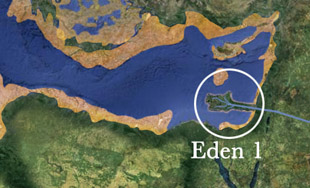
Click on image to view. You may need to enable Quicktime.
Click on the back button of your browser to return to this page.
Please wait for animation to load.
During the time of the first Garden the bed of the Mediterranean was fairly dry and a large population lived there, some if not most were Nodites. The time line of today's geologists states that the Mediterranean went dry, was dessicated, during the period which is called the Messinian Event, a desert like condition, dated almost to six million years ago. That age lasted for a little less than a million years. Since the time of the Garden is Paleolithic it occurred during the last ice age and that means it was cooler, at least to the tundra of the north. The basin area would have been warmer and much more comfortable. "In the empty Mediterranean Basin the summertime temperatures would probably have been extremely high even during the coldest phase of any glacial era. Using the dry adiabatic lapse rate of around 10 °C (18 °F) per kilometer, a theoretical temperature of an area 4 kilometers (2.5 mi) below sea level would be about 40 °C (72 °F) warmer than the temperature at sea level." (http://en.wikipedia.org/wiki/Messinian_salinity_crisis).
There are two assumptions by geologists for dates and temperatures. The first is that when the break at Gibraltar occurred it flooded the entire basin known as the Zanclean flood or deluge at 5.33 million years ago (mya) and second that the depth of the seabed was deeper than it really was. The seabed only became the level we know today because of the massive earthquake and volcanic activity after the time of the first Eden. But the important point is about the Messinian salt deposits which confirm the Urantia Book's statement that the Mediterranean had periods of being much dryer during its ancient history. Previous to the Zanclean flood there is suggested a repeated cycle of dry and flood eras but very much before the arrival of early man. Since that time the level of the Mediterranean may have fluctuated but has never been dry based on the assumption of the break of the sea wall of Gibraltar at such an early date. The discrepancy in dates between the accepted date by geologists of 5.33 mya and the Urantia Book's date of about 32 kya is about when Gibraltar gave way and thus the Mediterranean's final flood.
The map below is my interpretation of available data. It is an overlapping of faults, volcanoes and stress. The main red fault line is between the African and Eurasian plate (of which the Anatolian plate is considered as part), large blue arrows are direction of plate movement and the red area around turkey is stress. The greatest stress is along the fault line between the future Aegean and Mediterranean Seas. This area is a vertical slip fault zone. The triangle that marks a volcano in the Aegean Sea is for Santorini (also known as Thera one of many locations for the legendary location of Atlantis) which, when it erupted, was the largest volcanic event in the last 10,000 years. The other two red triangles are for Etna and Vesuvius and the stars are where I consider the location for the epicenter of that major earthquake event. The Urantia Book uses the plural of volcano which is why I use three as an illustration. There were probably more considering the enormity and scope of this event. The geological history indicates that this area has by far the greatest seismic activity. When that event occurred the sea floor was driven downwards and at the same time the dam of Gibraltar broke and the Sicilian land bridge submerged both being affected by the fault line running through them. The area just southwest of Greece is known as the Ionian Sea and is the deepest part of the Mediterranean.
The African plate is relentlessly moving into Europe. It will close Gibraltar again and collide with Europe at some point in the distant future. You can get an idea of how large the African plate is, running from a distance in the Atlantic west of Gibraltar to the Great Rift Valley between the African plate and the Arabian plate to the east. This should give you an understanding of how powerful these forces really are. What is not shown here are the faults of Italy which are extensive.
Another consequence of the great land and sea bed displacement is the uplift of the rim of the eastern shoreline. It also slowly elevated the Anatolian plate to the point that it induced a change in the weather. Because of the higher elevation there was more precipitation in the highlands north of Mesopotamia creating an increasing amount of snow melt which combined with the greater rain fall contributed to the Sumerian "world wide" flood.
"For thousands of years after the submergence of the first Eden the mountains about the eastern coast of the Mediterranean and those to the northwest and northeast of Mesopotamia continued to rise. This elevation of the highlands was greatly accelerated about 5000 B.C., and this, together with greatly increased snowfall on the northern mountains, caused unprecedented floods each spring throughout the Euphrates valley." (UB 874)

So, if we go by what the Book says and the geology as we know it, then the peninsula lies off the southern coastline of Israel or the Gaza Strip. The more southern its location the more likely it is buried under the Nile Cone which is where sediments from the Nile Delta are deposited. The cone extends into the Mediterranean until it tapers off completely before reaching the Eratosthenes Seamount. Another reason for its disappearance could be that the violent earthquake which was big enough to break the land bridge at Gibraltar, lower the seabed and raise the rim of the basin would likely cause a lot of damage to the peninsula. The Urantia Book only says it slowly sank beneath the waters. It does not mention what the condition was of Eden. As for Cyprus it probably took its punishment too. The major fault line lies just south of it and another runs through the mountainous area on its northern edge. Its saving grace is the fact it is on a different tectonic plate. Its a very small plate, it would have moved. Most likely it rose up further as a result of the subduction of the African plate beneath it. If that is true then it was always an island unless it was a peninsula that broke off from the main land. But as a peninsula no matter where it was attached it still would have been in the wrong location to be the first Eden. It is simply too far north.
The location of where the inland seas are positioned on the map above are partly referenced by the maps of the Messinian salt deposits and partly by what the Urantia Book alludes to. As for the size of the peninsula I think it is probably comparable to Cyprus or perhaps a bit smaller. In 2013 Cyprus had a population of 1.1 million. The Garden was meant to house 1.0 million. Both descriptions have surrounding mountains, a flat plain and surrounded by a sea but the Urantia Book would have Eden as narrow in shape.
As you may have noticed the modern geologic dates and Urantia Book dates differ by millions of years as to when the last flooding occurred. To help you understand why the dates do not match I have a theory but first a review of what scientists believe today:

The Accepted Theory
Starting at about 10 mya the African plate was moving due northward. Between the African plate and the Eurasian plate was the ancient Tethys Sea. It was the last of the great Tethys Ocean of Pangea and it was open to the Atlantic as well as the Indian Ocean. The passageway to the Indian Ocean was cut off by the Arabian plate and as the African plate continued to move northward it collided with the Iberian Peninsula and thus closing off the strait and the Mediterranean became an inland sea. This occurred at about 6 mya. This is the beginning of the Messinian Salinity Crisis which lasted until 5.33 mya. Geologists do know that there was a barrier between the western and eastern basins between Sicily and Africa due to the difference in water chemistry. During this time the Mediterranean may have gone completely dry or only partly dry. Over the intervening time period there were incursions of salt water. Then after roughly one million years the strait of Gilbraltar opened up again at 5.33 mya to reflood the Mediterranean to the current sea level.
This break is at the beginning of the Pliocene. The break at Gibraltar is estimated at this early date because "5.33 Ma – abrupt synchronous return to full marine conditions. Miocene/ Pliocene boundary. (Krijgsman et al, 1999)" (http://www.ougseurope.org/index.php?id=28). Other data as well seems to point to an occurrence at this time of 5.33. As an example, biodiversity of amphibians such as frogs, salamanders and newts centers around this time. There are other indicators (such as a sharp delineation across core samples) that some type of monumental rise in sea level happened.
An Alternate Theory
At that early time before 6 mya the Gibraltar strait was open and the Atlantic met with the remnant of the Tethys Sea called the Proto-Mediterranean. It was at this time when it closed that began the dessication of the Mediterranean with periodic inundations of salt water. All salt deposits throughout the basin are from the Atlantic Ocean. That is the published opinion. Regarding the difference in chemistry between the western and eastern basins, the eastern most likely has salt deposits that are from the Indian Ocean. Gibraltar was closed off due to the collision of north Africa and the Iberian Peninsula at about 6 mya but they do not know how high the Gibraltar isthmus actually was, which has a bearing on the periodic inundations of the Atlantic. As the waters evaporated the salts precipitated out to dry on the seabed. Now, we are talking about a lot of salt. These layers can be as thick as 3km or a little shy of 2 miles deep. However, considering other laminates within the salt deposition it could be reduced to as much as 50% or more. Some of these layers contain micro-fauna and flora which are organics. Boring core samples from the Glomar Challenger contain hard evidence of repeated wet and dry spells. Why this happened has been one of the ongoing discussions. Some scientists believe that this may be the result of flooding due to leakage from the isthmus. There are core samples that indicate as many as 69 such cycles had happened. "As shown in sea floor core samples, during the crisis the basin evaporated and was reflooded a stunning 69 times, as rising mountains temporarily closed off the sea, but periods of either (or both) rising sea levels or tectonic subsidence caused a refilling of the basin." (http://basementgeographer.com/the-zanclean-flood-refilling-the-mediterranean/)
According to some models (put forth on several web sites) the depth of the Mediterranean seabed was comparable to the Grand Canyon in Arizona in the US. That would be deeper than it was but not as deep as it became which is about twice as deep. There are also other computer models of a much higher seabed which reflect more closely the description from the Urantia Book. After a flooding at 5.33 the level of the Mediterranean may have never returned to the driest days of the Messinian. If that is the case then the later dryer periods would not be noticeable as being a part of numerous layers of fluctuation within the core samples. This would camouflage the total break after the time of the first Eden as just another rise in the sea level.
Since we have sea water reaching the seabed of the Mediterranean at a time when it was clear Gibraltar was intact then some mechanism was involved in allowing that to happen. This means the Atlantic could have been lapping over the embankment of Gibraltar without having it to be compromised in any way. There are several other choices. One being oceanic levels driven by climate, another being tectonic forces that could have multiple origins such as volcanoes, lithosphere instabilities as in a subsidence of the seabed (a further lowering) or sea water that is not from the Atlantic. Gibraltar was strong enough to resist the pressure of the Atlantic but not the later violent activity of the tectonic plate fault that runs through it. This fault line may be the answer to the rise and fall of the isthmus given fault lines by their nature are unstable and periodic inflow could still have been catastrophic without a breach happening. Finally we should consider the Arabian plate which was tilted. Geologists know that the Arabian plate was submerged at some point in the past. But their estimated dates are too early to be considered by 5.33 mya. But that would be in error. The Arabian plate has had a history of bobbing and therefore allowing inundations from time to time. This periodic plate movement would answer two mysteries. The first is the difference between the two basins in water chemistry and where all that salt water came from.
The cycle of flooding of the eastern basin suggests that the Sicilian land bridge was high enough to allow passage between Europe and Africa but had to have dipped down over its course to allow the waters from time to time to flow across it from the western basin to the eastern. It also may be tied to the phenomenon of the rise and fall of the isthmus thereby working in tandem. Although tectonic processes have been advanced as a reason for Gibraltar's failure, "no tectonic structure of this age has been unequivocally documented that could account for such a hypothesis... We show that such erosional process inevitably developed in the Gibraltar area. We finally propose that regressive fluvial erosion was at the origin of the opening of the Strait of Gibraltar." (Nicolas Loget, a, and Jean Van Den Driesschea aGéosciences Rennes, Université de Rennes 1, UMR 6118, Campus de Beaulieu, 35042 Rennes cedex, France. Available online 2 May 2006.) This theory would support the Urantia Book in that at 5.3 mya seismic activity did not breach Gibraltar. Another point to consider is about salt dessication, in that the added time per the Urantia Book elongates the dessication time frame by about five million years. And with a more shallow basin at a higher elevation it would more easily accommodate that time frame for repeated cycles of flood, even a large one, and evaporative cycles needed for multiple salts and differing layers to occur. If we further consider a higher level for the seabed then the depth of flooding would have been much shallower than today even if the sea and the ocean attained its equilibrium. The Urantia Book mentions the break of Gibraltar in association with the loss of life. The flooding at 5.33 mya would involve no loss of human life. It would be almost another four million years before humans appeared and perhaps is why the earlier flood is not mentioned.
-----------------
An Alternate Theory Sept 2016
The Mediterannean Conundrum, that is what I call it and it refers to the discrepency in dates between the UB and today's science. The UB dates for the flooding of the Mediterranean and those proposed by today's scientists vary by a huge amount. When I first wrote my impressions on this history I did not take into account of the Arabian plate and its oscillations. I have since updated some of the above text. It is this sentence that may hold the key to the periodic floodings with their accompanying salt deposits on the Mediterranean sea bed: "They [the Badonan tribes of which these are pre-Sangik] observed the Mesopotamian peninsula gradually sinking into the ocean, and though it emerged several times, the traditions of these primative races grew up around the dangers of the sea and the fear of periodic engulfment." (UB 720) Originally the Tethys Sea called the Proto-Mediterranean connected with the Indian Ocean. Because of the depth of the salt layers science knows that over a period of time the Mediterranean would just about dry up only to be reflooded. The mechanism has been a mystery. They have been looking to Gibralter for the answer and so did I with the consideration that the fault line runs through the isthmus. It seemed the most probable location for sea water leakage. I did a 180 on this when I realized it is much more likely that the moving and bobbing Arabian plate that is the answer because it did not finally join with the African plate until about 400,000 years ago. Until that time it could have been letting periodic inundations into the eastern Mediterranean and thus large amounts of salt water.
 Additional
Info March 2017
Additional
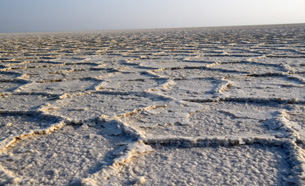
Info March 2017I recently ran across an article by chance on the Danakil Depression in Ethiopia. Since it is a vast salt plain I was interested in finding out if there was any information on how deep it is and how long it would take to produce a depth of salt of one mile (1.6 kilometers). What I discovered has a direct relationship with the Mediterranean Sea. I was totally unprepared for what I found. This part of Ethiopia is actually called a microplate and is located at the Afar triple junction. There is a rift between both the Nubia and Somalia plates and the fault running through the Red Sea that accounts for this microplate. It is very low lying in terms of geology and most likely will be at the forefront of global warming for submergence. Estimates vary from 1.5 miles/2.5 kilometers to 3 miles/5 km for depth of salt. "Some areas of the Danakil Basin are said to have between 2.5 and 5km thick salt layers deposited over millions of years while the area was connected to the Red Sea during periodic sea transgressions and flooding events." (http://earths-ends.com/the-geologists-nirvana-of-the-danakil-depression-part-1/) This is similar to the Mediterranean. The timeline for this deposition according to the article is "millions of years" which does not help much. I do not think at this point that we can get a reliable estimation of how long it takes to lay down these salt deposits and that comes, more or less, from the geologists themselves. The articles pertaining to the dynamics of plate tectonics are highly technical so I will not go into it here. But the gist of this situation is that because the African, Eurasian and Arabian plates interact, both the Mediterranean and the Red Sea are affected by these huge tectonic forces all of which is not entirely understood. So, therefore, what happens between these plates will impact both the Mediterranean and consequently the Danakil Depression. But it is not only salt from sea water that created the Danakil salt flats. Supersaturated hydrothermal brines from hot springs also contribute to the salt deposition. But the classic view of salt evaporites is by solar evaporation. For us it does not matter which way the salts were laid down because geologist assume that these salt deposits in the Mediterranean and Red Sea occured approximately by the same geo/solar process. However, salt tectonics of evaporation is the convincing argument (Jackson and Hudec, Salt Tectonics: Principles and Practice, © 2017). That is, sea water inundation followed by solar evaporation seems to be the mechanism by which major salt deposition occurs. Oh yeah, and the first article goes on to say that, "The estimated date of the most recent sea transgression into the Danakil basin is around 30,000 years ago." Compare that with the Urantia Book's date of 32,000 years ago. See Here for map.
---------------------
The Second Eden
After Adam and Eve left
the peninsula they traveled eastward to what could have been the
original location for the Garden but it was not the
first choice.
It was located between the Tigris and Euphrates rivers. If we refer to
the Sumerian texts the Garden would have been on the eastern bank of
the Euphrates side. It
would be here that civilization was jump started again. It was one
heritage of the Sumerians who would later build their cities to the
south
between the Tigris and Euphrates and to which the Sumerians referred to
the
northern plains as "Edin."
It
was because of the hard work of the Edenites in the second garden that
civilization really had a chance to take hold. The incredible length of
time over which this process took place demonstrates how difficult it
must have been. Practically nothing survived the rebellion.
"Only the Nodites and Amadonites was there persistence of the
traditions of Dalamatia and the culture of the Planetary Prince." (UB
821). Adam and
Eve had to build from the ground up. And that implies that the "Gift of
Civilization" is mainly Edenic. We owe Adam
and Eve and their family with all that they accomplished our deep and
abiding gratitude. Many of the arts of civilization would have their
origin here. Animal husbandry and agriculture which the Bible also
supports were part of the Garden's culture. The Urantia Book adds more
to the list including pottery, weaving and metalworking for some of the
physical aspects, sanitation, writing and art as intellectual
developments and civil administration, educational methods and
religious devotions as part of their high culture.
The
Sethite Priesthood
It is
no secret that the Sumerians claimed that
civilization was a gift from the gods. The Sumerians would have us
believe it goes all the way
back to Dalamatia. Unfortunately, any gains of civilization for the
common man were lost
due to the rebellion which ended in failure. But for the Nodites, the
Nephilim, there was that "persistence of the traditions of Dalamatia."
The centers for the repository for this knowledege could have been
ancient
Susa and southern Sumeria. The job of reintroducing civilization was
one of many
that Adam and Eve worked at implementing and it was a family affair. "The
religious rulers, or priesthood, originated with Seth, the oldest
surviving son of Adam and Eve born in the second garden." (UB 849)
There are three things you can say about this organization. First, they
were priests, religious rulers. Second, they were teachers par excellence. And
third, they were physicians. I would identify them with the Sumerian apkallu who were
above all priests, advisers to the king, bringers of
the me,
the wisdom of
civilization, and as protectors and healers. There is a link to the
page The Apkallu
at the bottom of this one for more information.
"For
thousands of years the sons of Adam labored along the rivers of
Mesopotamia, working out their irrigation and flood-control problems to
the south, perfecting their defenses to the north, and attempting to
preserve their traditions of the glory of the first Eden." (UB 869)
With this statement is an additional avenue for keeping the story of
Eden alive until it was written down albeit incompletely by the
Sumerians. At about 15,000 B.C. there was a regeneration of the Sethite
priesthood uplifting the Edenic culture and its civilization which was
carried out in waves by the now present Andites. There were Sethite
priests within the Andite migrations and between 8000 and 6000 B.C. a
large group moved eastward through the Elamite highlands to the Iranian
plateau and Turkmenistan (UB 873). Both Iran and Turkmenistan claim
the birthright of Zoroaster also known as Zarathustra:
"Zoroaster's
teachings, as noted above, centered on Ahura Mazda, who is the highest
god and alone is worthy of worship. He is, according to the Gathas, the
creator of heaven and earth; i.e., of the material and the spiritual
world. He is the source of the alternation of light and darkness, the
sovereign lawgiver, and the very center of nature, as well as the
originator of the moral order and judge of the entire world. The
conspicuous monotheism of Zoroaster's teaching is apparently disturbed
by a pronounced dualism: the Wise Lord has an opponent, Ahriman, who
embodies the principle of evil, and whose followers, having freely
chosen him, also are evil. This ethical dualism is rooted in the
Zoroastrian cosmology. He taught that in the beginning there was a
meeting of the two spirits, who were free to choose--in the words of
the Gathas--"life or not life." This original choice gave birth to a
good and an evil principle.
Corresponding
to the
former is a Kingdom of Justice and Truth; to the latter, the Kingdom of
the Lie (Druj), populated by the daevas, the evil spirits (originally
prominent old Indo-Iranian gods). Monotheism, however, prevails over
the cosmogonic and ethical dualism because Ahura Mazda is father of
both spirits, who were divided into the two opposed principles only
through their choice and decision. The Wise Lord, together with the
amesha spentas, will at last vanquish the spirit of evil: this message,
implying the end of the cosmic and ethical dualism, seems to constitute
Zoroaster's main religious reform.
His
monotheistic
solution resolves the old strict dualism. The dualist principle,
however, reappears in an acute form in a later period, after Zoroaster.
It is achieved only at the expense of Ahura Mazda, by then called
Ohrmazd, who is brought down to the level of his opponent, Ahriman.
At
the beginning of
time, the world was divided into the dominion of the good and of the
evil. Between these, each man is bound to decide. He is free and must
choose either the Wise Lord and his rule or Ahriman, the Lie. The same
is true of the spiritual beings, who are good or bad according to their
choices. From man's freedom of decision it follows that he is finally
responsible for his fate. Through his good deeds, the righteous person
(ashavan) earns an everlasting reward, namely integrity and
immortality. He who opts for the lie is condemned by his own conscience
as well as by the judgment of the Wise Lord and must expect to continue
in the most miserable form of existence, one more or less corresponding
to the Christian concept of hell. According to Avestan belief, there is
no reversal and no deviation possible once a man has made his decision.
Thus, the world is divided into two hostile blocks, whose members
represent two warring dominions. On the side of the Wise Lord are the
settled herdsmen or farmers, caring for their cattle and living in a
definite social order. The follower of the Lie (Druj) is a thieving
nomad, an enemy of orderly agriculture and animal husbandry."
(http://www.crystalinks.com/z.html)
I believe that the above teachings have a definite Sethite influence and that these religious beliefs had an impact on those long ago Jews who were held captive in Babylon and set free as a result of Cyrus the Persian king. More on Zoroastrian influence on Judaism and Christianity can be found on the page Lucifer.
"Given
that the first group of these ultimately canonical books [the Books of
Moses] was written while the Jews were held captive in
Mesopotamian
Babylon in the 6th century BC, it is apparent that Babylon was where
the original records were then held. In fact, from the time of Adam,
through some nineteen said generations down to Abraham, the whole of
Hebrew patriarchal history was Mesopotamian. More specifically, the
history was from Sumer in southern Mesopotamia, where the ancient
Sumerians did indeed refer to the grass-lands of the Euphrates delta as
the Eden."
(http://www.karenlyster.com/genesis.html)
The
above quote is from a supporter to the Grail King theory which involves
the story of the Merovingians.
As a matter of record this web site does
not support the Grail King theory but read what is said on this matter
and judge for yourself.
Cain and Enoch
In
Genesis 3:23 "...the Lord God sent him forth from the garden of Eden,
to till the ground from which he was taken." And Genesis 4:2 "...Now
Abel was a keeper of sheep, and Cain a tiller of the ground."
Within
the span of only several sentences the Bible says the arts of animal
husbandry and agriculture were known to Adam and Eve and their
children. This certainly predates the Neolithic revolution by a huge
time frame. But the Bible is accurate in that the Edenites did know
these arts although they were not the first humans which can be
attested by Cain going to the Land of Nod and finding a wife or "the
mark of Cain" put on him to protect him from harm by others. (In the
Genesis account it was after God told Cain he was to become a "fugitive
and a wanderer on the Earth" that "...the Lord put a mark on Cain."
This was done in response to Cain's lament in Genesis 4:14 - "Behold,
thou hast driven me out
this day from the face of the earth; and from thy face shall I be hid;
and I shall be a fugitive and a vagabond in the earth; and it shall
come to pass, that
every one that findeth me shall slay me." "Then Cain went away from the
presence of the Lord, and dwelt in the land of Nod, east of Eden").
 Click
on CAIN for more
on what
happened in the Garden,
Click
on CAIN for more
on what
happened in the Garden,
the Cain and Abel story and additional
information on the "Mark of Cain"
When I was doing further reading on the subject of Eden I came across this quote: "Cain married Remona, his distant cousin, and their son, Enoch, became the head of the Elamite Nodites." (UB 848) Elam and Sumeria had ties with one another. They were trading partners and shared loosely a Nodite culture. Later they would share the same language as the Babylonians. Its a situation where, at this time, you have the Garden of Eden to the north and a Nodite source from one very close to the Garden to the east. Granted the times of Enoch were well before the Sumerians but these were a people who held tenaciously to tradition. Both the Nodites and Sumerians revered their long past heritage. We have Enoch, more of an Adamite by birth but a Nodite by culture, who has a very intimate knowledge of all that went on that led to the tragic default living in close proximity. Looking at how close Babylon and Elam were it is easy for me to see that the story of Enoch made its way back to Babylon which then was eventually carried with the Jews released from seventy years of exile by the Persian king Cyrus and written in Aramaic upon their return to Judea. Aramaic was the language of Babylon at that time. Although there are no Aramaic copies of Enoch in extent there is a small portion of it in the Dead Sea Scrolls and it is written in Aramaic.
In the Bible Enoch is the son of Jared in whose time the Watchers descended upon Mount Herman. "When Jared had lived a hundred and sixty two years he became the father of Enoch" (Gen.5:18). "And they were in all two hundred; who descended in the days of Jared on the summit of Mount Hermon, and they called it Mount Hermon, because they had sworn and bound themselves by mutual imprecations upon it." (1 Enoch 6:6-7). (This statement also occurs in the Book of Jubilees and The Second Book of Adam and Eve.) Jared is from the Sethite list and Cain is from the Cainite list. There are two lists because there are two sources, the Priestly (Sethite) and the Jahwist (Cainite).
The Book of Enoch was very popular in its day. Jude, brother of Jesus, quotes it although it is not in the Bible and he attributes it to the Sethite Enoch. The Book of Enoch was banned at the Council of Laodicea. It has been considered as apocryphal ever since. Except by the Ethiopian Church.
There is a connection
between Enoch and Zoroaster.
"I would
like to
suggest, based on the course of this paper's argument, that an
assimilation (at some point in the exegetical process) of two
culture-heros has in fact transpired; namely, between Enoch and
Zoroaster. I suggest this despite my realization that nowhere in the
extent literary traditions is such an identification explicitly given.
The reasons for offering this correlation are based by and large upon
the popular Hellenistic image of the Persian prophet, facets of which
do not cohere with authentic Iranian traditions. First, one of
Zoroaster's primary accomplishments (according to Western interpreters)
was his discovery and development of astrology. Certain Jewish circles
attribute the same discovery to Enoch. Secondly, Zoroaster participated
in tours of the supernal and nether worlds; Enoch of course shares
these ascension experiences. Thirdly, there are persistent traditions
that Zoroaster was temporarily or periodically sequestered from mortal
company. One might compare the similarly mysterious occultation of
Enoch related in Gen. 5.24 and its dependent traditions."
(Pursuing
the Text: Studies in Honor of Ben Zion Wacholder, edited by
John C. Reeves and John Kampen, © 1994 Sheffield Academic
Press p. 274)
"Thus all the days of Enoch were three hundred and sixty five years. Enoch walked with God; and he was not, for God took him." (Gen. 5:23-4 RSV)
Even the Sumerians have traces of Enoch. In the Kings List Enmeduranna of Sippar seventh of the antediluvian kings is an Enochian candidate. "The Sethite genealogy may also be connected to the Sumerian King List.[5][1][2][3] Evidence for this include the solar symbolism of the seventh figure on each list (the Sumerian king Enmeduranna sharing his name with the city where worship of the sun god was focused, Enoch living 365 years). Like Enoch, Enmeduranna's advisor Utuabzu ascended to heaven." (http://en.wikipedia.org/wiki/Generations_of_Adam) This Sumerian king in sharing his name with his city is what the Bible has to say about Cain and Enoch. "Cain knew his wife, and she conceived and bore Enoch; and he built a city, and called the name of the city after the name of his son, Enoch." (Gen. 4:17) Enoch is also associated with Adapa. They both ascend to heaven and while there both are anointed. It is in 2 Enoch the Slavonic version in which Enoch is anointed with oil.
"Utuabzu ascended to heaven" is a reference to the apkallu advisor to Enmeduranna and as we see above, this list of Sumerian antediluvian kings are related the to the Sethite lineage from the time of Adam. The apkallu are related to the Sethite priests (they are symbolically the Sethite priests) but are not considered in this way by academia. In fact, the academics are not sure of who the apkallu really are. However, some do make a connection to the Sethite priests."The final connection links not with Enmeduranki, but with a fish-man (apkallu), with which each of the first seven kings associated and from whom they learnt all kinds of knowledge. Enmeduranki's apkallu, called Utu'abzu, is mentioned in another cuneiform text, where he is said to have ascended to heaven. This last link remains provisional, but at all events, the writer of Genesis 5:21-24 appears to either have created Enoch as a counterpart of Enmeduranki or, equally probably, to have alluded to an already existing Jewish tradition about Enoch, already modeled on the earlier figure."
(http://www.geocities.ws/nephilimnot/enoch.html)
As you may have noticed Gen 5:18 and Gen 4:17 attribute different fathers for Enoch. This is due to different writers contributing material to the Pentateuch (of which there are four sources) and thus the discrepancy for the father. But it is more than that, it is two different traditions involving competing histories and that extend well beyond this discussion. There is an oddity here. Jared was from the time of the arrival of the Watchers. No such reference is made to Cain although both names for the father of Enoch share the same history. It is ironic that Cain's father according to the Urantia Book was a Nodite - a Nephilim - a new race of men sired by the Watchers. That fact may help to explain why the Book of Enoch, 1 Enoch, contains such detailed information on the Lucifer Rebellion. Enoch would have gotten that story from his father. In real time Cain/Jared would have been from an era well after the time of the Watchers. Lost in the passage of time is the reason for the link-back to the Watchers of Enoch's genealogy. Cain certainly was connected to the Watchers via his father. In the end the real reason for that piece of information to have survived is as mysterious as Enoch himself.
-------------------------------------------------
Added March 2017
I think some clarification is in order on this subject of Cain and Jared. As stated there are two genealogical lists in Genesis,
the J narrative of the Jahwist for Cain and the P narrative of the Priestly source for Seth.
Here are the two lists:
Yahwist (J) Priestly (P)
1. Adam Adam
2. Cain Seth
3. Enoch Enosh
4. Irad Kenan
5. Mehujael Mahalalel
6. Methushael Jared
7. Lamech Enoch
8. Methuselah
9. Lamech
10. Noah
"There can be little doubt that both lists, J’s (4:17-24) and P’s (5:1-32), are fictional and were heavily influenced by Mesopotamian literary traditions. Both the lists of antediluvian patriarchs in Genesis 5:1-32 and the Sumerian Kings List express, in mythical terms, how the life-span of man was drastically reduced after the flood, and both sources list ten antediluvian figures who live mythically long lives prior to each account’s flood narrative. This is dramatized considerably more in the Sumerian Kings List where we have kings reigning for twenty to seventy thousand year periods prior to the flood. Obviously we are in the realm of myth, not historical data, and the biblical scribes were well aware of this fact."
(http://contradictionsinthebible.com/how-many-antediluvian-patriarchs-were-there/)
"If one were to read these two texts separately, as they once existed, J’s and P’s unique features and emphases would be more easily discernable. As it happens, however, these two texts were redacted together by later scribes, most likely in an effort to preserve both of these textual traditions. It is important to keep in mind that these accounts are not historical, nor even imagined to be historical by our writers. They are narratives whose purpose was to explain the origins and identity of a people as perceived through the writer’s own worldview or the particular elitist guild to which he belonged. Originally the Priestly writer, disagreeing with the earlier Yahwist version or finding that it did not suit his purposes or accord with his perception of the world, took upon him to “re-write” and most likely replace (!) this version of primeval history and craft a new one that better reflected his own theological agenda, and the needs and concerns of the audience to which his text was originally addressed. At a later point in time, this Priestly version, which was written to replace the early Yahwist text, was nevertheless inserted into the Yahwist text by a redactor. In other words, in a later interpretive endeavor to safeguard both traditions, a redactor strategically inserted the Priestly version into the Yahwist text. This in and of itself reorients the Yahwist text towards the more optimistic tenor of the Priestly writer’s account."
(http://contradictionsinthebible.com/the-priestly-writers-reworking-of-the-yahwist-material-of-genesis-1-11/)
These lists betrays two things. First is that the two lists have points of agreement, two Enochs and two Lamechs with similarities between other names such as Methuselah. Some lists also include two Noahs. This indicates the accepted opinion that both derive from a common oral tradition. Second is that it is based on some earlier list, the Sumerian King List. There are enough similarities between the two that it is probable. Concerning all of the above is why I believe it is Enoch from the Yahwist list (because of Cain) that we get the history of the Lucifer rebellion. There were no fallen angels according to the Priestly tradition therefore the true Enoch is not Sethite. Theologians and such believe the two Enochs mentioned from the two lists are in fact separate people. That alone helps to confuse the issue.
Things do get strange in these genealogies. The best defense I have read of the Seth lineage is that Cain is not recorded because he is not Adam's son. Abel is not recorded because he had no children. I thought this approach is pretty creative. Besides the similarities between the two lists there is another and that goes back to the Sumerian King List. It has to do with the line of Seth. The topic of the apkallu (discussed further on page: The Apkallu) discusses Seth and his followers and how his tradition became entwined with the King List. Whether this has any bearing in the Cain/Seth genealogies is open to question. Just thought I would mention it.
The Urantia Book: The final word is always from the UB. According to it Seth is Adam and Eve's son born in the second garden twenty nine years after Cain. Cain was born on the way to the second garden and is not Adam's son. Also, when the Hebrews were exiled to Babylon they did discover the King List with its story of the flood. At that time they could not trace their bloodline back to Adam and decided that they too would use the antediluvian story and let it all wash away with the flood thereby eliminating the problems with the genealogy. The line of descendants from Noah to Abraham (through Shem), about 400 years, is documented in the Bible. So, whether the Seth lineage to Abraham is correct or not is a matter of belief. The UB does have Enos as Seth's son and Kenan as his grandson. And Seth is the origin of the Sethite priesthood.
---------------------------------------------------
The "Third Eden" of the
Kopet Dagh
As
alluded
to on the Tree of Life page, this "Third Eden" was the location where
Adamson and Ratta settled and raised their family. Adamson was the son
of Adam and Eve and Ratta a pure line Nodite. It was their offspring
that merged with the later appearing Mesopotamian Andites that extended
the Andite culture to the east, north and south. This is also important
as it shows that pure line Nodites were still living at the time of the
Garden. And this means that that there was the probable memory of the
ancient rebellion still alive just before the invention of writing.
This area was also one of the easternmost old Vanite settlements. Adamson knew of this settlement from the stories he had heard from Van. It was only about twenty years after the establishment of the second garden that Adamson decided to locate this ancient settlement. It would be here that he would meet Ratta and where together they started their family.
On page 861 the UB states that Adamson was "the first-born of the violet race of Urantia." That means he is an older half brother to Cain. That does not make Cain second in line. There were many other siblings from the first garden as well. Adam and Eve had a very large family from over the past 100 years that they lived in the first garden. But many of their children after the default decided to become the wards of the Most Highs to live in Edentia. So Adam and Eve were much grieved at the loss of their eldest son as he left on his adventure to find this if not nostalgic perhaps enchanting place he had heard about.
The Kopet Dagh area has a quite interesting history. Some connections to this edenic area would be the legend of the two lovers, the legend of the Teutonic Norse Gods, the Goddess Idunna with her golden apples of immortality, the origin of the secondary midwayers (some who would align themselves with Lucifer and become known as evil spirits) and perhaps the birthplace of Zoroaster to the northeast. Then we have the origin of the Andonic race, the Sangik races and the Neanderthals from an area extending from the highlands of India to north and east of the Kopet Dagh and migrating out basically north and west. The Lut desert is located to the south in Iran. The name Lut appears to take on the significance of this area's history as Lut was one of the council of ten who chose rebellion. Iran is in part the "Land of Nod."
Below is a map showing part of the region with an overlay of ancient trade routes from about 3000 BC. Although the routes traverse both north and south of the Kopet Dagh mountains the top route goes through Ashkhabad an ancient city on the silk road. There is an interesting legend of two lovers. If we remember that Adamson was Adamic and Ratta was Nodite it makes us wonder about how this legend came to be.
"But in Turkmen folklore the name of the city is linked with the meaning «a city of love». According to a legend, when Nisa was under the rule of Nuramed, and Annau was under the rule of Pirakhmed, Allah put a veto on love. But against the interdiction, the daughter and the son of these governors fell in love. Realizing the threat to their safety, they hid themselves in a desert, until at last, parched with thirst, they came to a mountain range, found a lonely spring, and ran to slake their thirst, only to find it had run dry. The lovers went further, where they met a mountain river, but no sooner had they fallen to drink than it evaporated. The young man then dug to reach underground springs, which made Allah angry again, and He sent Azrail, the angel—divider, to them. However, God's envoy failed to carry out the sentence: having looked at the girl, he fell in love and forgot his mission. And then a spring of the same crystalline purity as love itself gushed out of the ground. They decided to stay here, near the won- derful spring which saved their lives; and after hearing their history other people moved here, too.
As
regards the meaning of the root «ashkg» there are
also
several possibilities. It links both with Astarta (Ashghoret, Ishghar)
— goddess of fertility and love in ancient eastern mythology,
and
with the Parphian King Arshak I, whose name is mentioned as Ashk I in
the Armenian original sources, while the dynasty, founded by him is
called «ashkanids». Finally, there is an absolutely
fantastic version, according to which Ashkhabad is located on the site
of Asgarda, celestial settlement of the gods — as featured in
the
Scandinavian myths «Inglingsaga» and
«Junior
Edda» by Snorri Sturlusson."
(http://siyakhat.narod.ru/ashgabat.html)

The
distance between the second Garden and the settlement in the western
Kopet Dagh region
is about 800 miles or about 1,300 kilometers
The
Gods of Asgard
"The
Old
Norse reckoned that there were three races of Gods: the Aesir,
the Vanir, and the Jotnar. The Aesir are those beings most often
referred to in the ancient literature simply as "the Gods," in fact the
word "As" means "God." They are the Gods of human society, representing
things such as leadership, craft, justice, etc. The Vanir are more
closely connected to the earth and represent the fecundity of the land
and sea, and the natural forces which help mankind. Once there was a
great war between the Aesir and the Vanir, but this was eventually
settled when it was determined that neither side could win, and Frey,
Freya, and Njord came to live with the Aesir to seal the peace. The
Jotnar are a third race of Gods and at constant war with the Aesir, but
there is not and never will be peace in this battle. The Jotnar are
never called Gods, but rather referred to as giants. They represent the
natural forces of chaos and destruction as the Aesir represent forces
of order and society. Just as fire and ice mix to form the world, this
creative interaction of chaos and order maintains the balance of the
world. In the end the two sides will meet in the great battle of
Ragnarok and the world will be destroyed, only to be reborn.
The Norse
notion of the Gods was very much involved with tribalism. The
Aesir are the Gods of the tribe or clan. The Vanir are those Gods who
are allied with the clan, but who are not part of it. The Jotnar or
Giants are the "outlanders" or more simply everyone else.
The Norse
Gods were not held to be all powerful or immortal. Their
youth was maintained very precariously by the magickal apples of the
Goddess Idunna [Inanna?]. More importantly at the end of the world a
good number of the Gods will die in battle. The Northern view of the
world was a practical one with little assurance for the future and
little perfection and the Gods are no exception.
It is very
important to understand that the Gods are real and living
beings. They are not mere personifications of natural forces, nor are
they Jungian archetypes that dwell only in our minds--although Jung's
work may be helpful in understanding their nature as living beings.
Those divinities who we call "Gods" (i.e., the Aesir and Vanir) are
also "personal deities" who take an active interest in the affairs of
mankind, and seek relationships with their followers. This is important
to remember when we perform ceremonies or pray to the Gods. They aren't
magical symbols to be manipulated, nor is our religion some type of
giant cosmic vending machine where sacrifices are inserted and
blessings come out. The Gods are living beings and offer us benefits
because we are their friends and companions. They should always be
treated with respect."
(http://www.webcom.com/~lstead/RBGods.html)
"Odins
Migration"
"The
other
ship type probably represents a "skin boat" with a rather
short and bulky hull and an interior framework of wood, appearing on
the petroglyphs as if viewed from outside. Such a boat is mentioned in
early Norwegian sagas written down by the Icelander, Snorre Sturlason,
before his death in 1241, (Snorri, The Sagas of the Viking Kings of
Norway. English translation: J. M. Stenersens Forlag, Oslo 1987).
According to the saga, the Viking kings descended from Odin, an
immigrant hierarch who came in a vessel called Skithblathnir
(Skidbladner) which could be folded together like a cloth. Odin came
from the land of the "Aser", and is, therefore, frequently referred to
as "Asa-Odin". The legendary land of the people known as Aser is given
a very exact location in Snorre's saga as east of the Caucasus
mountains and the Black Sea.
From there,
according to the same saga, Odin, owner of the foldable
boat migrated with all his people northwestwardly through Russia,
Saxland, and Denmark into Sweden where he died and lay buried in a huge
funerary mound at Sigtuna. Asa-Odin's saga with his boat and his
itinerary has been considered by Nordic historians as a myth concocted
in medieval times, although they consider the Nordic people as
Caucasians. But, perhaps, Odin's boat may indicate that the land of the
Aser really lay by the Caspian Sea east of the Caucasus."
http://www.azeri.org/Azeri/az_latin/latin_articles/latin_text/latin_31/eng_31/31_thorazerconn.html)
It seems odd for a Scandinavian legend to extend to the Kopet Dagh area but it seems to have come through the shamanistic traditions of Siberia, Finland and Lapland. But this is more than just a legend for there is terrestrial proof of Asgard and Odin. A quick note about giants: in the Celtic legends the giants seem to have moved up through Germany to Scandinavia and then by sea to Ireland and the British Isles. The Celtic legend just about mirrors the "Odins migration" as seen above.
"The
location of Nisa, the spiritual centre of the
Parthian Kingdom, was identified not long ago. It
occupied
two heights not far from the present-day settlement Bagir near
Ashkhabad, Turkmenistan's capital.
One of the
two heights was taken by a imperial fortress of the Arsacids
which protected palaces as well as the auxiliary buildings, temples,
wine depositories and the guard's quarters. This place is now called
the Old Nisa. There are grounds to believe that this was the residence,
or one of the residences, of the Parthian rulers. A few structures of
the site have been studied and the approximate appearance of one of
them has been recaptured.
The most
interesting seems to be the so-called Square House in the Old
Nisa. Figuratively speaking, it is the key to Asgard. This Square House
had twelve chambers of the similar type, with treasures and pieces of
art. What was the function of these chambers? Was that a treasury?
Undoubtedly, but not only. It was the treasury of Asgard! Each room was
devoted to one of the twelve Ases. When the gifts to Ases from various
lands filled this treasury, the doorways of the chambers were immured
one after another and sealed by priests. With time all the rooms of the
treasury house were filled with the offerings that had supposedly come
from the numerous allied tribes and even from the far-away Thracia.
After that the second row of the treasuries was built. When they were
filled, the treasury house was expanded again; the courtyard surrounded
by storerooms was girded with a pillared portico.
Is
there
any direct evidence that the Square House belonged to Ases,
and, above all, to the supreme deity? Yes, there is. One of the rooms
contained ivory rhytons measuring 30 - 60 cm. in height. They date back
to the 2d century BC, i.e. the age of Odin. The upper part of the
rhytons is decorated with the embossed friezes. Some experts believe
that these friezes portray Olympian gods of the ancient Greeks. This
cannot be the case. One can talk about the Greek influence, about
exquisite workmanship seen on a particular rhyton, but, obviously, this
is not a depiction of Greek gods. It is not difficult to recognise
Odin, Thor, other gods and goddesses doing same things that Ases did in
the sagas. The treasury with the rhytons belonged to Odin, the supreme
god. After all, it was said in the Prose Edda that he needed not
victuals but wine. Near this treasury in the Old Nisa there also used
to be a big wine storeroom. Odin himself took part in ritual
festivities, which befitted his role of a deified ancestor."
(http://www.swedish-russian.com/sample2.html)
On another web site I found this on the ancient city of Merv which is not far to the east of Ashkhabad:
"In
Hindu, Farsi, and Arab tradition, Merv is regarded as the ancient
Paradise, the cradle of the Aryan families."
(http://www.drummingnet.com/alekseev/ChapterVIII.html)
Atlantis
It
would not be a long stretch of the imagination to consider Eden to be
the long lost Atlantis. As to what has been attributed to Atlantis
could be a combination of legends of the first and second garden.
The ancient history of the 100 and of Adam and Eve was carried out to the world by the migrating Andites and the stories and oral traditions of these events found their way into the traditions of the cultures of distant lands. But it makes sense that the Garden of Eden would be the genesis of the Atlantis legend. This is the source of the revolution that changed the world. It was the traditions Eden that was the touchstone for civilization. No where on the planet was there anything comparable to its depth of culture, technologies and leadership. As the techniques of agriculture spread out from the fertile crescent legends followed in its wake. One of those legends was of a paradise of an advanced people and in a great cataclysm disappeared beneath the sea. And so the legend of Atlantis was born. The migration was of a people that carried this legend within their blood. Their ancestors had lived the ancient story.
There are several lists of Atlantian features out on the Internet. Those items that support the Eden-as-Atlantis would include: irrigation canals, tropical climate, large population, volcanism, sunken continent, superior technology, metals, a plain which contained the capitol city, mountains came down to the sea enclosing the plain, north of the equator, the plain was in a valley, the island’s rivers originated on the highlands, the island provided almost all the requirements for human life and precious stones.
The location of the first garden does not fit with Plato's description of where it was situated - in the Atlantic and west of the coast of Africa. But there is an ancient city that has been linked to the mythologies of Atlantis. That city is Tartessos in southern Spain. It was destroyed by a tsunami at the height of it's power.
"Aerial
photos show the existence of large circular and rectangular forms that
could not have been produced by nature.
The images, together with literary accounts by ancient Greek
geographers have given weight to the theory that a great Tartessian
city once existed within the park.
The Tartessian civilization, which developed in southern Spain between the 11th and 7th centuries BC and became rich trading gold and silver from local mines, has long been linked by mythologists to the Atlantis legend.
While the Spanish researchers refuse to speculate on whether they are on the brink of discovering Atlantis others believe their research could be a breakthrough in a centuries old quest.
"Evidence is mounting that suggests the story of Atlantis was not mere fiction, fable or myth, but a true story as Plato always maintained," said Georgeos Diaz-Montexano, a Cuban archeologist who has spent the last 15 years searching for the submerged city.
"Atlantis is not exactly where the CSIC is looking, but it is close," he claimed.
The
theory is just the
latest in a long list of suggested locations for Atlantis, including
various Mediterranean islands, the Azores, the Sahara desert, Central
America and Antarctica.
(http://www.telegraph.co.uk/news/worldnews/europe/spain/7019522/Lost-city-of-Atlantis-could-be-buried-in-southern-Spain.html
- 19 Jan 2010)
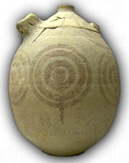 "It
does not also seem chance that only in Iberia are found remains of an
ancient circular concentric city that was alternating circular pits of
water with rings of ground on those that they were building and that
were connected by means of bridges, as well as complex canalizations
that were serving to bring the waters of the mountains; quite almost
exactly equal to as it describes Plato in the Critias. Circular cities
or with protection pit around someone of them are known in other places
of Europe, but none as that of Jaén – with these
so
complex hydraulic characteristics , and so similar to the principal
city of the Atlantis – not so ancient as the concentric
circular
city of Jaén.
"It
does not also seem chance that only in Iberia are found remains of an
ancient circular concentric city that was alternating circular pits of
water with rings of ground on those that they were building and that
were connected by means of bridges, as well as complex canalizations
that were serving to bring the waters of the mountains; quite almost
exactly equal to as it describes Plato in the Critias. Circular cities
or with protection pit around someone of them are known in other places
of Europe, but none as that of Jaén – with these
so
complex hydraulic characteristics , and so similar to the principal
city of the Atlantis – not so ancient as the concentric
circular
city of Jaén.
Ceramics
with concentric circles will be able to be in many places of the
Mediterranean, belonging to other peoples as Greeks, Phoenicians and
Etruscans, but ceramics with symbols of “Concentric
Rings and
Channel”, as the scheme of Atlantis, only they appear in
Iberia
as the investigative Hisppanic – Cuban demonstrates, at least
up
to the date."
(http://www.atlantisarchives.org/tag/concentric-rings")
 The
"Concentric Rings and Channel" may be found on Iberian ceramics but
this design is ancient. Neolithic petroglyphs from Scotland, England
and elsewhere display what is termed ring cups. These predate the
Iberian design by thousands of years. No one really knows what these
designs mean but they appear in northern Europe, India, Mesoamerica and
the United States. The ring cup to the left is from Scotland and is a
drawing of a cup and ring design carved in rock. The number of rings
varies in these pertroglyphs and this design sometimes has and
sometimes
not the so called channel. Some of the channels are really channels
that are carved deeper than the rings themselves. Also there are
varieties of the cup and ring design which add to the mystery of its
meaning. The Tartessian symbol may be the symbol of Atlantis or it
could
be one of those ancient symbols whose real meaning is lost to us. But
the location on the Atlantic seaboard and past the Pillars of Hercules
- as stated by Plato - should give us a pause for thought.
The
"Concentric Rings and Channel" may be found on Iberian ceramics but
this design is ancient. Neolithic petroglyphs from Scotland, England
and elsewhere display what is termed ring cups. These predate the
Iberian design by thousands of years. No one really knows what these
designs mean but they appear in northern Europe, India, Mesoamerica and
the United States. The ring cup to the left is from Scotland and is a
drawing of a cup and ring design carved in rock. The number of rings
varies in these pertroglyphs and this design sometimes has and
sometimes
not the so called channel. Some of the channels are really channels
that are carved deeper than the rings themselves. Also there are
varieties of the cup and ring design which add to the mystery of its
meaning. The Tartessian symbol may be the symbol of Atlantis or it
could
be one of those ancient symbols whose real meaning is lost to us. But
the location on the Atlantic seaboard and past the Pillars of Hercules
- as stated by Plato - should give us a pause for thought.
(Image from: http://www.perceptions.couk.com/westward.html)
(http://www.science-frontiers.com/sf062/sf062a01.htm)
 "Now
over one thousand of the ’cup and ring’ carvings
can be
admired on a new website, which carries 6,000 images and is said to be
the most comprehensive of its kind in the world. The site, which goes
live today [Jan
14, 2005],
includes the 250 panels unearthed during a two-and-a-half year trawl of
some of England’s remotest countryside, in the expansive
moorlands of Northumberland.
"Now
over one thousand of the ’cup and ring’ carvings
can be
admired on a new website, which carries 6,000 images and is said to be
the most comprehensive of its kind in the world. The site, which goes
live today [Jan
14, 2005],
includes the 250 panels unearthed during a two-and-a-half year trawl of
some of England’s remotest countryside, in the expansive
moorlands of Northumberland.Experts, however, are still grappling with the origins and meaning of these abstract carvings, believed to be the work of Neolithic and Early Bronze Age people between 6000 and 3500 years ago, although there are several theories."
(http://www.innovations-report.com/html/reports/earth_sciences/report-38890.html)
This is but one of many stories of where Atlantis was located. It is mentioned here because of its connection to the Neolithic enigmatic cup and rings symbol.
Paradise:
Eden vs Dilmun
There
as been academic
speculation that Dilmun and Eden are the same. They are not. The
confusion arises, of course, from the fact that both are called a
paradise. Eden was
to the north west of Dilmun which was a Nodite city that replaced the
destroyed Dalamatia. Technically, the inhabitants of Dilmun were of
Nodite heritage and the those of Eden were Adamic. Thus they were two
different races. Although the southern Nodites interacted with the
inhabitants of the garden there still was a divide between them.
"The
Sumerians did not have a "unified" Eden myth.
Instead they had numerous myths dealing with a place called Dilmun.
Just what and where was Dilmun? There seems to have been two such
places in Sumerian literature. A mythical paradise-like place and a
real geographic local that traded with and paid tribute to various
Mesopotamian lands. Most scholars now identify Dilmun with the island
of Bahrain. This may well be the case for the later historical Dilmun,
but the earlier paradise like Dilmun could not have been there.
The
only similarity between Genesis and Sumerian
myths is that they both have a paradise in the east. The most important
theme of Eden is the Trees and the Fall of Man. In fact the whole point
of the Genesis tale is the Fall of Man and the introduction of sin and
death, not that man was placed in a garden. The Sumerians made no
mention of this and a paradise or earlier golden age is common in many
religions and cultures. It is obvious to me that the Hebrews did not
borrow from the Sumerians."
(http://www.geocities.com/garyweb65/eden1.html)
"The
Land of Tilmun/Dilmun known account of a
paradisial garden appears on a cuneiform tablet from ancient Sumer.
Here we learn of the mythical place called Dilmun, a pure, clean,
bright place where sickness, violence, and old age do not exist. At
first this paradise lacks only one thing: water. Eventually this is
provided by the Sumerian water god, Enki. At once, Dilmun is
transformed into a garden of fruit trees, edible plants, and flowers.
Dilmun, however, is a paradise for the gods alone and not for human
beings, although one learns that Ziusudra (the Sumerian counterpart of
Noah) was exceptionally admitted to the divine garden." (An
Encyclopedia of Archetypal Symbolism)"
(http://www.piney.com/BabEpicParad.html)
 If
one
reads the ancestral records, Dilmun is where the sun rises which would
place it east of the Sumerian city states. To the north the
name
Eden survived. The Sumerians were quite aware of Eden but did not mix
very much with them even though as Andites they had Adamic blood. They
preferred the culture of the Nodites. Dilmun is most likely located in
Elam but exactly where is unknown. One Sumerian description
has Dilmun at the mouth
of two bodies of water. The Urantia Book places it to the north and
east but near the Persian Gulf, page 858. Just as there were two
Gardens there were two Dilmuns. One was in remembrance of Dalamatia
and the other as a trading partner which some have designated as
Bahrain. There is a small ruined city, just foundations, that has been
labeled Dilmun on the northern tip of Bahrain.
If
one
reads the ancestral records, Dilmun is where the sun rises which would
place it east of the Sumerian city states. To the north the
name
Eden survived. The Sumerians were quite aware of Eden but did not mix
very much with them even though as Andites they had Adamic blood. They
preferred the culture of the Nodites. Dilmun is most likely located in
Elam but exactly where is unknown. One Sumerian description
has Dilmun at the mouth
of two bodies of water. The Urantia Book places it to the north and
east but near the Persian Gulf, page 858. Just as there were two
Gardens there were two Dilmuns. One was in remembrance of Dalamatia
and the other as a trading partner which some have designated as
Bahrain. There is a small ruined city, just foundations, that has been
labeled Dilmun on the northern tip of Bahrain.
"“Eden,”
in Hebrew means,
“delight.” It was the first residence of humankind.
Controversy has revolved around the question of the geographic location
of Eden. The name Eden is probably connected with Edinn, the Sumerian
name for the plain of Babylon."
(http://www.unifiedftheory.com/Exc6.htm)
If you wish to read the translations of the Sumerian tablets go to the ETCSL: full catalog of Sumerian literary compositions at http://www-etcsl.orient.ox.ac.uk/catalogue.htm. This is an excellent resource for the translations of the various records of the Sumerians. Another very good resource is: http://www.earth-history.com/index.html


