The
Anunnaki: The Seven Great Gods
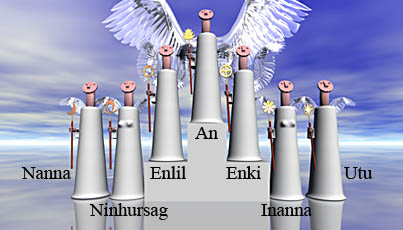
“Those
Who From Heaven to Earth Came”
“The
Shining Ones”
This page is about the Anunnaki and is one of the most popular. My guess is that many visiting this site arrive here first. If this describes you then you should read the introduction first to get a better understanding of what this page and all the other pages on this site are about. You need a context to understand the historical significance of this subject - what modern historians/archaeologists/paleontologists consider as myth. It is not myth. The Anunnaki are a result of an unrecognized prehistorical event. The introduction will also help you understand who the Nephilim are. They too, as the Anunnaki, are a result of certain events in prehistory - deep into the Paleolithic. Legends of the existence of the Anunnaki and Nephilim are true but quite different than you might assume. The link to the Introduction page is at the bottom of this page. If you are familiar with this web site then some of the following will be repetitious.
For those who are unfamiliar as to who are the Anunnaki the following is a brief definition. The Anunnaki are the pantheon of Sumerian gods. Depending where you get your information and what epics are being referenced the total number varies with Enoch giving the number of 200 which is the number the Urania Book gives as well which includes the human associates who were modified to be sustained by the Tree of Life. The ones most important are the seven great gods as pictured above. It is mainly these seven that comprise most of the Sumerian epics. The pantheon of "gods" in the above description is the most broad description but fails to explain who and what they were. The Anunnaki were real and just as the Sumerians wrote they did come from a place we call heaven. The Sumerians were writing/documenting their own history for they are directly connected to the Anunnaki. There are a lot of sites devoted to the legend of these Anunnaki. Almost all of it is myth. First are the Sitchen sites and how the Anunnaki came from Nibiru. Then there are the believers that the Anunnaki are from a reptilian race (a reference to the Winged Serpent?) or have something to do with UFOs all of which is pure fantasy. The Anunnaki grew out of the legend of the Caligastia 100 and the Lucifer rebellion. One tipoff is the fact that they were a council with a leader (An). A very earthly arrangement that reflects a heavenly one and one they would have been very well aware of and fashioned themselves after:
"God's heavenly council was made up of angelic servants often called “sons of God” (Job 1:6; Job 2:1).
God sent these servants from the council from time to time to do His bidding (Job 1-2).
For Jeremiah the sign of false prophets was that they had not “stood in the counsel of the Lord” (Jeremiah 23:18).
(http://www.studylight.org/dic/hbd/view.cgi?number=T1427)
The Caligastia 100 are the original Anunnaki whose mission was to teach early man the ways of civilization. You can find a reference to this statement in the Book of Jubilees as noted elsewhere on this web site (Lucifer). Jubilees uses the term Watchers which is also the Biblical term for the Anunnaki. This is what the Sumerian statement refers to that civilization was a "gift from the gods". And like just about everything else the Sumerians wrote about, it is true. At that time the Anunnaki were the government of the planet. Their authority was divine. This is also why the statement that "kingship descended from heaven" was Sumerian as well. Then came the Lucifer rebellion, that "war in heaven". And it is because of this event that there was a split among the ranks of the Anunnaki with some considered as "good" and some considered as "bad". Those who are the "bad" Anunnaki are the ones who were the progenitors of the Nephilim.
The Sumerian stories about all of this prehistory for the most part uses the main and most important seven sages to tell these epics. These "gods" play different roles in these stories, roles which may not be accurate. But the stories themselves are. What I find interesting is that many of these stories are about Adam and Eve (Eve mostly), the Tree of Life and Eden. They too are a part of the Anunnaki and just like the Caligastia 100 they came from heaven. The Sumerian account of civilization coming from heaven is true even though it includes two different divine regimes. Adam and Eve came well after the rebellion and they were the new planetary government. The statement "kingship descended from heaven" is much more appropriate to Adam and Eve than the much older Caligastia 100. The Edenic influence could be considered greater than the older participants because one, the stature of Adam and Eve and the stronger of the two, the closer proximity on the time line to us of Eden vs. the original 100. We are talking about extreme lengths of time which is a major contributor to the confusion regarding the interpretation of these so-called myths. For example the division between Enlil and Enki. Both knew each other at the time of their arrival. In the Sumerian story of the flood they are in conflict. The story of the flood is true, there was a great flood and described as a "world flood" which in reality it was not, only to be mistakenly identified as such much later. But neither role of these two opposing forces is true because they were no longer around at the time of the flood. Enlil, who was Nod, was less than dust by this time and Enki, who was Van, had returned long ago to where he came from. But that does not negate the story itself that to the Sumerians there was a world flood - as far as they were concerned. Who would have thought that the Sumerians created the first Hollywood using the same actors in different roles to tell different stories?
The "canonization" of the Anunnaki is well after the establishment of the second garden. The council of the Sumerian Anunnaki was not entirely ancient Anunnaki, that is, Nodite - of the fallen although there is a very strong Nodite influence. It includes the Adamic and Vanite and points to, I think, it's Andite roots. The Andites appear at about 25,000 BC. Their bloodline includes both Adamic and Nodite. They may even be the "smarter humans" created by Ninhursag. They were smarter. By 3,000 BC the Adamite and Nodite bloodlines were quite blended and the stories about the Anunnaki reflect both cultures.
And now onto the players. The following definitions for the individual Anunnaki are my personal take on these great gods. You will not find these definitions anywhere else but here.
"Fundamental to anything regarding the Sumerians are their gods and goddesses, whom as a group they called the Anunnaki (literally, “those who from heaven to earth came”). As in any later pantheon, the Anunnaki consisted of a number of very different personalities, that clashed with each other often and in an enormous variety of ways. While their very distinct personalities can be used to establish Archetypes, all of the evidence suggests that the Anunnaki were historical figures and not mythological.
The Sumerian Family Tree, in fact, distinguishes between those Gods and Goddesses who were born on earth (the new generation) and those born in heaven. The Sumerian texts also describe the Epic of Creation (of which Genesis is a condensed version), as well as a continuing semi-sibling rivalry between Enki and Enlil, their offspring, and those humans who voluntarily or otherwise began the process of choosing up sides."
(http://www.halexandria.org/dward183.htm)
"Laurence Gardner [2] has written: “Every item of written and pictorial attestation confirms that the ancient Sumerians were absolutely sincere about the existence of the Anunnaki, and those such as Enki, Enlil, Nin-khursag and Inanna fulfilled earthly functions with designated community duties. They were patrons and founders; they were teachers and justices; they were technologists and kingmakers. They were jointly and severally venerated as archons and masters, but there were certainly not idols of religious worship as the ritualistic gods of subsequent cultures became. In fact, the word which was eventually translated to become ‘worship’ was avod, which meant quite simply, ‘work’. The Anunnaki presence may baffle historians, their language may confuse linguists and their advanced techniques may bewilder scientists, but to dismiss them is foolish. The Sumerians have themselves told us precisely who the Anunnaki were, and neither history nor science can prove otherwise.” "
(http://www.geocities.com/elchasqui_2/Genesiskings7.html)
"For over a millennium, about 5000 years ago, there was one dominant and unchanging belief in what we would today call a religion. In this ancient time religion and culture were identical. The leaders and rulers of men were described as being in intimate contact with the "gods," who were collectively known as Anunaki. The growing dictionary of words and meanings that was being compiled by the translations of the Nippur fragments quickly hinted to something extraordinary. That the ancient "gods" took their name from "Anu," meaning heaven, and "ki," which means earth. Literally, they were "those who came from heaven to earth.""
(http://www.viewzone.com/origins.html)
The following personal definitions are really too brief but they should give you an idea of the personality behind the name.
 An - Angelic/Rebel
As based on a pre-historical figure, most likely Caligastia the now defunct and dysfunctional ex-Planetary Prince. At the time of the rebellion he was proclaimed by his subordinate as "God of Urantia and supreme over all." (Urantia Book p755)
An is at the top as a creator god of the Sumerian pantheon but he is more like a retired god and may be the prototype for El. Distant in the affairs of humankind.
No home town. AKA Anu, Anus and the father of the gods
His palace is at the top in the heavens of the axis mundi.
 Enlil - Watcher/Rebel
As based on a pre-historical figure, most likely Nod namesake to the "land of Nod" east of Eden. One of the leaders in the 100 (the commission on industry and trade). Most often second in command but also older half brother to Enki. Not the most popular god around as he is the one responsible for the Sumerian flood to wipe out the noisy humans. In some epics he is responsible for the mes. Marduk, a younger upstart Babylonian god, wrested the axis mundi from Enlil to his own temple Esagil at Babylon. According to Babylonian epics Marduk is Enki's son. Sweet.
Home town is Nippur at one time the spiritual center of Sumeria. AKA Ellil and the king of the Anunnaki/Lord of the Sky
His palace is in the middle of the axis mundi.
 Enki -
Watcher/Loyalist
Enki -
Watcher/LoyalistAs based on a pre-historical figure, most likely Van as in the Kingdom of Van and Lake Van. One of the leaders in the 100 (the supreme court of tribal co-ordination and racial co-operation). Like Enlil he was deemed the keeper of the mes which are the declarations of civilization. A popular god who saved humanity from the Sumerian flood and other disasters. Although titled Lord of the Earth he is associated with sweet water as opposed to salt water.
Home town is Eridu the first Sumerian city. AKA Ea and the Lord of the Earth
His palace is in the abyss at the bottom of the axis mundi.
Read more on Van as Enki on the page Van.
 Inanna -
Adamic/Loyalist
Inanna -
Adamic/LoyalistAs based on a pre-historical figure, most likely Eve. Sometimes referred to as the Earth Goddess. As a "late comer" she may have been grafted onto an earlier version of the Goddess if one existed. Origin of the Earth Goddess is not certain but may date from deep into the Paleolithic. Despite her lower status within the Anunnaki pantheon she wields great power. Her strongest associations are with the sacred tree, the serpent and the bestower of kingship. She was also a very popular goddess.
Home town is Erech/Uruk (along with Gilgamesh). AKA Ishtar and the Goddess of Love and War and the Queen of Heaven
Read more on Eve as Inanna on the page The Tree of Life.
 Utu - Adamic/Loyalist
As based on a pre-historical figure, most likely Adam. As Genesis states Adam was an agriculturalist. As Utu the Sun god he has many roles which include agriculture. Like his "sister" Inanna he too is of a lower rank. This may be due to the lateness of their arrival after the rebellion with An, Enlil and Enki being far older gods with their standings within the 100 or the fact that Adam and Eve are not Nodite. However, they were superhuman planetary rulers, connected with Enki and thus their importance to the Sumerian pantheon.
Home town probably none as he was always rising in the east and setting in the west. AKA Shamash and the god of justice
Read more on the symbolic connection of Adam as Utu and Eve as Inanna on the page The Sun and Rosette
 Nanna -
Nodite?/Aboriginal?/Semetic
Nanna -
Nodite?/Aboriginal?/SemeticAs based on a pre-historical figure, unknown but is male. May have been included within the pantheon due to the importance to the hunter/gatherers. Would have had an ancient tradition prior to agriculture. "Before Dilmun existed, palm trees grew in my city" so says Nanna in the Sumerian epic The Journey of Nanna to Nippur. May have kept power because he was a lunar marker of religious feasts/festivals (Easter partly follows the lunar calendar). In the Sumerian texts he is the father of Inanna and Utu. Associated with Astrology because of his connection to the lunar calendar and cycle. He was very powerful.
Home towns Ur and Harran. AKA Sin and as the Lord of Wisdom.
 Ninhursag -
Watcher?/Nodite?
Ninhursag -
Watcher?/Nodite?As based on a pre-historical figure, unknown. She could be one of the oldest goddesses as she personifies the earth as Ki at the time of creation. Her symbol is an omega shape that represents the uterus (the womb of creation). In the epic Enki and Ninmah (Ninmah as Ninhursag) they try to create the first humans from clay. Her interactions with Enki may have more to do with Dilmun than with Eden.
Home town unknown but could be Kish. AKA Aruru and the mother of the gods.
In the later Babylonian epics these gods have their counterparts plus the god Marduk who is the Swiss army knife of all gods. He does it all. He creates the world by defeating Tiamat, he creates the first humans, dethrones a top Sumerian god and declares Babylon as the center of the world. Not bad. The following quotes have a semblance to the situation at the time of the rebellion, in particular that of Nod so it could be a retelling of that story when after they had chosen up sides.
"The sixty members of the planetary staff who went into rebellion chose Nod as their leader. They worked wholeheartedly for the rebel Prince but soon discovered that they were deprived of the sustenance of the system life circuits. They awakened to the fact that they had been degraded to the status of mortal beings. They were indeed superhuman but, at the same time, material and mortal." (Urantia Book p 757)
"Enoch elaborates with the leading Watcher, Semjaza, in fear of receiving all blame for their passions:
Semjaza, who was their leader, said unto them: “I fear ye will not indeed agree to do this deed, and I alone shall have to pay the penalty of a great sin.” And they all answered him and said: “Let us all swear an oath, and all bind ourselves by mutual imprecations not to abandon this plan but to do this thing.” Then sware they all together and bound themselves by mutual imprecations upon it. And they were in all two hundred; who descended in the days of Jared on the summit of Mount Hermon, and they called it Mount Hermon, because they had sworn and bound themselves by mutual imprecations upon it." ( Enoch 6:4-7)
"Thus freed from all burdens [Marduk created man as their slave], the gods wanted to show their gratitude to Marduk, and as a token they took, of their own free will, for one last time, spade in hand to build Babylon and Marduk's temple Esagila. In the new temple the gods then assembled and distributed the celestial and terrestrial offices. The "great gods" went into session and permanently appointed the "seven gods of destinies," or better "of the decrees," who would formulate in final form the decrees enacted by the assembly." (From the Myth of Atrahasis)
(http://ragz-international.com/sumerian_and_akkadian_myths.htm)
"Marduk then announced his intention of building a city for himself, Babylon, with room for the gods when they come there for assembly. His fathers suggested that they move to Babylon themselves to be with him and help in the administration of the world he had created. Next, he pardoned the gods who had sided with Tiamat and had been captured, charging them with the building tasks. Grateful for their lives, they prostrated themselves before him, hailed him as king, and promised to do the building."
(http://ragz-international.com/sumerian_and_akkadian_myths.htm)
The
Reigns of the First Kings
The
reign of the first Sumerian kings are exceeding long a length that can
only be called superhuman. "After the kingship descended from heaven,
the kingship was in Eridu." This statement is from the Sumerian kings
list. The first king was Alulim and he
ruled for 28,800 years. But his was not the longest kingship
as
Enmen-lu-ana ruled for 43,200 years. It is because of these
unbelievable long reigns that scholars do not put any credence into
these dates. There are 19 total known
kings lists and they do not match exactly. Not all kings that are known
are on the list. Some kings are on some lists and not others. The
Sumerian kings
list relates numerically to the Biblical list of the patriarchs but
differ enough that the Biblical list most likely was not copied from
the Sumerian list. In fact it seems just the reverse. The
antediluvian portion was written after the postdiluvian list. The
extremely
long lives of the earliest kings could be attributed to a scribe who
mistakenly calculated the time line in the sexagesimal rather than the
decimal notation. This is the current speculation. Zecharia Sitchen quotes 450,000 years for the arrival of
the
Anunnaki. It is most likely that the figure of 450,000 years is from
one of the kings list. The one I looked at tallied 400,000 years.
Here's what the Urantia Book says on this subject:
"...
This lengthening of the reigns of these older kings
signifies that some of the early Nodite rulers (immediate descendants
of the Prince's staff) did live longer than their later-day successors
and also indicates an effort to stretch the dynasties back to Dalamatia.
The records of such long-lived individuals are
also due to
the confusion of months and years as time periods. This may also be
observed in the Biblical genealogy of Abraham and in the early records
of the Chinese. The confusion of the twenty-eight-day month, or season,
with the later introduced year of more than three hundred and fifty
days is responsible for the traditions of such long human lives."
(Urantia Book p. 857-8)
Dalamatia the first city built on the earth dates back to about 500,000 years ago. It was destroyed by a tidal wave from the Persian Gulf. At 400,000 years ago it would have existed.
"And all of this explains how the Sumerians appeared so suddenly and mysteriously on the stage of action in Mesopotamia. Investigators will never be able to trace out and follow these tribes back to the beginning of the Sumerians, who had their origin two hundred thousand years ago after the submergence of Dalamatia. Without a trace of origin elsewhere in the world, these ancient tribes suddenly loom upon the horizon of civilization with a full-grown and superior culture, embracing temples, metalwork, agriculture, animals, pottery, weaving, commercial law, civil codes, religious ceremonial, and an old system of writing. At the beginning of the historical era they had long since lost the alphabet of Dalamatia, having adopted the peculiar writing system originating in Dilmun. The Sumerian language, though virtually lost to the world, was not Semitic; it had much in common with the so-called Aryan tongue." (Urantia Book p 860)
The
Patriarchs
The
Biblical antediluvian
patriarchs were
all from Mesopotamia. They are: Adam, Seth, Enos, Cainan,
Mahaleel, Jared, Enoch, Methuselah,
Lamech and Noah. These are the ten generations between the expulsion
from the garden to the bringing of the flood - according to the
Biblical record. Since these patriarchs lived in southern Mesopotamia they
would have
been exposed to the Sumerian stories of the flood, creation of the
world, babe in
the reeds, tower of Babel, the creation of humans from clay,
the Land of Nod, the Nephilim and of course the
Anunnaki. Coupled with that was the fact of the Jewish internment in
Babylon after their capture and deportation by King Nebuchadnezzar. They too would have been exposed to these same legends.
Just
a thought.
The Flood
There
are five
cities "before the flood" listed in the kings list. They are Eridu,
Bad-Tibira, Larak, Sippar and Shuruppak. Eridu is listed as Sumeria's
first city. Considering how conscientious and proud the Nodites were of
their past history, Eridu most likely was their first city and that
goes as well for the other four being the group of five first cities. Two locations however
are in question and those are Bad-Tibira (aka Badgurgurru) and Larak
which some archaeologists think is Larsa. But archaeologists have
determined by the best of their abilities that the locations on the map
below are correct. Click on it for a larger view. Some though do not
think these cities have been
located. In keeping with tradition
these five cities were supposedly rebuilt over the foundations of the
older cities. We still do this today. Eridu
is regarded as the first city built by man. Shuruppak is the home town
of Ziusudra who we know as Noah. These five cities are also chronicled
in the "Eridu Genesis", that kingship descends from heaven and it
describes the flood.
 When
surmising about the Nodite heritage there are some conclusions I have
arrived at. First, the original 100 were well versed with the tools of
civilization. When they arrived their mission was to help early man
become civilized and they did work for this goal for an extremely
long time. The rebellion destroyed almost all of their efforts but they still had the knowledge and
skills within their culture. Second,
the rebellion did not erase those memories of who they were
and
where they came from. If anything, in realizing their now
mortality, they instilled that desire of remembrance for their
former glory deep into their culture. It has been said that they
(the Sumerians) "walked backward into the future" meaning they never
forgot their past.
For instance, Dilmun as the place of the garden for the gods was
Dalamatia and is one
marker for the memory that stretches back easily more than 200,000 years.
As far as the kings list goes with the extraordinary length of kingly
reigns they did in fact place it on the time line when Dalamatia
existed. But I think this was just a lucky coincidence based on the
fact that they were confused on the length of the year. But it is
ironic that they were correct. The reign of kings when totaled does
reach back to the age of Dalamatia. However, it also makes Eridu
400,000 years old. I doubt that.
When
surmising about the Nodite heritage there are some conclusions I have
arrived at. First, the original 100 were well versed with the tools of
civilization. When they arrived their mission was to help early man
become civilized and they did work for this goal for an extremely
long time. The rebellion destroyed almost all of their efforts but they still had the knowledge and
skills within their culture. Second,
the rebellion did not erase those memories of who they were
and
where they came from. If anything, in realizing their now
mortality, they instilled that desire of remembrance for their
former glory deep into their culture. It has been said that they
(the Sumerians) "walked backward into the future" meaning they never
forgot their past.
For instance, Dilmun as the place of the garden for the gods was
Dalamatia and is one
marker for the memory that stretches back easily more than 200,000 years.
As far as the kings list goes with the extraordinary length of kingly
reigns they did in fact place it on the time line when Dalamatia
existed. But I think this was just a lucky coincidence based on the
fact that they were confused on the length of the year. But it is
ironic that they were correct. The reign of kings when totaled does
reach back to the age of Dalamatia. However, it also makes Eridu
400,000 years old. I doubt that.

Third, the Sumerians also wrote about the Garden of Eden with its sacred tree - another ancient memory and fairly accurate. The goddess Inanna had a holy garden in which a sacred tree was planted and from which she received her bed and throne, symbols of her power to grant kingship. It was cut down by Gilgamesh who in his epic searched for the plant of immortality. The Sumerians also mention the Plain of Eden later to be known as the Plain of Babylon. So the Sumerian cuneiform tablets contain much very ancient "history". The story of the flood is so powerful that it divides their history into two parts. Writing occurred just after the flood if you accept 5000 BC as this date (see below). Therefore, I think, is why the five pre-flood cities were known and mentioned. Given this part of Sumerian history we can only guess what else was kept alive and that seems to be the manifested "from out of nowhere" knowledge, creativity and inventiveness of these so suddenly appearing Sumerians.
The flood story is Mesopotamian.There is much historical data that floods, some severe, happened in Mesopotamia with the result that the first writings described them. Anyone who has looked at the current pictures of Iraq will see it is flat as a pancake. So you have a flat alluvial plain with two great rivers running through it. Both rivers have their origin in the northern mountains and fed by melting snows and rain. Historians do not know exactly when the great flood occurred but some estimate that it could have been some time around 5000 BC. This is a very good guess considering our present day knowledge of climate change. Consider the following:
"The Würm ice-age made its last attack
around 8000 BCE. The geological epoch starting then is called Holocene.
Within a fairly short time (of order 1000 year) the world climate is
basically the same as nowadays, with fluctuations on a large time
scale. Recovery to normal temperature after an ice age is generally
fast. It was even warmer and wetter than it ever has been since. The
optimum of the warm and wet period (called Atlanticum, one of the
subdivisions of the Holocene) is around 5000 BCE. It is the era in
which England becomes an island again and northern Europe changes in
marshland by the heavy rainfall. Modern shorelines are approximately
reestablished. Coastal settlements earlier than 5000 BCE are now under
water. During the Atlanticum westerly rainstorms stray deep into the
desert zones of North Africa and the Near East. The present-day steppe
areas were turned into green land. Many lakes are seen, in particular
in Africa, that are now always dry. The distribution of the
precipitation is the same as nowadays, only the absolute values change."
(http://home.swipnet.se/~w-63448/mesopotam.htm)
For
those who date the flood at around 3200BC that is not supported by
scientific evidence. In fact that period of time was one that was more
dryer. Radiocarbon dating of sea floor sediment reveals less water and
hence a drier climate.
See this URL for more information:
(http://home.swipnet.se/~w-63448/mesopotam.htm)
The
Ancient World Concept
To
understand the flood as a world wide phenomenon we must understand the
ancient concept of how the Sumerians understood their world. To begin
with the
universe was believed to be one huge and perhaps infinite salt ocean.
Whether in the Bible or in the Sumerian tables the creation story is
the same. First:
Genesis 1:6 "And
God said, Let there be a firmament in the midst of the waters, and let
it divide the waters from the waters."
Genesis
1:7 "And God made the firmament, and divided the waters which were under the
firmament from the waters which were above the
firmament: and it was so."
Genesis
1:8 "And God called the firmament Heaven. And the evening and the
morning were the second day."
Genesis
1:9 "And God said, Let the waters under the heaven be gathered together
unto one place, and let dry land appear:
and it was so." (KJV)
Now
to compare this creation story (which is one of two in Genesis, the Enuma Elish
also has two versions) with what the Sumerians wrote in the
poem The
Creation of the Pickax:
"After heaven had been moved away from earth,
After
earth had been separated from heaven,
After
the name of man had been fixed;
After
An had carried off heaven,
After
Enlil had carried off earth,
After
Ereshkigal had been carried off into Kur as its prize; ...
More form The
Creation of the Pickax:
The lord, that which is appropriate verily he caused to appear,
The
lord whose decisions are unalterable,
Enlil,
who brings up the seed of the land from the earth,
Took
care to move away heaven from earth,
Took
care to move away earth from heaven.
In
order to make grow the creature which came forth,
In
the "bond of heaven and earth" (Nippur) he stretched out the . . ."
As we can see in both accounts of creation Heaven was separated from earth. A further explanation occurs in the Babylonian poem the Enuma Elish for the firmament in the context of Marduk's defeat of Tiamat where he "puts up a roof for the sky" from half of her body. As I understand it Tiamat although a terrible dragon-like creature represents salt water and her counterpart Aspu is fresh water. Also to the Sumerians there may have been land in the form of a mountain, the abode of the gods, but there may have been a beginning now lost where there was no land at the beginning of creation. The implication from The Creation of the Pickax is that there was land when "heaven was moved away from earth". In any case a vault of heaven was created, the firmament, and that now an atmosphere was present. In the Sumerian version it is Enlil who is the god of the air. Anu is the sky god.
The result of the world creation was to the Sumerians basically a flat circle of land surrounded by a river or ocean, a hemisphere above that was the firmament and a hemisphere below containing the underworld and the Aspu. The firmament is what it says it is, that it is a solid hemisphere holding back the cosmic ocean. It was on this firmament that the sun, moon and stars traveled upon. The main topical feature of the land was the two rivers running through it. This is hardly the world wide view we have today. A mighty flood would be a world flood. It must have been terrible, so massive as to split the recording of history into antediluvian and after the flood periods as we can see in the Sumerian kings list and other texts.
From the Myth
of Atrahasis
we have the Akkadian description of the flood:
No one could see anyone else,
They could not be recognized in the
catastrophe.
The Flood roared like a bull,
Like a wild ass screaming the
winds howled
The darkness was total, there was no
sun.
Nintu
[a
goddess] was
wailing
Would a true father have given
birth to the rolling sea
(So that) they [humans] could
clog the river like dragonflies
They are washed up like a raft on a
bank,
They are washed up like a raft on a bank in open
country!
I have seen, and wept over them!
Shall I (ever) finish weeping for them?'
After this great destruction Enlil when spotting the boat becomes distressed, "How did any man survive the catastrophe?"..."Enki made his voice heard And spoke to the great gods, I did it, in defiance of you! I made sure life was preserved..." It is at this point that the story breaks off and we do not know what happens to Atrahasis or his boat. The concept of a firmament, a flat world ringed by water and a hemispherical underworld survived to the times of the Greeks and Romans. The following are what I call the "round" maps and not straying that far in concept from Sumeria:
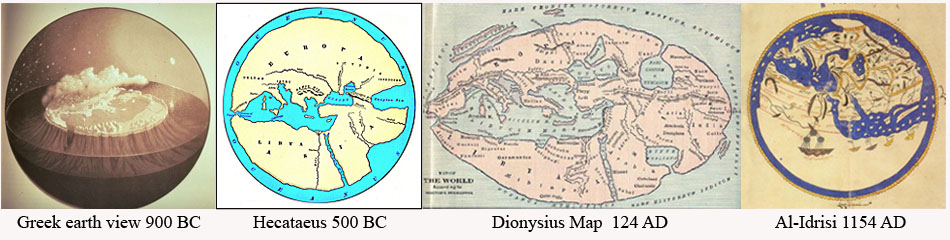

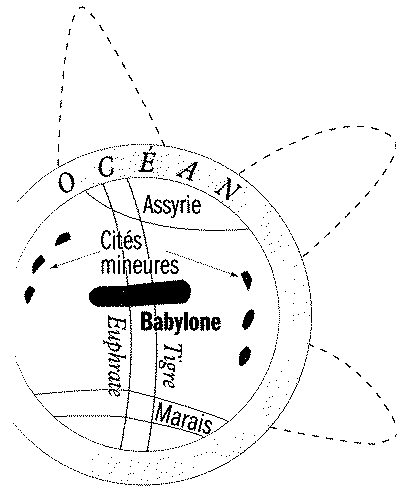 This
map is Babylonian from about 600 BC. In the black and white
illustration you can see
that the center is Babylon represented as a black area with six
cities on the perimeter as smaller black areas. Assyria is at the
northern top and the marshes
at the bottom. There are the two great rivers of Iraq running in
parallel from
north to south. Other illustrations have this band as representing the
Euphrates only. A ring representing the encircling ocean of water is
also
present. This is the map of the world as the Sumerians and Babylonians
knew it. It would be a template of how the world would be represented
for almost the next thousand years. The notion of a flat earth can be
found in the Bible, Daniel 4:10-11 KJV "And thus were the visions of mine head in my
bed; I saw, and behold a tree in the midst of the earth, and the height
therefore was
great. The tree grew, and was strong, and the height therefore reached
unto heaven, and the sight thereof to the end of all the earth:" The implication being
that if the world were spherical then not everyone could see this great
tree which is the world tree the axis
mundi.
They could all see it only if the world were flat. The prophet Daniel
at this time was captive in Babylon during the reign of King
Nebuchadnezzar. The
Egyptians had a similar view except they were the center of the
universe. The Egyptian goddess Nut and the outstretched wings of the
solar disk represented the firmament.
This
map is Babylonian from about 600 BC. In the black and white
illustration you can see
that the center is Babylon represented as a black area with six
cities on the perimeter as smaller black areas. Assyria is at the
northern top and the marshes
at the bottom. There are the two great rivers of Iraq running in
parallel from
north to south. Other illustrations have this band as representing the
Euphrates only. A ring representing the encircling ocean of water is
also
present. This is the map of the world as the Sumerians and Babylonians
knew it. It would be a template of how the world would be represented
for almost the next thousand years. The notion of a flat earth can be
found in the Bible, Daniel 4:10-11 KJV "And thus were the visions of mine head in my
bed; I saw, and behold a tree in the midst of the earth, and the height
therefore was
great. The tree grew, and was strong, and the height therefore reached
unto heaven, and the sight thereof to the end of all the earth:" The implication being
that if the world were spherical then not everyone could see this great
tree which is the world tree the axis
mundi.
They could all see it only if the world were flat. The prophet Daniel
at this time was captive in Babylon during the reign of King
Nebuchadnezzar. The
Egyptians had a similar view except they were the center of the
universe. The Egyptian goddess Nut and the outstretched wings of the
solar disk represented the firmament. For more information on the ancient flat earth theory go to: http://www.edwardtbabinski.us/geocentrism/scientific_creationism.html.
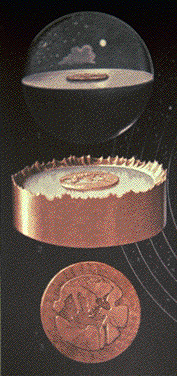 "In the
imagination of the Mesopotamians (the Sumerians, Elamites, Babylonians
and Assyrians), the earth was a flat disc, surrounded by a rim of
mountains and floating on an ocean of sweet water. Resting on these
mountains was the hemispherical vault of the sky, across which moved
the stars, the planets, the sun and the moon. Under the earth was
another hemisphere containing the spirits of the dead. The
Mesopotamians visualized the whole spherical world-universe as being
immersed like a bubble in a limitless ocean of salt water."
"In the
imagination of the Mesopotamians (the Sumerians, Elamites, Babylonians
and Assyrians), the earth was a flat disc, surrounded by a rim of
mountains and floating on an ocean of sweet water. Resting on these
mountains was the hemispherical vault of the sky, across which moved
the stars, the planets, the sun and the moon. Under the earth was
another hemisphere containing the spirits of the dead. The
Mesopotamians visualized the whole spherical world-universe as being
immersed like a bubble in a limitless ocean of salt water."(http://kl4www.ki.ku.dk/Samfund/Book.pdf)
For a further explaination of the Babylonian map click here: Babylon Map
"Firmament by Rabbi Geoffrey W. Dennis
Hebrew "Rakia." God places a firmament between the waters of earth and
the waters of heaven to separate them. Some say there are two
firmaments, based on a Biblical verse (Deut. 10:14), but most teach
there are seven. Later traditions identify the word rakia as referring
to just one of the seven heavens, the level that holds the heavenly
bodies."
(http://www.pantheon.org/articles/f/firmament.html)
The Firmament and the
Seven Heavens:
"The idea that the heavens are multiple and stacked
one
above another was widespread among the ancient cultures of the world.
Perhaps this came from a natural tendency to ask what lay above the
dome of the sky and to imagine a hierarchy of additional skies in which
the gods dwelled. But the number of heavens one finds in the
world’s ancient mythologies was not necessarily seven. Lesser
and
greater numbers were imagined, too. The number of seven, or sometimes
eight, first took hold in the Near East and eastern Mediterranean world
as a blend of Babylonian astronomy and early Greek science.
This concept we find only in rabbinic literature, where it plays an important role, especially in the early form of Jewish mystical thought known as “Hechalot” or “Palace” mysticism. In the Hechalot tradition, it is the task of the mystical initiate to ascend by meditative techniques through the seven heavens one after another, overcoming angelic challenges in each, and then to pass safely through the seven “palaces” of the seventh heaven in order to reach the base of God’s throne. Similar beliefs, each with a complex angelology, existed among various Gnostic sects in the Roman Empire and had some currency in early Christianity, too, at least to judge by Paul’s remark in Corinthians II that “I knew a man in Christ… [who was] caught up to the third heaven.” From Judaism and/or Christianity the idea also spread to Islam, so that we read in Sura 71 of the Quran, “See you not how Allah has created the seven heavens one above another, and made the moon a light in their midst and made the sun a lamp?”
To be in “seventh heaven” is thus to reach the pinnacle of bliss. The expression has been around in English for a long time, although whether it got there from indigenous Christian sources, Jewish ones or Muslim ones, I don’t know. It almost certainly doesn’t come from in zibnten himl, since it’s older than the late 19th-century Yiddish-speaking immigration to the United States. Yet neither does in zibnten himl, which derives from internal Jewish traditions, come from it. Both go back to ancient beliefs that are thousands of years old."
(http://www.forward.com/articles/11110/ By Philologos. Questions for Philologos can be sent to philologos@forward.com.)
Some additional information can be found on the page The First Legend.


