The Nephilim and Rephaim

The Progeny of the Rebellion
Genesis 6:1-4
"1 When men began to increase in number on the earth and daughters were born to them, the
2 sons of God saw that the daughters of men were beautiful, and they married any of them they chose.
3 Then the LORD said, "My Spirit will not contend with man forever, for he is mortal;
his days will be a hundred and twenty years."
4 The Nephilim were on the earth in those days - and also afterward - when the sons of God went to the daughters of men and had children by them. They were the heroes of old, the men of renown."
Revised Standard Version
The Watchers
As
a
brief introduction to the Watchers, they are considered as the angels
who
came to Earth, mated with female humans and sired a race of giants.
They are the Biblical "sons of God" as stated above. Their offspring
are the Nephilim and Rephaim the literary giants of old.
Although mentioned
in the Bible it is the books of Enoch and Jubilees that contains the
most extensive description for these beings.
"The
Watchers were "a specific race of divine beings known in Hebrew as nun
resh 'ayin, 'irin' (resh 'ayin, 'ir' in singular), meaning 'those who
watch' or 'those who are awake', which is translated into Greek as
Egrhgoroi egregoris or grigori, meaning 'watchers'. These Watchers
feature in the main within the pages of pseudepigraphal and apocryphal
works of Jewish origin, such as the Book of Enoch and the Book of
Jubilees. Their progeny, according to Hebrew tradition, are named as
nephilim, a Hebrew word meaning 'those who have fallen' or 'the fallen
ones', translated into Greek as gigantez, gigantes, or 'giants' - a
monstrous race featured in the Theogony of the hellenic writer Hesiod
(c. 907 BC)."
(Andrew
Collins, From the Ashes of Angels - The Forbidden Legacy of a Fallen
Race (1996) p. 3
(http://www.mystae.com/restricted/streams/scripts/watchers.html)
(http://www.semjaaza.com/thewatcher.html)
"The books of Enoch, expunged from the set of canonical sacred books by the Christian Church in the 4th century AD, were previously accepted and generally greatly estimated by the Church fathers (they are even now part of the Canon of the Ethiopian church). These books in their present version are dated usually at the second century BC. It is likely that such a date just refers to the surviving versions, where an ancient obsolete language was modernized. They were indeed considered, e.g. by St Augustin, as works of "hoary antiquity" and they do in fact deal with prediluvian events, about which only intriguing hints may be found in Genesis. That several texts dealing with very ancient events were once in circulation to be later completely lost, also follows from references in the Pentateuch to vanished books, e.g. The wars of Jahweh."
(http://itis.volta.alessandria.it/episteme/ep7/ep7-eden.htm)
And no, the Council of Nicaea in 325 AD did not exclude the apocrypha such as the Book of Enoch from the Bible. It was banned at the Council of Laodicea (364 AD) along with forty two others which includes The First and Second Book of Adam and Eve.
The two names which we are most familiar for the "rebel" angels are the Watchers and the Anunnaki. Watchers is the Biblical name and Anunnaki is the Sumerian name. The rebellion of these so-called angels is because of Lucifer also known by his ancient name Azazel. All of this mysterious and contested history begins with Lucifer's egotistical pride and his puny attempt (at least on a cosmic scale) to raise himself above God. And as it has been said, "Pride goeth before destruction, and an haughty spirit before a fall". KJV And so this very ancient saga as it has been written begins with celestials coming to this planet, become enamored with the women and by having sex with them beget their sons and daughters, the Nephilim believed to be giants. As a side note, the infamy of the Nephilim is the purported reason for the flood, which according to some theologians was 120 years after the fall.
In researching the Genesis quote above, I have not found anything relating the 120 year life span in regards to the Watchers. This 120 years I believe is the statement that they, the Watchers, had now become mortal. In Genesis 5:5 Adam lives 930 years. Noah's father Lamech lived 777 years. Both lived before the flood. But Abraham lived 175 years and his wife Sarah lived 127 years after the flood so the date could not have referred to humans. Scholars explain the figure of 120 years as referring to the time for the coming of the flood (also given time for repentance) but this in my opinion does not address scripture: "My Spirit will not contend with man forever...". My interpretation is that since these beings could have lived forever, this new life span marks that they have been reduced to mortal men as a result of their transgressions. It is because the Watchers became mortals that precipitated the decision to mate and thus increase their numbers. The result being the Nephilim. So I think this reference is about life span and not time frame. As a Urantia Book reader I know the time frame from the fall of the Watchers to the Sumerian flood is not 120 years, it is a chasm of time. Therefore the only thing left is the mortality of the Watchers. "And Noah was six hundred years old when the flood waters was upon the earth." Genesis 7:6. He was nine hundred and fifty years when he died. So Noah lived even longer than Abraham. No matter how you look at it, the Watchers and the Nephilim are a problem for the religious scholars. And as a final note: this explanation does not conflict with scripture; it makes very good sense based on the inclusion "for he is [now] mortal."
The
Traditional and Primary View of Giants (Nephilim)
"These
giants are often mentioned in the early
books of the Old Testament until the last of them were finally killed
off. The word nephilim only appears twice in the Old Testament (Gen
6:4; Num. 13:33), but these giants are also referred to as gibbor (Gen
6:4; Num. 13:33; Job 16:14) and rephaim when they reappear in a more
limited fashion after the flood (Gen. 14:5; 15:20; Deu. 2:11, 20; 3:11,
13; Jos. 12:4; 13:12; 15:8; 17:15; 18:16; II Sam. 5:18, 22; 21:16, 18,
20, 22; 23:13; I Chr. 11:15; 14:9; 20:4, 6, 8; Isa. 17:5; 26:14). They
were known by the proper names of Rephaim, Emim, Anakim, and
Zamzummim."
Bryan
T. Huie
(http://www.aristotle.net/~bhuie/gen6sons.htm)
The Greek term giants also referred to the titans of their mythology. The titans were partly terrestrial and partly celestial. They rebelled against their father Uranus but were defeated by Zeus and thrown into Tartarus. This is the story of the fallen.
"The B'nai Elohim is a term
that refers to angels. It occurs four times in the Old Testament (2)
and is rendered "Angels of God" in the ancient Septuagint translation.
(3) The intrusion of certain angels into the human family resulted in
unnatural offspring termed Nephilim, which derives from the Hebrew naphal
(to fall), or the Fallen Ones. (The Greek Septuagint renders
this term gigantes, which actually means "earth-born." This is often
misunderstood to mean "giants"[emphasis added]---which they
also happen to have been, incidentally.)"
(http://www.ldolphin.org/noahdays.html)
"Giants -
(1.) Heb. nephilim, meaning "violent" or "causing to fall" (Gen. 6:4).
These were the violent tyrants of those days, those who fell upon
others. The word may also be derived from a root signifying "wonder,"
and hence "monsters" or "prodigies." In Num. 13:33 this name is given
to a Canaanitish tribe, a race of large stature, "the sons of Anak."
The Revised Version, in these passages, simply transliterates the
original, and reads "Nephilim."
(2.) Heb. rephaim, a race of giants (Deut. 3:11) who lived on the east
of Jordan, from whom Og was descended. They were probably the original
inhabitants of the land before the immigration of the Canaanites. They
were conquered by Chedorlaomer (Gen. 14:5), and their territories were
promised as a possession to Abraham (15:20). The Anakim, Zuzim, and
Emim were branches of this stock.
(3.) Heb. 'Anakim (Deut. 2:10, 11, 21; Josh. 11:21,
22; 14:12, 15; called "sons of Anak," Num. 13:33; "children of Anak,"
13:22; Josh. 15:14), a nomad race of giants descended from Arba (Josh.
14:15), the father of Anak, that dwelt in the south of Palestine near
Hebron (Gen. 23:2; Josh. 15:13). They were a Cushite tribe of the same
race as the Philistines and the Egyptian shepherd kings. David on
several occasions encountered them (2 Sam. 21:15-22). From this race
sprung Goliath (1 Sam. 1 Chr. 11:9-47; 29:24.) The band of six hundred
whom David gathered around him when he was a fugitive were so
designated. They were divided into three divisions of two hundred each,
and thirty divisions of twenty each. The captians of the thirty
divisions were called "the thirty," the captains of the two hundred
"the three," and the captain over the whole was called "chief among the
captains" (2 Sam. 23:8). The sons born of the marriages mentioned in
Gen. 6:4 are also called by this Hebrew name."
(http://www.biblelearn.com/east1474.htm)
"It is significant, however, that the Genesis
Apocryphon mentions the Nephilim, and makes reference to the "sons of
God" and the "daughters of men" introduced in Genesis 6. The Apocryphon
also elaborates considerably on the succinct statements found in the
Bible, and provides valuable insights into the way these ancient
stories were interpreted by the ancient Jews.
The copy of the Genesis Apocryphon discovered at Qumran dates back to
the 2nd century B.C., but it was obviously based on much older sources.
When discovered in 1947, it had been much mutilated from the ravages of
time and humidity. The sheets had become so badly stuck together that
years passed before the text was deciphered and made known. When
scholars finally made public its content, the document confirmed that
celestial beings from the skies had landed on planet Earth. More than
that, it told how these beings had mated with Earth-women and had begat
giants".
(http://www.mt.net/~watcher/enoch5.html)
"The
Apocryphal books tell us this: Originally the angels, or Sons of God,
all surveyed the world and its beings from on high, and among the were
those called the Grigori or Watchers. "The Watchers" can be translated
with several shades of meaning, and depending on the translator means
"observers" or "sentinels, sleepless ones"; whether they are vigilant
or simply curious, they watch. Some texts say they were tempted by the
beauty of human women ("the Sons of God saw the daughters of men, that
they were fair..."), while others grant them a compassionate Promethean
urge to guide and teach or a touching desire for family and
companionship; there were, we're told, no female Watchers. Whatever
their motive, two hundred of the Watchers, led by the great angel
Semjaza-Azazel, defied divine direction, descended to Earth and took a
personal hand in humankind's education. Crafts and sciences, arts and
letters, and the many skills of magic - all of which are described as
"secrets...made in heaven", intended only for the Celestials to know -
were shared with our distant ancestors. "And Azazel taught men to make
swords and daggers and shields and breastplates ...bracelets, and
ornaments, and the metals of the earth, and the art of making up the
eyes and beautifying the eyelids (...angels invent eye shadow...)
...Amezarak taught all those who cast spells and cut roots; Armaros the
release of charms, spells, and magical skills; Baraqiel,
astrology...Asradel, the path of the moon...Penemue: this one showed
the sons of men the bitter and the sweet; he taught men the art of
writing with ink and paper, and through this many have gone astray."
Even reproductive choice was granted: "Kasdeyae: this one showed the
sons of men the blows which attack the embryo in the womb so that it
miscarries."
The Apocrypha claim the disembodied Nephilim are the origin of demons,
and accuse them of many crimes. Jubilees places the blame for the Flood
squarely upon the fornication of the Watchers and the iniquity and
bloodshed of the Nephilim...Noah, petitioning God to "let not wicked
spirits rule over [my grandchildren] and destroy them", adds, "Thou
knowest what thy Watchers, the fathers of these spirits, did in my
day..." making it clear that the demonic spirits and the Nephilim are
considered one and the same."
Paula O'Keefe (www.spookhouse.net/angelynx/nephilim/tiamat.html)
 Argob
Argob
"Argob's Sixty Cities of
the Giants
Deuteronomy 3:4 states that the Argob, which Jair seized from the giant
King Og, contained sixty cities built by the huge Rephaim. To those who
never saw it, it seemed incredible that an oval-shaped district only
twenty-two miles long and fourteen wide could accommodate that many
cities. But archaeologists and other travelers to that region can still
vouch for it. For the ruins, even after all these centuries, not only
remain, but, in fact, still stand in a great state of preservation.
"The streets," observes Cyril Graham, "are perfect, the walls perfect,
and, what seems more astonishing, the stone doors are still hanging on
their hinges. . . . Some of these gates are large enough to admit of a
camel passing through them, and the doors are of proportionate
dimensions, some of the stones of which they are formed being eighteen
inches in thickness. The roofs also are formed of huge stone slabs
resting on the massive walls. All betoken the workmanship of a race
endowed with powers far exceeding those of ordinary men; and [all] give
credibility to the supposition that we have in them the dwellings of
the giant race that occupied that district before it was invaded by the
Israelites. We could not help being impressed with the belief that had
we never known anything of the early portion of Scripture history
before visiting this country, we should have been forced to the
conclusion that its original inhabitants, the people who had
constructed those cities, were not only a powerful and mighty nation,
but individuals of greater strength than ourselves."
Continues
Graham: "When we find one after another, great stone
cities,
walled and unwalled, with stone gates, and so crowded together that it
becomes almost a matter of wonder how all the people could have lived
in so small a place; when we see houses built of such huge and massive
stones that no force which can be brought against them in that country
could ever batter them down; when we find rooms in these houses so
large and lofty that many of them would be considered fine rooms in a
palace in Europe; and, lastly, when we find some of these towns bearing
the very names which cities in that very country bore before the
Israelites came out of Egypt, I think we cannot help feeling the
strongest conviction that we have before us the cities of the Rephaim
of which we read in the Book of Deuteronomy."26 "
(http://www.stevequayle.com/Giants/Mid.East/Giants.Mid.East2.html)
Porter's
description of some of the houses in Hit, a town just north east of
Argob. "The
streets were narrow and irregular, and thus widely different from those
laid out in many other cities in this land by Roman architects. A large
portion of the town is ruinous; but some of the very oldest houses are
still perfect. They are simple and massive in style, containing only
one story, and generally two or three large rooms opening on an
enclosed court. The walls are built of large stones roughly hewn,
though closely jointed, and laid without cement. "
( J.L. Porter Giant Cities of Bashan
and Syria's Holy Places in 1866 p. 32)
In the town
of Hebran:
"But the simple, massive, primeval houses were to us objects of greater
attention. Many of them are perfect, and in them the modern inhabitants
find ample and comfortable accommodation. The stone doors appeared even
more massive than those of Kerioth; and we found the walls of the
houses in some instances more than seven feet thick. Hebran must have
been one of the most ancient cities of Bashan."
( J.L. Porter Giant Cities of Bashan
and Syria's Holy Places in 1866 p. 88)
William McClure Thomson:
"The existing ruins are nearly four miles in circumference, and
although many of the houses and other edifices in their present
condition are of an age comparatively modern, yet they were erected on
foundations and out of materials far more ancient. Most of the present
inhabitants reside in the vaults of old structures which may
fairly be said to be underground, so great is the accumulation above
them of debris of ruined buildings. To reach them one has to descend as
into subterranean courts and caverns."
(
William McClure Thomson The
Land and the Book or Biblical Illustrations drawn from the Manners and
Customs, the Scenes and Scenery, of the Holy Land
1880 p. 461)

 Gilgal
Refaim
Gilgal
Refaim
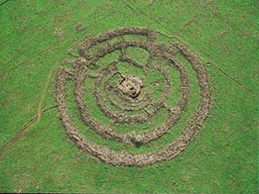
Another archaeological site is a
construction of concentric stone circles and reputedly built by giants.
"The
Circle of the Giants - Gilgal Refaim. 5200-year-old monument believed
by some to have been built by the biblical giants, also called
Nephilim." "The fact remains that Israeli archaeologists are totally
mystified by the Gilgal Refaim. No other complex built in the Middle
East resembles it and it predates the pyramids by over 500 years. The
indigenous nomads of the time did not engage in this kind of megalith
building, so outsiders were probably the builders. According to the
Bible, the only outsiders living on the Golan Heights back then were
giants. "
(http://www.mt.net/~watcher/chamishgiants.html Copyright ©
1999 by Barry Chamish)
"The
picture above is of the Gilgal Refaim (The Circle Of The Refaim) in
Israel. It is said to have been built by those same people that Goliath
descended from. In the late 1980's a group of British archaeologists
may have uncovered skeletal evidence for giants in Jordan. At the site
of Tel es-Sa'idiyeh, archaeologist Jonathan Tubb and a team from the
British Museum unearthed the remains of some extremely tall people."
(http://liberalcommonsense.blogspot.com/2005_08_01_liberalcommonsense_archive.html)
The above
quote is from a very good blog. You will find it listed under
Tuesday, August 09, 2005
 Baalbek
"According to an Arabic manuscript found at Baalbek
and quoted by Alouf in his informative History of Baalbek "after the
flood, when Nimrod reigned over Lebanon, he sent giants to rebuild the
fortress of Baalbek, which was so named in honour of Baal, the god of
the Moabites and worshippers of the Sun."66 Local tradition even
asserts that the Tower of Babel was actually located at Baalbek."
(http://www.newdawnmagazine.com/articles/Baalbek%20-%20Lebanons%20Sacred%20Fortress2.html)
 Map
of Chedorlaomer's march
Map
of Chedorlaomer's march
Chedorlaomer (At
the time of Abraham)
For twelve years the kings of Canaan - most notably Sodom and Gomorrah
- paid taxes to an Elamite king known as Chedorlaomer. They rebelled in
the thirteenth year refusing to pay their tributes. In the fourteenth
year Chedorloamer raised an army to march on them and enforce their
servitude. The march would be about 800 miles one way. This campaign
would continue to extend his control over an important trade route, the
King's Highway, to Egypt through this part of Canaan. There is
speculation that the five rebellious kings had an alliance with the
giants. Both Ecclesiasticus (16:8-9) and the Book of Jubilees (20:5),
confirm that giants lived in Sodom and Gomorrah with Birsha, king of
Gomorrah, probably being a giant as well. It may be that both sides
employed giants in their armies. If the alliance is true it would make
sense that King Chedorlaomer and his three king allies would fight the
Nephilim first as he would be at his freshest and greatest strength.
Then fighting his way south engaged each tribe separately
starting with the Rephaim at Ashtoroth-Karnaim in Geshur. Next were the
Zuzim at Ham in Argob. His great army worked its way down the eastern
side of the Jordan Valley to battle the Emim at Shaveh-Kiriathiam in
Moab and the Horim in Seir. Again the Rephaim in southern Canaan at
Hazazon-Tamar fought these armies but to no avail. Now on the west side
of the Jordan Valley Chedorloamer turned his armies against the
Amalekites and the Amorites who lived in Chatzatzon Tamar. To the north
lay the gathered armies of the five kings. Chedorloamer defeats the
five kings and takes their booty. But he also finds Lot, Abram's
(Abraham) nephew, and takes him away as well. When Abram found out what
had happened he perused the four armies and in a midnight raid rescued
Lot and his family. There are several reasons why this moment is so
important. First this is the first time Abram is called a Hebrew. This
is a term used by a non-Israelite. It may refer to the fact that Abram
was from "the other side of the river" but that is speculation. Second,
The army of Chedorlaomer was a confederation of four kings and as best
that can be comprehended they were from middle Anatolia (Hittite), the
southern area of the Black Sea, Babylon and Elam (Persia - today Iran).
The immense size of this army indicated the importance of the battle.
But the third reason is the most important. According to the Bible
Abram was instructed to go into Canaan and when he arrived scripture
states "And the Lord appeared unto
Abram, and said Unto thy seed will I give this land..." (Gen 12:7 KJV).
It was after this raid that Melchizedek made the covenant
with him (Urantia Book 1020). In the Bible part of the covenant is the
possession
of land: "And I will give unto thee,
and to thy seed after thee, the land wherein thou art a stranger, all
the land of Canaan, for an everlasting possession; and I will be their
God" (Gen 17:8 KJV known as the Abrahamic covenant). As
Urantia Book
readers know, this is a pivotal point in history where there is an
agreement that God does everything and man only
needs to believe. This truth would later be stated
by Jesus, "By faith alone are you saved." But
Abraham never laid direct claim to the land of Canaan during his
lifetime. After the birth of Isaac which fulfilled Melchizedek's
promise is when Abram became Abraham. Most of this story of the battle
can be found in the fourteenth chapter of Genesis.
After King David there is no mention of the Nephilim in the Holy Land. They are referred to as shades and the dead. Og was the last of the Rephiam according to the Bible. Today the Valley of the Rephiam is a part of Israel just south of Jerusalem by a few miles. It took some time to finally kill them off - around a thousand years from the times of Abraham to David.
The name Nephilim is of an uncertain origin. No one can say for sure what the etymology is. Most web sites concerning this subject say it is Hebrew from the Semetic root npl "to fall". I do not think it comes directly from Hebrew. I think it predates Hebrew and the language of Canaan. Actually the Canaanites and Hebrews spoke the same language (and shared some religious beliefs). It was a Semitic language and spoken by the Phoenicians and Philistines. So Nephilim in not an exclusively Hebrew word. To be even more specific Hebrew is a subgroup of the Canaanite language now extinct. Also, the Canaanites were writing before the Hebrews. It was after all the Phoenicians who invented the alphabet. So Nephilim moves over to Canaanite as a root word. Even the name Canaan is extremely ancient. But we can only go back to a Proto-Canaanite language before all is lost to the prehistoric. All references to the Nephilim have them as ancient and most likely very ancient. "These mighty men of old were the Gibborim or Gibbowrim. If we look at Green’s Interlinear Bible it says (reading the literal words): the giants were on the earth in days those and even afterwards when came in the sons of God (the word for God there is haElohim, i.e. sons of the God) to the daughters of men (the word there is haAdam, i.e. the Adam) and they bore to them, they were heroes (the word for heroes is haGibborim, i.e. the heroes) who existed from times ancient, the men of name or renown." (http://www.ccg.org/english/s/P154.html) The name Nephilim is probably a remnant of an even older language now lost. Nephilim most likely was always associated with fallen angels. Maybe not as the name Nephilim itself but certainty the name would be easily understood as it relates to what they were. The Nephilim are so old that they are sometimes referred to as the "aboriginal giants" of Canaan.
An
Alternate Traditional View
The word nephilim has been mistranslated as
'giants' ever since Flavius Josephus translated it as such in his book,
Antiquities of the Jews; ..."
(http://www.motherbedford.com/ANU01.htm)
The Greek word "Tartarus" (used here to denote the
"darkness" where
these specific angels are confined) was also the "underworld" where the
Titans (hybrid man-gods) are being held, according to Greek mythology.
These passages are the only time in scripture the word "Tartarus" (the
Greek underworld) is used to refer to hell. Peter and Jude knew their
audience, and they knew exactly what they were talking about.
In fact, the term "Giants" in the KJV is only rendered as such, because
the Greek translation of the Old Testament (Septuagint) used the phrase
"gigantis" in Genesis 6, which was the Greek word for the Titans of
(ahem!) "myth," and is where the English word "giant" originally comes
from, hence this rendering in the King James Version. All other modern
translations remain faithful to the Hebrew root word "naphal," which
means "to fall," or "fallen ones."
These angel-human hybrids of Genesis 6 are the factual basis for the
"gods" of ancient cultures.
"Returning to Genesis chapter six, after the sons
of God took human wives, verse four continues: “There were
giants in the earth in those days; and also after that, when the sons
of God came in unto the daughters of men, and they bare children to
them, the same became the mighty men which were of old, men of
renown.” However the King James version erroneously
translated the Hebrew term nefilim as “giants,” and
shem as “renown.” If the original words are used
the verse reads: “The Nefilim were upon the Earth, in those
days and thereafter too, when the sons of the gods cohabitated with the
daughters of the Adam, and they bore children unto them. They were the
mighty ones of Eternity — the People of the shem.”
Nefilim stems from the Semitic root NFL, “to be cast
down.”[8] The first line of Genesis 6:4 means Those who were
cast down were upon the Earth. They were the fallen angels!"
(http://www.alchemylab.com/origins_of_alchemy.htm)
"The exact term "sons of God" (B'nai haElohim in
Hebrew) used in Genesis
6:1-4, is used also in Job 1:6, 2:1 & 38:7 always referring to
angels. Unfortunately, many competent Bible scholars of today still
believe the "sons of God" are of human lineage. This is simply because
it has been taught in seminaries for centuries, thanks to the deceptive
and radically unsound doctrinal shift introduced by the church at this
point in history."
(http://www.alienresistance.org/bibleabductions.htm)
"The Sons of Seth Heresy
Beginning around 400 A.D., portions of the church began to take an
unusual stand against the angelic interpretation of Genesis 6. Rather
than teaching what the text clearly says (especially when examined in
Hebrew, below), and what had been the Orthodox Jewish and early
Christian view for all time previous, the idea was introduced that this
passage "really" referred to the lineages of Cain and Seth, the
surviving sons of Adam. They said it simply means that the "rebellious"
lines of Cain were marrying the "faithful" descendants of Seth. The
unfounded presumption of this theory is that ALL of Seth's descendants
were godly, while ALL of Cain's were rebellious. While a sketchy
pattern can be drawn from Genesis, it is really a ridiculous injustice
to the concept of free will and of God's dealing with individuals to
dogmaticly hold to this position. It further implies that Sethites were
somehow immune to the effects of the Fall itself."
(http://www.alienresistance.org/sons_of_seth.htm)
A
Third View on This Ancient History
As
concerning giants, the
Urantia Book does not state that there were the traditional giants as
we have come to understand the ancient records. However, it does say
that there were Nephilim and that these Nephilim were a result of the
mating of the rebel 100 with indigenous humans. These Nephilim
are the Nodite race. This is similar to the alternate view
above where
there was a celestial and human blending but the results are not
necessarily giants. As for the menacing attitude of giants, the Nodites
were well known for their belligerent behavior.
"The
postrebellion era on Urantia witnessed many unusual happenings. A
great civilization - the culture of Dalamatia - was going to pieces.
"The Nephilim (Nodites) were on earth in those days, and when these
sons of the gods went in to the daughters of men and they bore to them,
their children were the 'mighty men of old,' the 'men of renown.'"
While hardly "sons of the gods," the staff and their descendants were
so regarded by the evolutionary mortals of these distant days; even
their stature came to be magnified by tradition. This, then, is the
origin of the well-nigh universal folk tale of the gods who came down
to earth and there with the daughters of men begat an ancient race of
heros. And all this legend became further confused with the race
mixtures of the later appearing Adamites in the second garden."
(Urantia Book p. 856)
So
the
first half of the legend is true. There were progeny from the union
between the Watchers and indigenous humans. The second
part of referring to the huge size seems to have its origin in the
confusion with the Adamites who were, as archaeologists would term it,
"extremely tall people." This reference to extremely tall people is a
result of graves containing such. So the second part is true as well
but it does not refer to the giants of legend but to the tall ones from
the
Garden of Eden. The Adamites from the second Garden did move out into
the world of early man. They were biological uplifters to help improve
the health and well being of the surrounding peoples. They were also
teachers of Edenic civilization. The Nodites had also moved out much
earlier
into
the surrounding lands and with the intermingling of Adamic, Nodite and
indigenous people the Andite race emerged.
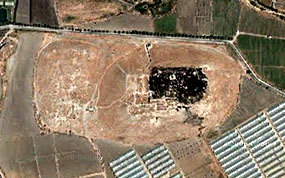 Extremely
Tall People
Extremely
Tall People
"In
the late 1980's a group of British archaeologists might have uncovered
skeletal evidence for giants in Jordan. At the site of Tel
es-Sa'idiyeh, archaeologist Jonathan Tubb and a team from the British
Museum unearthed the remains of some extremely tall people...While the
Bible states that Goliath's height was six cubits and a span, the other
ancient texts disagree. The Septuagint, the Dead Sea Scrolls and
Josephus all agree that Goliath was merely four cubits and a span,
which lowers his height to a more manageable seven feet or so...While
this does not make him a giant, a claim the Bible never makes of
Goliath, it does make him a very tall individual in a day when the
average height was significantly less than it is today."
(http://www.amazon.com/Footsteps-Goliath-Various/product-reviews/B000BK7XIG)
There are claims that two seven foot female skeletons were found at Tel es-Sa'idiyeh. This is not true. The archaeologist Johnathan Tubbs to whom this claim is attributed and who excavated at Tel es Sa'idiyeh denied outright that there ever were such skeletons (The Unseen Realm: Recovering the Supernatural Worldview of the Bible by Michael Heiser).
"Og,
the king of Bashan, is depicted in the Bible, the midrash in the
Tannaitic period and by Josephus as a giant of realistic dimensions. In
the Amoraic exegeses he became a figure of monstrous proportions,
possibly under the influence of views that appear in the Apocrypha. One
expansion of his image was already delivered in the name of palestinian
Amoraim, but it is linked to the dimension of time. This stretching
could also have sparked the fertile midrashic imagination for the
physical stretching of his body."
(http://cat.inist.fr/?aModele=afficheN&cpsidt=15682944
KOSMAN Admiel, University of Potsdam, Abraham Geiger College,
ETATS-UNIS)
The
Bible
At
the time of authoring, the Biblical
passing of the giants had already happened. Although writing had been
around for some time the Hebrews did not start writing until 900 BC and
they were writing in the language of the Philistines from whom Goliath
supposedly descended. Tales of giants were already folk lore at the
beginning of the writing the Bible. When Ptolemy had the Septuagint
created the name Nephilim was written as "gigantes" which simply meant
"earth born" and Nephilim from the Hebrew naphal
(to fall), means fallen or fallen ones. Neither
of these terms means giants and strangely both are true. But somehow
this legend of giants became
incorporated into
the Bible complete with names, size and a genealogy. It is possible
that Og, Goliath, and Arba were real people just not with the
superhuman height and strength attributed to them.
"The
Hebrews had no written language in general usage for a long time
after they reached Palestine. They learned the use of an alphabet from
the neighboring Philistines, who were political refugees from the
higher civilization of Crete." (Urantia Book p. 838)
Six
Fingers
The
giants
were supposed to have six fingers. This is known today as a condition
called polydactyly. There are six fingered people today. In some cases
this extra digit is fully formed and functional. Having six fingers is
not exclusive to the giants.
Argob
The
Rev
J.L. Porter has written much about Argob including details on its
architecture. One convincing fact for me about Argob was that the stone
doors
at Argob
were constructed with a ball and socket hinge. This hinge has been
discovered at Hazor from a Canaanite temple confirming that in ancient
times hinges were
constructed this way. The description of tunnels under Argob does not
seem out of place either considering ancient tunnels have been in many
places including South America. Cyclopean construction at Argob -
almost expected. In his book, The
Ruins of Bible Cities 1886,
Ebenezer Davies
states in Jerash Jorden an example of this type of construction is
visible. Jerash is perhaps one of the most amazing examples of Roman
building you can visit today. Porter also did a good job of the general
description of the lava beds which was described in the same way by
other authors. Porter was not the first to visit Argob. Cyril Graham
reported the same thing - great cities built by giants before Porter
did. Burckhardt visited Argob even before Graham. It was at this time
that archaeologists were investigating what we term the Holy Land to
find and confirm evidence of references from the Bible.

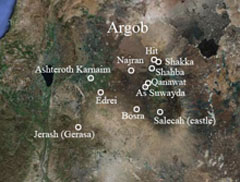
 The
location of the sixty cities is not
on the volcanic tract but rather west of it. The map to the left shows
the location of some of the cities mentioned by Porter. On this map
Edrei is shown which today is known as Dar'a the Biblical capitol of
King Og. Ashteroth Karnaim to the northwest is where
Chedorlaomer defeated the Nephilim in
his first battle. These are the cities that those early archaeologists
visited at the turn of the century. The descriptions of
the appearance
of these cities
by these early adventurers can
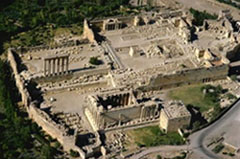
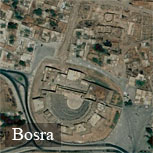
be appreciated in Bosra which has a large Roman amphitheater but more
importantly an "old city". You can still see the colonnaded avenue
leading to the Roman bath just in front of the amphitheater.
This may be the closest
to how it looked a century ago when Porter, Graham, Burckhardt
and others visited these cities.
The ruins are spread throughout
several cities. Below are
five examples
of Roman ruins.
Both images to the left are clickable.
The
location of the sixty cities is not
on the volcanic tract but rather west of it. The map to the left shows
the location of some of the cities mentioned by Porter. On this map
Edrei is shown which today is known as Dar'a the Biblical capitol of
King Og. Ashteroth Karnaim to the northwest is where
Chedorlaomer defeated the Nephilim in
his first battle. These are the cities that those early archaeologists
visited at the turn of the century. The descriptions of
the appearance
of these cities
by these early adventurers can
be appreciated in Bosra which has a large Roman amphitheater but more
importantly an "old city". You can still see the colonnaded avenue
leading to the Roman bath just in front of the amphitheater.
This may be the closest
to how it looked a century ago when Porter, Graham, Burckhardt
and others visited these cities.
The ruins are spread throughout
several cities. Below are
five examples
of Roman ruins.
Both images to the left are clickable.

What
Townsend MacCoun has to say
about the city of Kunawat (Qanawat) which is one of the cities of the
Roman Decapolis is descriptive of some of the cities located between
Argob and the Sea of Galilee: "Everyone
who has visited
Kunawat is amazed at the number and variety of the ruined buildings,
castles, temples, churches, convents, theater, baths, palaces,
reservoirs, underground apartments, costly tombs." (Page 42)
(The Holy Land
in Geography and in History, Townsend MacCoun
1897)
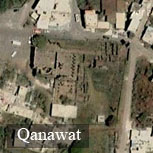
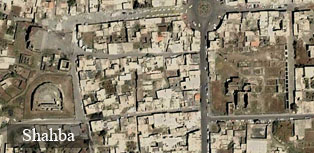
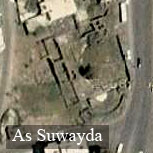
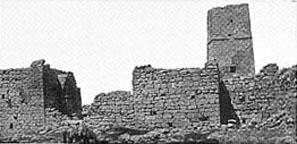
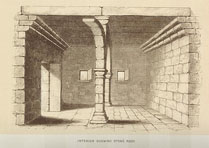
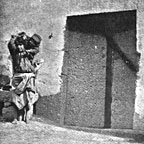 The
story of the sixty cities of the giants may be exotic and romantic but
sadly not true. There is no evidence for these cities and the
location of Argob for some
historians is in
doubt. Even the
illustration above from Porter's work shows a room built of average
size blocks. The photos to the left are typical and are from A
Visit to Bashan and Argob by
Algernon Heber-Percy, 1895. Algernon visited the cities of Porter's
travels and found no ancient giant architecture but found much we call
Greco-Roman. The first photo to the left is the ruins from 'Ayun.
The next one is of a pair of stone doors, neither are megalithic.
John Lewis Burckhardt in 1812
published
a book titled Travels
in Syria and the Holy Land
and in it he also details Greco-Roman ruins but nothing of ancient
giant buildings. Despite the detailed descriptions and dimensions from
Porter and Graham there is nothing to back
it up. This brings up the fundamental question of were they telling the
truth or simply unaware of what they were actually looking at? I think
it probably is a combination of seeing what you want to see with
embellishment. Finally, it has been over a century since these early
explorers and still no one has found the giant cities of Argob. For
myself, I wanted to believe Porter and Graham but after reexamining the
evidence my conclusion is that there are no giant cities. Before
reconstructing this page I wrote about the reality of the giant cities
and believed it was true. Porter after all gave an eyewitness account
that there was giant architecture. I took him at his word. But since
there were no giants
there could not be giant cities and in the end I could not find a shred
of evidence for it. I was led
astray like so many others.
The
story of the sixty cities of the giants may be exotic and romantic but
sadly not true. There is no evidence for these cities and the
location of Argob for some
historians is in
doubt. Even the
illustration above from Porter's work shows a room built of average
size blocks. The photos to the left are typical and are from A
Visit to Bashan and Argob by
Algernon Heber-Percy, 1895. Algernon visited the cities of Porter's
travels and found no ancient giant architecture but found much we call
Greco-Roman. The first photo to the left is the ruins from 'Ayun.
The next one is of a pair of stone doors, neither are megalithic.
John Lewis Burckhardt in 1812
published
a book titled Travels
in Syria and the Holy Land
and in it he also details Greco-Roman ruins but nothing of ancient
giant buildings. Despite the detailed descriptions and dimensions from
Porter and Graham there is nothing to back
it up. This brings up the fundamental question of were they telling the
truth or simply unaware of what they were actually looking at? I think
it probably is a combination of seeing what you want to see with
embellishment. Finally, it has been over a century since these early
explorers and still no one has found the giant cities of Argob. For
myself, I wanted to believe Porter and Graham but after reexamining the
evidence my conclusion is that there are no giant cities. Before
reconstructing this page I wrote about the reality of the giant cities
and believed it was true. Porter after all gave an eyewitness account
that there was giant architecture. I took him at his word. But since
there were no giants
there could not be giant cities and in the end I could not find a shred
of evidence for it. I was led
astray like so many others.
"The
identification of Argob, a region of the kingdom of Og, is a
matter of much difficulty. It has been equated on philological grounds
to the Lejā. But these arguments have been shown to be shaky if not
baseless, and the identification is now generally abandoned. The
confidence with which the great cities of Og were identified with the
extensive remains of ancient sites in the Lejā and Hauran has also been
shown to be without justification. All the so-called "giant cities of
Bashan" without exception are now known to be Greco-Roman, not earlier
than the time of Herod, and, though in themselves of very high
architectural and historical interest, have no connexion whatever with
the more ancient periods. No tangible traces of Og and his people, or
even of their Israelite supplanters, have yet been found.
This
fact somewhat weakens the various identifications that have been
proposed for the cities of Bashan enumerated by name. Edrei for example
is identified with Ed-Dera‛a. This is perhaps the most satisfactory
comparison, for besides the Greco-Roman remains there is an extensive
subterranean city of unknown date, which may be of great antiquity,
though even this is still sub judice. The other identifications that
have commanded most acceptance are as follows: - Ashteroth Karnaim,
also called Ashtaroth and (Josh. xxi. 27) Be-eshterah, has been
identified with Busrah (Bostra), where are very important Herodian
ruins, but there is no tangible evidence yet adduced that the history
of this site is of so remote antiquity. From the similarity of the
names, it has also been sought at Tell Ashari and Tell ‛Ashtera. The
true site can be determined, if at all; by excavation only;
identifications based on mere outward similarity of names have always
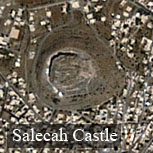
been fruitful sources of error. Salecah is perhaps less doubtful; it is
a remarkable name, and a ruin similarly styled, Salkhat, is to be seen
in the Hauran. It is inhabited by Druses. Another town in eastern
Manasseh, namely Kenath, has been identified by Porter with Kanawat,
which may be correct."
(http://chestofbooks.com/reference/Encyclopedia-Britannica-2/Bashan.html)
Click Here for page two with more legends of King Og, the Patriarchs and Gilgal Rephaim